Convert Fahrenheit to Celsius Instantly
Need a quick and accurate temperature conversion? Enter any Fahrenheit value in the calculator below to see the equivalent temperature in Celsius immediately. The calculator accepts positive numbers, negative temperatures, and decimals.
It uses the exact formula °C = (°F − 32) × 5/9 and displays the result to a maximum of two decimal places. This makes it suitable for weather, travel, cooking, study, and everyday temperature conversions.
Converting Fahrenheit to Celsius is simple when you use the correct formula or the calculator on this page. Enter any temperature in degrees Fahrenheit to receive the equivalent value in degrees Celsius instantly. For a manual calculation, subtract 32 from the Fahrenheit value and multiply the result by 5/9.
Quick answer:
°C = (°F − 32) × 5/9
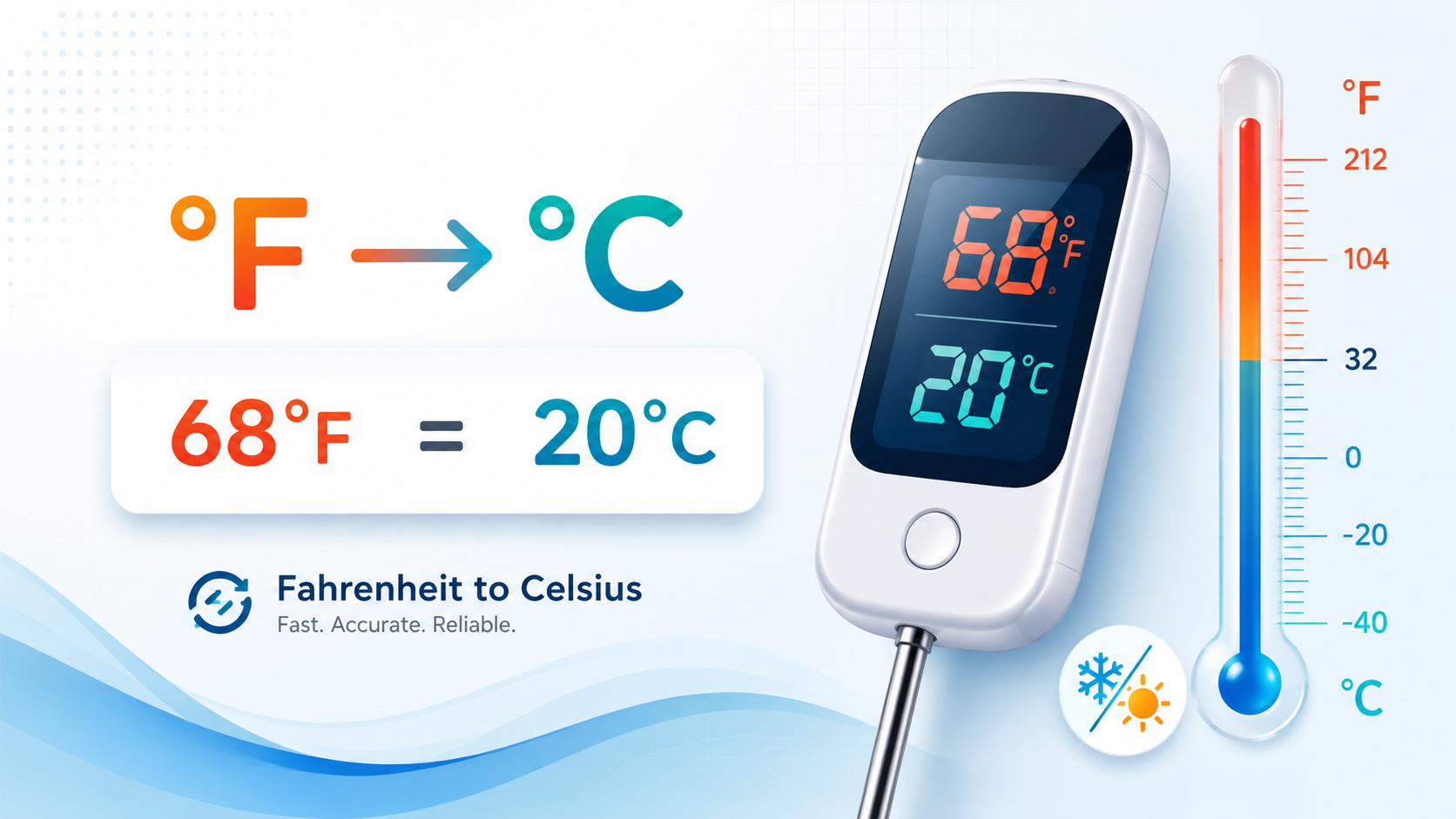
For example, 68°F equals 20°C. The National Institute of Standards and Technology lists the equivalent exact formula as (°F − 32) ÷ 1.8.
How to Convert Fahrenheit to Celsius
The exact Fahrenheit to Celsius formula is:
°C = (°F − 32) × 5/9
Follow these two steps:
- Subtract 32 from the Fahrenheit temperature.
- Multiply the result by 5/9, or divide it by 1.8.
Both methods produce the same answer.
Fahrenheit to Celsius Example
To convert 77°F:
(77 − 32) × 5/9 = 25°C
Therefore, 77°F is equal to 25°C.
Another useful example is 32°F:
(32 − 32) × 5/9 = 0°C
This is the freezing point of water under standard reference conditions.
Why Fahrenheit to Celsius Conversion Matters
Temperature scales are not used uniformly around the world. Fahrenheit is the standard scale commonly used for everyday temperatures in the United States, while Celsius is standard in most areas outside the United States.
This difference makes temperature conversion important whenever information moves between countries, measurement systems, publications, devices, or audiences.
A reliable Fahrenheit to Celsius converter removes uncertainty and reduces the risk of calculation mistakes. It is especially useful when an exact answer matters more than a quick mental estimate.
Where Is This Conversion Used Most Often?
Weather and International Travel
A U.S. weather forecast may describe 86°F as a hot day, while a forecast using Celsius reports the same temperature as 30°C.
Travelers, international students, remote workers, and people reading foreign weather reports often need to change Fahrenheit to Celsius to understand local conditions. Weather services outside the United States commonly display temperatures in Celsius, although some allow users to change the preferred unit.
Cooking and Oven Temperatures
Recipes and ovens may use different temperature scales. A recipe written for an American audience may list an oven setting in Fahrenheit, while an oven elsewhere may be marked in Celsius.
Because cooking conversions are sometimes rounded to practical oven settings, use an oven temperature conversion chart when selecting an actual appliance setting. For example, 350°F converts mathematically to approximately 176.67°C, but an oven may commonly be set to 175°C or 180°C.
Science, Education, and Technical Work
Celsius is widely used in scientific education and metric-based measurement. Students and professionals may need to convert readings from older documents, U.S. equipment, technical manuals, or imported instruments.
In technical work, retain enough decimal places for the precision required by the task. Avoid rounding the result before completing any additional calculations.
Body Temperature and Health Information
Thermometers, health articles, and medical documents may display different scales. For reference, 98.6°F converts to 37°C.
The conversion itself is mathematical, but the interpretation of a body-temperature reading may also depend on the measurement method, age, symptoms, and professional medical guidance.
Appliances, Heating, and Air Conditioning
Thermostats, refrigerators, freezers, laboratory equipment, and industrial controls can use Fahrenheit or Celsius.
Conversion may be necessary when:
- changing thermostat settings;
- following an appliance manual;
- comparing product specifications;
- using imported equipment;
- communicating with someone who uses another scale.
Important Reference Temperatures
A few familiar values make the two scales easier to understand:
- 32°F = 0°C: freezing point of water under standard reference conditions
- 50°F = 10°C: a cool outdoor temperature
- 68°F = 20°C: a common room-temperature reference
- 86°F = 30°C: a hot day
- 212°F = 100°C: boiling point of water at standard atmospheric pressure
- −40°F = −40°C: the point at which both scales display the same number
NIST also uses 32°F, 50°F, 68°F and 86°F as practical reference values for freezing conditions, a cold day, room temperature and a hot day.
These reference points are useful for checking whether a calculated result appears reasonable.
How Accurate Is the Calculator?
The calculator uses the exact relationship between the two temperature scales:
°C = (°F − 32) ÷ 1.8
Results are displayed to a maximum of two decimal places for readability. This is usually sufficient for weather, travel, cooking, home temperature settings, and other everyday uses.
For laboratory, engineering, or scientific applications, retain the number of decimal places required by the original measurement and the accuracy standard of your work. Rounding too early can introduce avoidable errors into later calculations.
Can You Estimate Celsius Without a Calculator?
For a quick mental estimate, subtract 30 from the Fahrenheit value and divide by 2:
Estimated °C ≈ (°F − 30) ÷ 2
For example:
80°F → (80 − 30) ÷ 2 = approximately 25°C
The exact result is 26.67°C. The shortcut is therefore useful for a rough weather estimate, but it should not replace the exact Fahrenheit to Celsius formula for cooking, science, body-temperature readings, or technical work.
Common Conversion Mistakes
The most common mistake is applying the operations in the wrong order. Always subtract 32 before multiplying by 5/9. Multiplying first produces an incorrect result.
Another mistake is using the reverse formula. The formula:
°F = (°C × 9/5) + 32
converts Celsius to Fahrenheit, not Fahrenheit to Celsius.
Also remember that converting an actual temperature is different from converting a temperature interval. A temperature change of 1°F equals a change of 5/9°C, but an actual reading such as 1°F must also account for the 32-degree offset between the scales.
Finally, do not reject negative inputs. Cold-weather temperatures can fall below 0°F, and the correct formula works normally with negative values. For example:
−4°F = −20°C
Fahrenheit to Celsius Conversion Chart
The table below starts at 1°F and then lists temperatures in 10-degree Fahrenheit intervals up to 100°F. Results are rounded to two decimal places.
| Fahrenheit (°F) | Celsius (°C) |
|---|---|
| 1°F | −17.22°C |
| 10°F | −12.22°C |
| 20°F | −6.67°C |
| 30°F | −1.11°C |
| 40°F | 4.44°C |
| 50°F | 10°C |
| 60°F | 15.56°C |
| 70°F | 21.11°C |
| 80°F | 26.67°C |
| 90°F | 32.22°C |
| 100°F | 37.78°C |
Subtract 32 from the Fahrenheit value, then multiply the result by 5/9. You can also divide the result by 1.8.
100°F is approximately 37.78°C.
70°F is approximately 21.11°C.
The two scales are equal at −40 degrees:
−40°F = −40°C
Yes. Under standard reference conditions, 32°F equals 0°C, which is the freezing point of water.
Neither temperature scale is inherently more accurate. Accuracy depends on the thermometer, sensor, calibration, measurement method, and rounding. Fahrenheit and Celsius simply express temperature using different reference points and degree sizes.
The Fahrenheit and Celsius scales use different zero points. Subtracting 32 removes the offset between the two scales before the Fahrenheit-sized degree interval is converted into the Celsius-sized interval.
Yes. The calculator accepts negative numbers and decimal values. For example, −4°F converts to −20°C.
Calculation and accuracy note: This converter uses the exact temperature conversion formula °C = (°F − 32) ÷ 1.8. Results are calculated automatically and rounded only for display. The calculation method has been checked against conversion guidance published by the National Institute of Standards and Technology.