About Easy Unit Convert
Easy Unit Convert is a free online resource designed to make everyday unit conversion fast, clear and easy to understand.
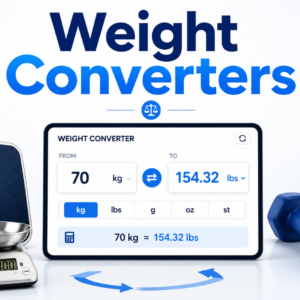
Sometimes you only need one number: How many pounds is 70 kg? How many centimeters is 12 inches? How many miles is 10 kilometers?
At other times, you need more than the result. You may want to know the formula, understand why the conversion works, compare several values, or check whether you are using the correct measurement system.
Easy Unit Convert was created for both situations.
Our goal is simple: give you the conversion you need quickly, while also providing enough reliable information to understand and use the result with confidence.
Why Easy Unit Convert exists
Measurement systems are not always as straightforward as they seem.
Metric units are used throughout most of the world, while imperial and US customary units remain common in countries such as the United States and the United Kingdom. Travel distances may be shown in kilometers or miles. Body weight may be expressed in kilograms, pounds or stones. Recipes may use milliliters, cups, fluid ounces, teaspoons or tablespoons.
Even units with the same name can sometimes represent different quantities. A US gallon, for example, is not the same volume as an Imperial gallon.
Easy Unit Convert helps make these differences easier to navigate.
Instead of providing only a blank calculator, we aim to create useful conversion resources that answer the questions people actually have:
- What is the converted value?
- What formula should I use?
- Is the conversion exact or rounded?
- Which measurement system is being used?
- How can I calculate it manually?
- What are some common converted values?
- When is this conversion commonly needed?
The result is a growing collection of focused conversion tools and practical measurement guides.
What you can convert
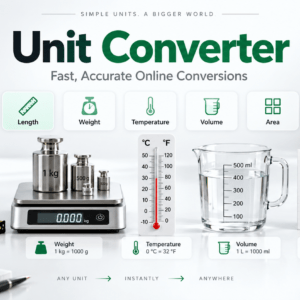
Easy Unit Convert covers many of the measurements people use in everyday life, work, travel, cooking, fitness and international communication.
Our main conversion categories include:
Length and distance
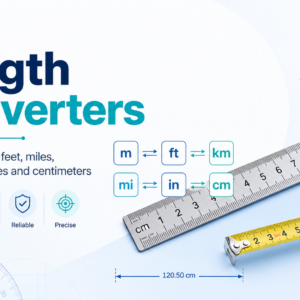
Convert between units such as millimeters, centimeters, inches, feet, meters, kilometers and miles.
These conversions are commonly useful for product dimensions, height measurements, travel distances, running and fitness, DIY projects and international specifications.
Weight and mass
Convert kilograms, grams, pounds, ounces and stones.
Weight and mass conversions can be useful when comparing body weight, recipes, product specifications, package weights and measurements from different countries.
Volume
Convert liters, milliliters, cups, fluid ounces, gallons, pints, quarts, tablespoons and teaspoons.
These tools are particularly useful for cooking, baking, recipes, beverages and everyday liquid measurements.
Where different measurement systems use different values for similarly named units, understanding the context is important.
Temperature
Convert between Celsius, Fahrenheit and Kelvin, as well as common temperature measurements used for cooking, ovens, weather and everyday situations.
Temperature conversion is especially important because Celsius and Fahrenheit are not converted using a simple multiplication factor. Each converter therefore shows the appropriate relationship and formula.
Area
Convert square feet, square meters, acres, hectares and other common area measurements.
Area conversions are useful when comparing property sizes, land measurements, floor areas, construction specifications and international real-estate information.
Our approach to accurate conversions
Accuracy is one of the most important principles behind Easy Unit Convert.
Unit conversions are based on established mathematical relationships between measurement units.
Some conversion relationships are defined exactly.
For example:
- 1 inch = 2.54 centimeters exactly
- 1 pound = 0.45359237 kilograms exactly
- 1 mile = 1,609.344 meters exactly
- Kelvin = Celsius + 273.15
When an exact relationship exists, it forms the basis of the calculation.
However, many converted results contain more decimal places than are useful in everyday situations. In those cases, a displayed result may be rounded for readability while the underlying conversion relationship remains more precise.
For example, 1 kilometer is approximately 0.621371 miles. Depending on the context, showing 0.62 miles may be sufficient, while technical work may require additional decimal places.
For this reason, our converter pages aim to make the difference between an exact conversion factor and a rounded practical result clear whenever it matters.
More than just the final number
A calculator should answer your question quickly.
It should not force you to read a long article before showing the result.
That is why our converter pages are designed around a simple principle:
answer first, explain second.
You can enter a value and get your conversion quickly. If you want to understand the calculation in more detail, many pages also provide:
- the conversion formula;
- worked examples;
- frequently used conversion values;
- conversion tables;
- explanations of the units;
- practical use cases;
- answers to common conversion questions.
This approach makes the site useful both for someone who needs a result in seconds and for someone who wants to understand the measurement behind it.
Metric, Imperial and US customary units
One of the most common sources of conversion errors is assuming that every unit belongs to the same measurement system.
The International System of Units (SI) and the wider metric system use units such as meters, kilograms, liters and degrees Celsius.
Imperial and US customary measurements include units such as inches, feet, miles, pounds, fluid ounces, pints and gallons.
Some units have the same name in different systems but do not always represent the same quantity.
This is especially important with volume measurements.
For example, US and Imperial gallons, pints and fluid ounces are different sizes. A conversion that ignores this distinction can produce the wrong answer even if the arithmetic itself is correct.
Easy Unit Convert therefore aims to identify the relevant measurement system clearly whenever that distinction affects the result.
Built for real-world questions
Most people do not search for a conversion because they are studying measurement theory.
They have a practical question.
You might be:
- comparing your weight in kilograms and pounds;
- following an overseas recipe;
- checking furniture dimensions;
- converting a running distance from kilometers to miles;
- comparing property sizes in square feet and square meters;
- reading an international product specification;
- checking an oven temperature;
- converting land measurements between acres and hectares.
Our content is developed around these real-world situations.
Conversion tables and examples are selected to help users find useful answers quickly rather than simply adding more numbers to a page.
How we develop and improve the website
Easy Unit Convert is an evolving resource.
We regularly expand existing converter pages, improve explanations, add practical examples and create new tools where they can genuinely help users.
When developing conversion content, our priorities are:
Accuracy
The mathematical relationship between units must be correct.
Clarity
The answer and formula should be understandable without unnecessary complexity.
Usefulness
The page should help solve a real measurement problem rather than exist simply to contain a calculator.
Transparency
Where rounding, measurement-system differences or unit ambiguity may affect a result, that context should be explained.
Accessibility
The core conversion tools are free to use and do not require an account or a separate app.
These principles also guide how older pages are reviewed and improved as Easy Unit Convert grows.
Corrections and feedback
Accuracy matters, and we welcome corrections.
If you notice a conversion, explanation, table or formula that you believe is incorrect or unclear, please contact us and tell us which page you were using and what you found.
We can then review the calculation or content and make a correction where necessary.
You can learn more about how conversion information is prepared and reviewed in our Accuracy & Editorial Policy.
For questions or feedback, please visit our Contact page.
Independent and user-focused
Easy Unit Convert is an independent online unit-conversion resource.
Our primary purpose is to help visitors solve measurement and conversion questions as quickly and clearly as possible.
We design our pages for people first: the calculator should be easy to find, the result should be clear, and supporting information should be useful rather than distracting.
No registration is required to use the conversion tools.
Important note about conversion results
Our converters and guides are intended for general informational and everyday calculation purposes.
While we aim to provide accurate results, some professional, scientific, engineering, medical, commercial or regulatory applications may require specific standards, tolerances, significant figures or certified measuring procedures.
For applications where measurement precision has safety, legal, medical or financial consequences, always verify the required standard for your particular situation.
Our goal
Easy Unit Convert has one straightforward goal:
to make measurement conversion easier to understand and easier to use.
Whether you need a quick answer, a formula, a conversion chart or a better understanding of two measurement systems, we want you to be able to find the information you need without unnecessary complexity.
Explore our converters and choose the measurement you need.
Fast answer. Clear calculation. Useful context.
Last reviewed: August 2026