
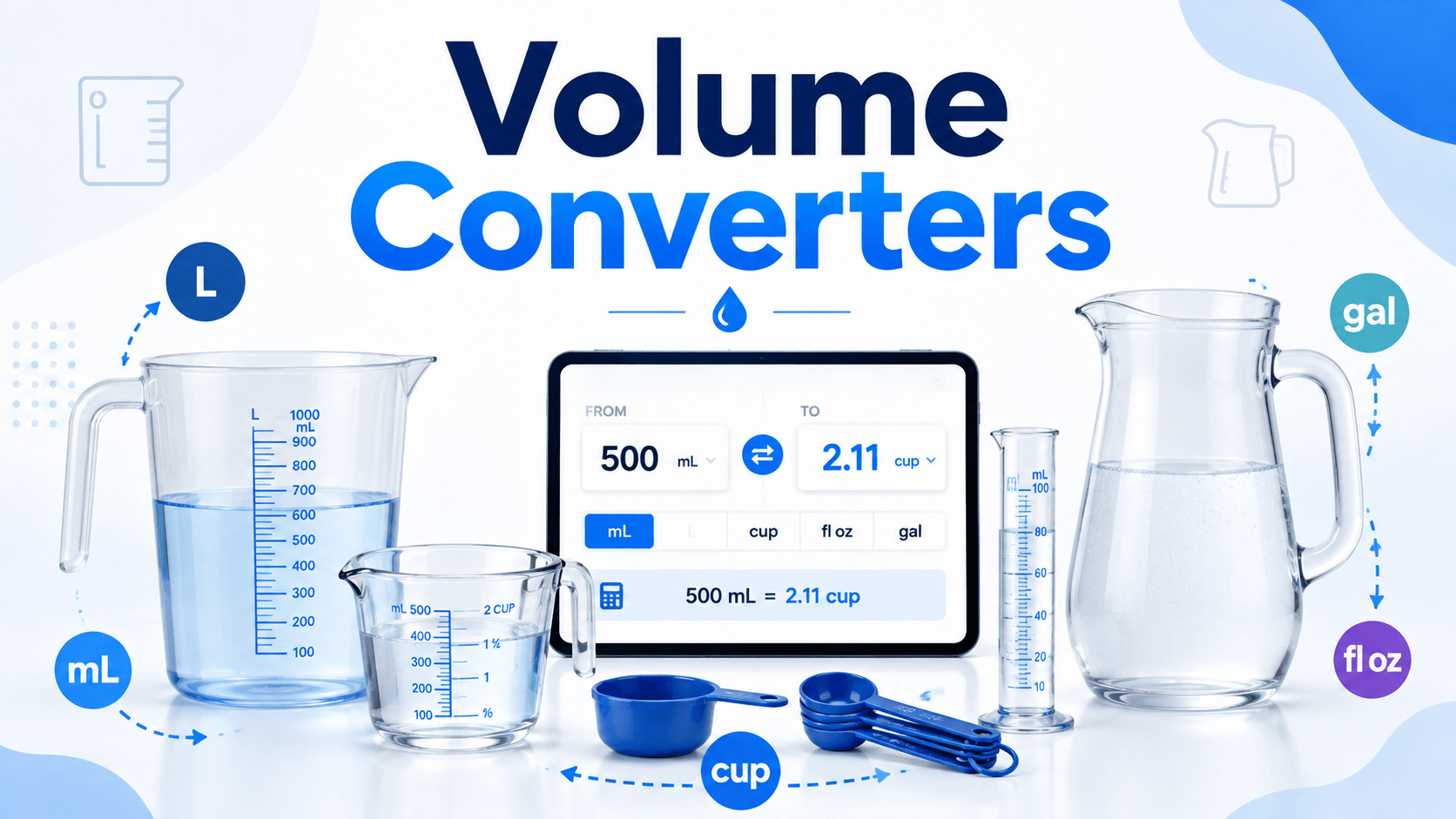
These tools change a measurement from one unit of capacity or three-dimensional space into another without changing the actual quantity. Therefore, you can use the tools below to convert liters, gallons, milliliters, fluid ounces, cups, tablespoons, teaspoons, pints, and quarts quickly and accurately.
This page brings common metric and US customary conversions together in one place. However, gallon, fluid ounce, cup, pint, and quart values refer to US liquid units unless a converter states otherwise.
How Do These Measurement Tools Work?
These online tools apply a specific conversion factor to a value. For example, 1 US gallon equals exactly 3.785411784 liters, while 1 liter equals approximately 0.264172 US gallons. Therefore, the right converter can provide an accurate result without requiring a manual calculation.
These tools are useful for international recipes, drink quantities, fuel volumes, container capacities, laboratory measurements, and everyday household tasks. In addition, each dedicated conversion page explains the relevant formula. Consequently, you can check both the result and the calculation behind it.
Common Conversion Formulas
The table below provides a quick reference for the tools available in this category. Because several US and Imperial units have the same names but different sizes, the following formulas use US liquid measures.
| Conversion | Basic formula | Common uses |
|---|---|---|
| Liters to Gallons | US gal = L × 0.264172 | Fuel, tanks, and drinks |
| Gallons to Liters | L = US gal × 3.78541 | Fuel economy and containers |
| Milliliters to Fluid Ounces | US fl oz = mL × 0.033814 | Drinks, recipes, and packaging |
| Fluid Ounces to Milliliters | mL = US fl oz × 29.5735 | Recipes, bottles, and labels |
| Cups to Milliliters | mL = US cups × 236.588 | Cooking and baking |
| Milliliters to Cups | US cups = mL ÷ 236.588 | International recipes |
| Tablespoons to Cups | US cups = tbsp ÷ 16 | Scaling ingredients |
| Teaspoons to Tablespoons | tbsp = tsp ÷ 3 | Small recipe quantities |
| Pints to Liters | L = US pt × 0.473176 | Milk, drinks, and containers |
| Quarts to Liters | L = US qt × 0.946353 | Food storage and liquids |
The conversion factors follow standard metric and US customary definitions. Although the table displays rounded factors for convenience, the calculators can retain greater precision before presenting the final answer. As a result, they reduce errors caused by rounding too early.
Choose a Conversion Tool
Choose the unit pair that matches your task:
- Liters to Gallons
- Gallons to Liters
- Milliliters to Fluid Ounces
- Fluid Ounces to Milliliters
- Cups to Milliliters
- Milliliters to Cups
- Tablespoons to Cups
- Teaspoons to Tablespoons
- Pints to Liters
- Quarts to Liters
- Tablespoon How Many Teaspoons? Converter & Chart
Each page focuses on one direction of conversion. Consequently, you can enter a value, read the result, and review the correct formula without sorting through unrelated units. Moreover, additional conversion tools can be added as the collection expands.
US and Imperial Units Are Not the Same
A US gallon and an Imperial gallon do not represent the same volume. While one US liquid gallon equals exactly 3.785411784 liters, one Imperial gallon equals exactly 4.54609 liters. Therefore, choosing the wrong gallon standard can produce a significant error.
Fluid ounces also differ between the two systems. For example, a US fluid ounce is approximately 29.5735 milliliters, whereas an Imperial fluid ounce is approximately 28.4131 milliliters.
Cup sizes can vary as well. A US customary cup equals approximately 236.588 milliliters, although some recipes use a rounded 240 mL cup or a 250 mL metric cup. For this reason, first check the country or measurement standard used by the original source. Then, select the matching unit definition before converting the value.
How to Use These Conversion Tools
Using these tools takes only three steps:
- First, choose the starting and target units, such as gallons to liters.
- Next, enter the volume you want to convert.
- Finally, read the result and round it only as much as your task requires.
For example, you can convert 2.5 US gallons to liters by multiplying 2.5 by 3.785411784. As a result, you get 9.46352946 liters. However, for an everyday estimate, you can round this value to 9.46 liters.
Why Measurement Accuracy Matters
Small differences can affect a recipe, fuel estimate, laboratory measurement, or the stated capacity of a container. Moreover, selecting the wrong gallon, fluid ounce, or cup standard may create a much larger error than ordinary rounding.
Reliable calculators reduce this risk because they apply a defined factor consistently. Nevertheless, the final answer should reflect the precision of the original measurement. For instance, a roughly measured cup of water does not require an answer containing six decimal places.
Liquid volume should not be confused with weight. A fluid ounce measures volume, whereas an ounce without the word “fluid” usually measures mass. Therefore, converting fluid ounces to grams requires the density of the ingredient. Consequently, it is not a simple volume-to-volume conversion.
Frequently Asked Questions
There are exactly 1,000 milliliters in 1 liter. To convert liters to milliliters, multiply the number of liters by 1,000.
One US liquid gallon equals exactly 3.785411784 liters. In contrast, one Imperial gallon equals exactly 4.54609 liters, so always check which measurement system is being used.
One US fluid ounce equals approximately 29.5735 milliliters. Therefore, multiply fluid ounces by 29.5735 to obtain milliliters.
No. A fluid ounce is a unit of volume, while an ounce is generally a unit of mass or weight. Consequently, you need the substance’s density to convert between them.
Check where the recipe was published. US customary recipes commonly use a cup of approximately 236.588 mL, while many metric recipes use 250 mL. Some US cooking guidance also rounds one cup to 240 mL.
Rounding depends on the purpose of the calculation. Two or three decimal places are usually sufficient for everyday use, although scientific or technical work may require greater precision.