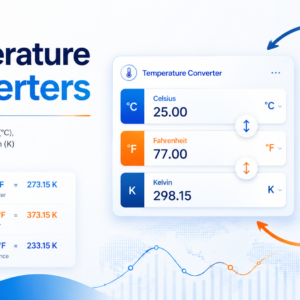
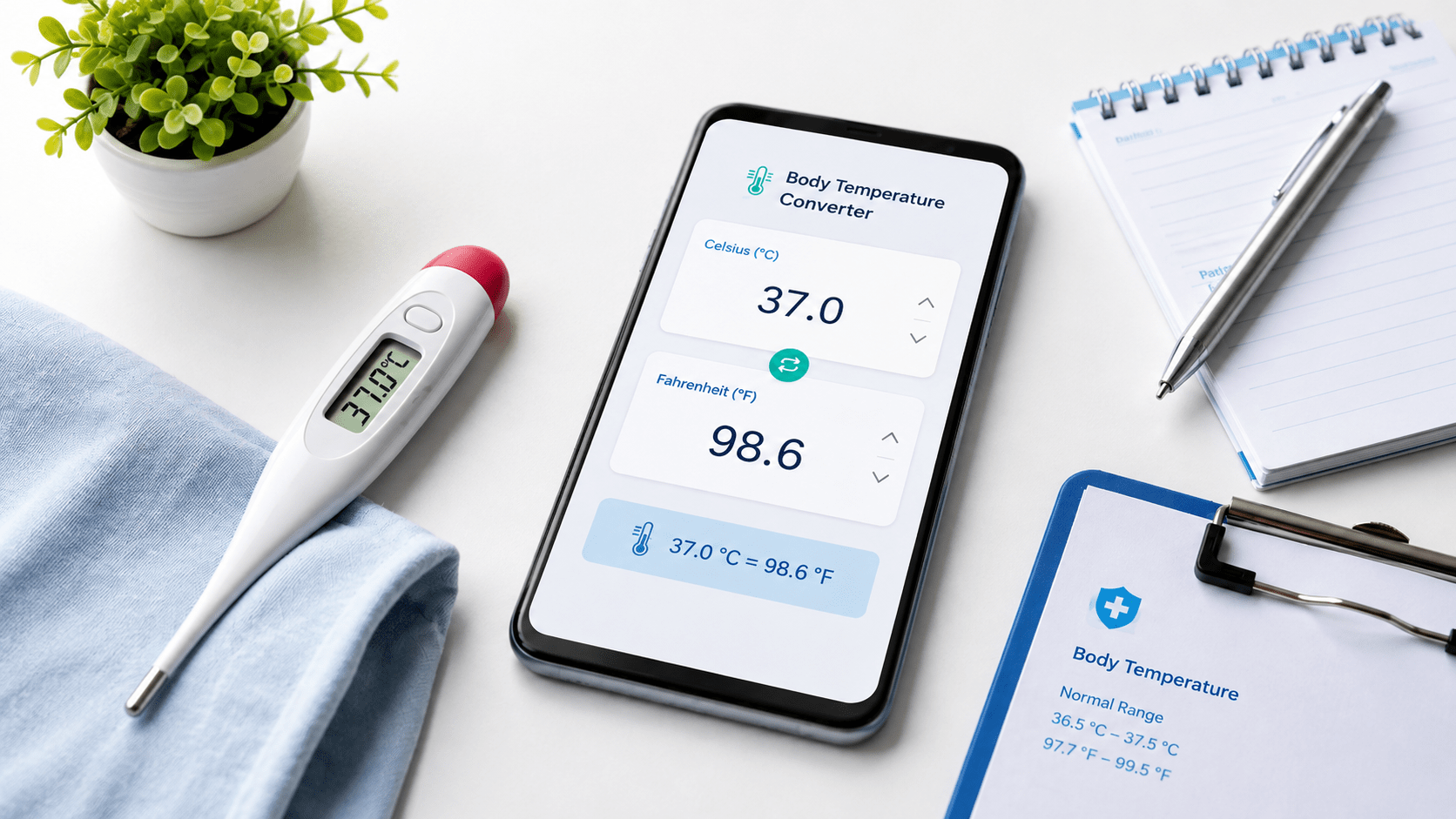
Use this body temperature converter to change a thermometer reading between Celsius and Fahrenheit in seconds. Enter the value, choose the original unit, and the calculator will display the converted result. For example, 37°C equals 98.6°F, while 100.4°F equals 38°C.
The tool performs unit conversion only. Therefore, it does not diagnose fever, infection, hypothermia, or another medical condition. Body temperature also depends on age, time of day, activity, and the place where the reading was taken.
Quick Body Temperature Conversions
| Celsius | Fahrenheit |
|---|---|
| 35°C | 95°F |
| 36°C | 96.8°F |
| 37°C | 98.6°F |
| 38°C | 100.4°F |
| 39°C | 102.2°F |
| 40°C | 104°F |
How to Use the Body Temperature Converter
First, type the temperature shown on your thermometer. Next, select Celsius or Fahrenheit as the input unit. The converter then calculates the equivalent value automatically.
For the clearest result, enter the reading exactly as it appears. A decimal can matter when you are comparing nearby values. For example, 37.5°C converts to 99.5°F, whereas 38°C converts to 100.4°F.
Finally, remember that changing the unit does not change the measurement itself. It only expresses the same temperature on a different scale.
Body Temperature Conversion Formulas
The calculator uses the standard formulas below.
Celsius to Fahrenheit Formula
°F = (°C × 9/5) + 32
For example, convert 37.8°C to Fahrenheit:
(37.8 × 9/5) + 32 = 100.0°F
Fahrenheit to Celsius Formula
°C = (°F − 32) × 5/9
For example, convert 102.2°F to Celsius:
(102.2 − 32) × 5/9 = 39°C
Although the formulas are simple, a body temperature converter is faster when you need an immediate result. In addition, it reduces the risk of a typing or arithmetic error.
Body Temperature Conversion Chart
| Celsius (°C) | Fahrenheit (°F) |
|---|---|
| 35.0 | 95.0 |
| 35.5 | 95.9 |
| 36.0 | 96.8 |
| 36.5 | 97.7 |
| 37.0 | 98.6 |
| 37.5 | 99.5 |
| 38.0 | 100.4 |
| 38.5 | 101.3 |
| 39.0 | 102.2 |
| 39.5 | 103.1 |
| 40.0 | 104.0 |
| 40.5 | 104.9 |
| 41.0 | 105.8 |
This table is useful for quick comparisons. However, use the calculator when your thermometer shows a value that is not listed.
What Is a Normal Body Temperature?
The familiar reference value is 37°C, which equals 98.6°F. However, normal body temperature is not one fixed number.
A typical temperature may range from approximately 97°F to 99°F, or 36.1°C to 37.2°C. Moreover, the reading can change because of age, physical activity, health status, and time of day.
Consequently, one measurement should always be considered in context. Your usual baseline can be helpful, but symptoms and the measurement method also matter.
Why the Measurement Location Matters
A temperature can be taken in the mouth, rectum, armpit, ear, or on the forehead. These methods do not always produce identical results.
For example, MedlinePlus provides different fever reference values for children depending on whether the temperature was measured rectally, orally, or under the arm.
The body temperature converter changes Celsius to Fahrenheit or Fahrenheit to Celsius. Nevertheless, it does not adjust a reading from one measurement location to another.
Therefore, record where the temperature was taken. In addition, follow the instructions supplied with your thermometer.
When Is Body Temperature Considered a Fever?
A reading of 38°C, or 100.4°F, is widely used as a fever threshold in many public-health and clinical settings. The CDC, for example, uses a measured temperature of 100.4°F or 38°C as its general fever definition.
However, the appropriate interpretation can vary according to age and measurement site. A person may also feel unwell even when the number remains below a commonly used cutoff.
For this reason, do not use the converted result as a diagnosis. Instead, consider symptoms, medical history, measurement location, and professional guidance.
What Does a Low Body Temperature Mean?
A low reading can also require attention. The NHS defines hypothermia as a body temperature below 35°C, which equals 95°F. Hypothermia is a medical emergency that requires urgent treatment.
Possible warning signs include:
- persistent shivering;
- confusion or unusual sleepiness;
- pale or cold skin;
- slurred speech;
- slow breathing.
A surprising value may sometimes result from poor thermometer placement, a weak battery, or an unsuitable measurement method. Even so, repeat the measurement carefully rather than ignoring a concerning low result.
When Should You Seek Medical Help?
Age and symptoms are important. A baby younger than three months with a rectal temperature of 38°C, or 100.4°F, needs prompt medical assessment.
Medical attention is also important when a high or low temperature occurs together with symptoms such as:
- difficulty breathing;
- confusion;
- seizures;
- a stiff neck;
- repeated vomiting;
- severe dehydration;
- unusual drowsiness;
- another symptom that causes concern.
Moreover, seek urgent care when someone may have hypothermia or a heat-related illness. A calculator can convert the number, but it cannot assess the person’s overall condition.
Why Convert Body Temperature Between Celsius and Fahrenheit?
Celsius is standard in most countries, while Fahrenheit remains common in the United States. Therefore, travelers, international families, caregivers, and healthcare workers may need to compare readings across both systems.
Conversion is also helpful when a thermometer uses an unfamiliar unit. Likewise, medical instructions, telehealth notes, product manuals, or health records may display a different scale from your device.
Common Body Temperature Conversion Mistakes
The most common mistake is reversing the two formulas. Another error is rounding too early. For body temperature, keeping one decimal place is generally more useful than rounding to a whole number.
It is also important not to treat 37°C as a universal boundary between healthy and ill. Although 37°C is a familiar reference point, normal readings vary.
Finally, oral, forehead, ear, rectal, and underarm measurements should not be compared as though they were interchangeable.
What This Body Temperature Calculator Can and Cannot Do
This body temperature calculator can:
- convert Celsius to Fahrenheit;
- convert Fahrenheit to Celsius;
- display decimal results;
- help compare international thermometer readings.
However, it cannot:
- measure your body temperature;
- determine the cause of a high or low reading;
- correct an inaccurate thermometer;
- adjust the result for age or measurement location;
- replace professional medical advice.
For reliable use, measure your temperature with a suitable thermometer first. Then use the body temperature converter to change only the unit.
37°C equals 98.6°F. It is the traditional reference value for average body temperature, although healthy readings can vary.
100.4°F equals 38°C. This value is widely used as a fever threshold. However, age and measurement method can affect its interpretation.
99°F equals approximately 37.2°C. It may fall within a typical range for some people. Nevertheless, the answer depends on the measurement site, time of day, usual baseline, and accompanying symptoms.
35°C equals 95°F. A temperature below this level meets the NHS definition of hypothermia and requires emergency medical attention.
The mouth and armpit measure temperature at different body sites. Consequently, the readings may not match even when both measurements are taken correctly.
No. The converter only changes the measurement unit. Fever thresholds for children depend on age and where the temperature was measured.
The mathematical conversion is exact when the input value is correct. However, the usefulness of the result depends on the thermometer, measurement technique, and chosen level of rounding.
No. It is a traditional average rather than a universal normal value. Healthy body temperature can vary between people and throughout the day.
Medical Information Notice
This page provides unit conversion and general educational information. It is not a diagnostic tool and does not replace advice from a qualified healthcare professional. Contact a medical professional when a temperature reading or related symptoms cause concern.