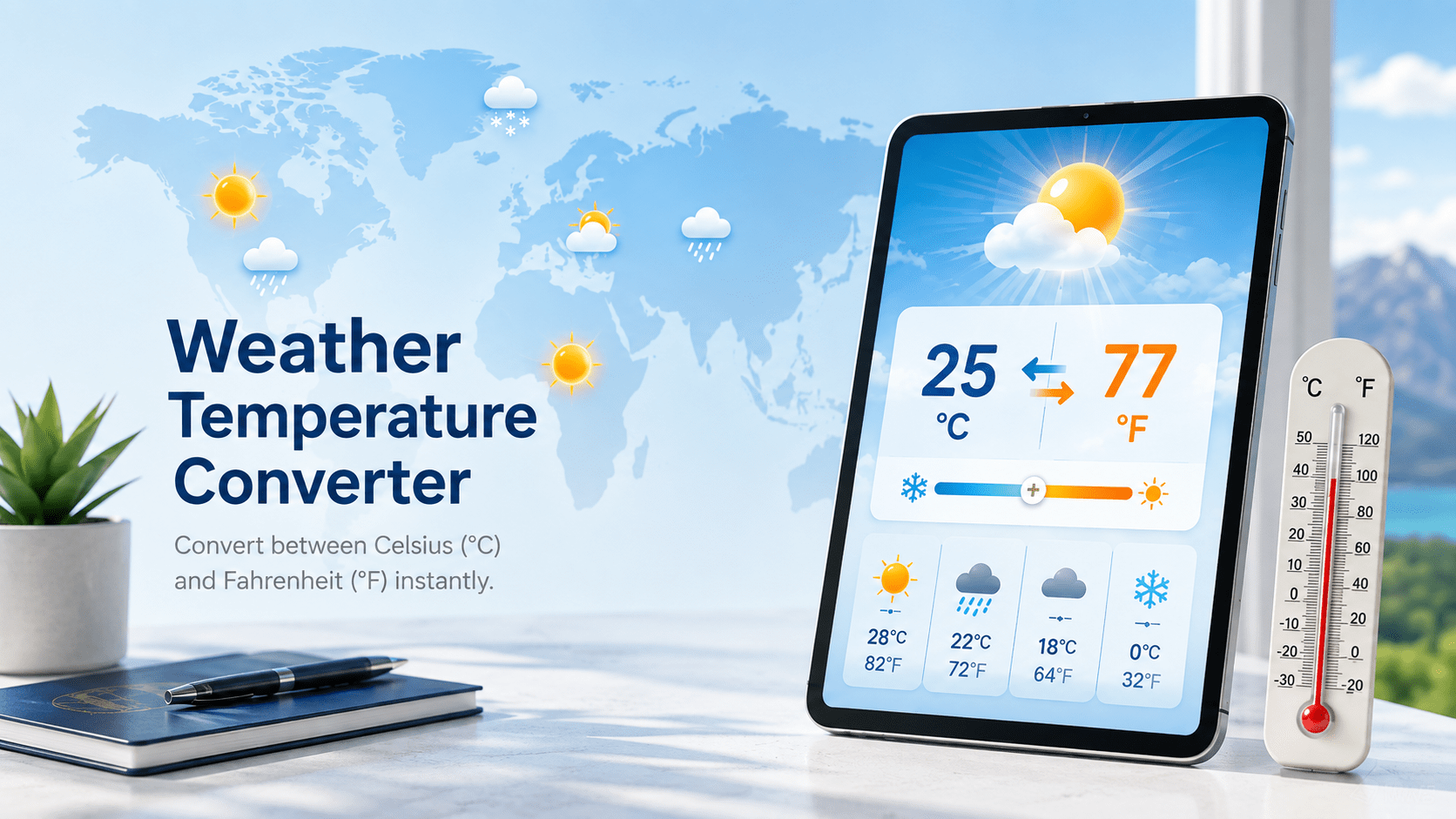
Use this weather temperature converter to change an outdoor temperature between Celsius and Fahrenheit instantly. Enter the value shown in a forecast, select the original unit, and review the equivalent result. The calculator works with positive temperatures, negative values, and decimals, so it is useful for travel, international forecasts, outdoor plans, and everyday weather comparisons.
Quick answer
- Celsius to Fahrenheit: °F = (°C × 9/5) + 32
- Fahrenheit to Celsius: °C = (°F − 32) × 5/9
For example, 25°C equals 77°F, while 68°F equals 20°C. These are the standard formulas also used by the National Weather Service.
What Is a Weather Temperature Converter?
A weather temperature converter is an online tool that expresses the same air temperature in another unit. It does not change the weather reading itself. Instead, it translates the number from the Celsius scale to the Fahrenheit scale, or in the opposite direction.
This distinction matters when you read a forecast from another country. Fahrenheit is commonly used for everyday weather in the United States, whereas Celsius is standard in most other areas. Therefore, a conversion tool helps you understand local conditions without estimating or applying the formula manually.
How the Weather Temperature Converter Works
First, enter the temperature exactly as it appears in the forecast. Next, confirm whether the original value is in degrees Celsius or degrees Fahrenheit. Finally, the weather temperature converter applies the correct formula and displays the equivalent value.
Convert Celsius to Fahrenheit
Use this formula:
°F = (°C × 9/5) + 32
You can also multiply by 1.8 instead of 9/5.
For example, convert 28°C:
(28 × 1.8) + 32 = 82.4°F
Consequently, a forecast high of 28°C is equal to 82.4°F.
Convert Fahrenheit to Celsius
Use the reverse formula:
°C = (°F − 32) × 5/9
For example, convert 77°F:
(77 − 32) × 5/9 = 25°C
Therefore, 77°F is equal to 25°C.
Common Weather Temperatures in Celsius and Fahrenheit
The following chart provides practical reference points for outdoor temperatures. However, personal comfort can vary because humidity, wind, sunshine, clothing, and activity level all affect how conditions feel.
| Celsius | Fahrenheit | General weather reference |
|---|---|---|
| −40°C | −40°F | Celsius and Fahrenheit are equal |
| −30°C | −22°F | Extremely cold |
| −20°C | −4°F | Very cold |
| −10°C | 14°F | Freezing winter weather |
| 0°C | 32°F | Freezing point of water under standard reference conditions |
| 5°C | 41°F | Chilly |
| 10°C | 50°F | Cool |
| 15°C | 59°F | Mild or cool |
| 20°C | 68°F | Mild and comfortable for many people |
| 25°C | 77°F | Warm |
| 30°C | 86°F | Hot |
| 35°C | 95°F | Very hot |
| 40°C | 104°F | Extreme heat |
Although a chart is useful for familiar values, the calculator is better for temperatures such as 17°C, 73°F, or any decimal reading.
How to Read an International Weather Forecast
Begin by checking the unit symbol beside the number. A forecast marked °C uses Celsius, while a forecast marked °F uses Fahrenheit. Afterward, look at the daily high, overnight low, and any “feels like” value separately.
For instance, a European forecast may show a high of 24°C and a low of 13°C. Those values convert to 75.2°F and 55.4°F. As a result, the day may feel warm in the afternoon but much cooler later.
Conversely, a United States forecast of 86°F during the day and 68°F overnight equals 30°C and 20°C. Converting both values gives a clearer picture than converting only the daily maximum.
Negative signs also require attention. A temperature of −4°F does not equal −4°C. In fact, −4°F converts to −20°C. Therefore, always enter the minus sign when the forecast falls below zero.
Actual Air Temperature and “Feels Like” Temperature
A standard conversion changes only the unit. It does not calculate heat index, wind chill, humidity, or other weather effects.
Heat index combines air temperature with relative humidity to estimate how hot conditions feel to the human body. Meanwhile, wind chill describes how cold people and animals feel because wind increases heat loss from exposed skin.
Suppose a forecast lists an actual temperature of 32°C and a “feels like” temperature of 38°C. The actual reading converts to 89.6°F, while the apparent temperature converts to 100.4°F. Both conversions are correct because they refer to two different weather values.
Therefore, use the weather temperature converter for each number separately. Do not treat the converted air temperature as a new heat-index or wind-chill calculation.
Why Weather Temperatures May Be Rounded
Forecast services often display whole degrees for readability. Consequently, converting a rounded value may produce a decimal result. For example, 21°C equals 69.8°F, which a weather app may show as 70°F.
Small differences can also appear when a reported value is converted, rounded, and converted back again. The National Weather Service explains that some observing stations convert Fahrenheit readings to Celsius and round them before distribution. Therefore, converting those rounded values back to Fahrenheit can occasionally create a difference of one or two degrees.
In addition, separate apps may use different stations, forecast models, update times, or rounding rules. The converter can translate the supplied number accurately, but it cannot make different forecast sources identical.
For everyday planning, one decimal place is usually more than enough. However, you may keep two decimal places when comparing data or checking a manual calculation.
Fast Mental Estimates for Weather Conversion
An exact calculation is always best. Nevertheless, simple shortcuts can help when you need a quick estimate.
To estimate Fahrenheit from Celsius, double the Celsius number and add 30. Thus, 20°C becomes roughly 70°F; the exact result is 68°F.
To estimate Celsius from Fahrenheit, subtract 30 and divide by two. Using this method, 80°F becomes roughly 25°C; the exact result is about 26.67°C.
These shortcuts are convenient for casual conversation. However, they become less accurate near temperature extremes. Therefore, use the exact calculator for travel planning, weather records, safety information, or any situation where precision matters.
When to Use a Weather Temperature Converter
Use a weather temperature converter when a forecast, travel guide, news report, smartwatch, vehicle display, or outdoor device uses an unfamiliar scale. It is also helpful when discussing the weather with someone who uses a different temperature unit.
Travelers can compare destination forecasts before packing. Moreover, runners, cyclists, hikers, and other outdoor users can translate hourly temperatures into a familiar scale before choosing clothing or planning a route.
The tool is designed for weather readings. Although the mathematical formulas also work for other temperatures, a dedicated body-temperature or oven-temperature converter may provide more relevant context for those uses.
Accuracy and Calculation Method
Every conversion uses the exact relationship between Celsius and Fahrenheit:
°F = (°C × 9/5) + 32
°C = (°F − 32) × 5/9
The calculator accepts whole numbers, decimals, zero, and negative weather temperatures. Results may be rounded for display, but the calculation should retain the full value until the final step.
Important reference points were checked against the formulas, including −40°C = −40°F, 0°C = 32°F, 20°C = 68°F, and 30°C = 86°F. The National Weather Service publishes the same formulas and equivalent reference tables.
Enter the value in the calculator and select the original unit. For a manual Celsius-to-Fahrenheit conversion, multiply by 9/5 and add 32. For Fahrenheit to Celsius, subtract 32 and multiply by 5/9.
25°C equals 77°F.
70°F is approximately 21.11°C. For a typical weather forecast, this may be rounded to 21°C.
The two scales display the same number at −40 degrees:
−40°C = −40°F
Yes. Negative values are valid in both scales. For example, −20°C equals −4°F, while −4°F equals −20°C.
No. Air temperature is the measured or forecast atmospheric temperature. A “feels like” value may account for humidity, wind, or other factors. Convert each displayed value separately.
Weather services often round temperatures to whole numbers. Therefore, a converted and rounded result may differ slightly from a value calculated from more precise source data.
The mathematics is the same, but those topics need different context. Use a dedicated oven temperature converter for cooking and a body temperature converter for thermometer readings.