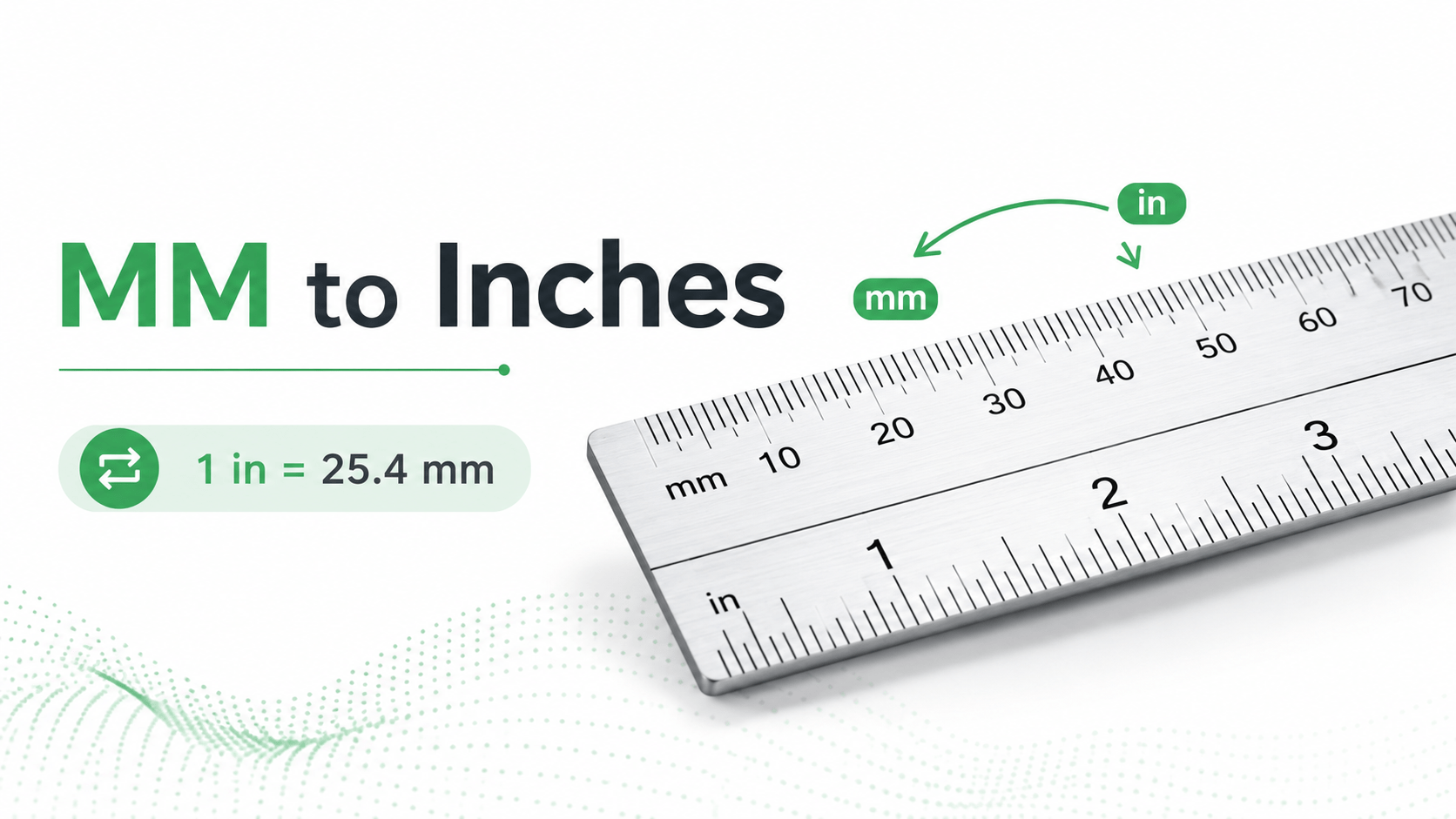
Converting mm to inches is simple: divide the number of millimeters by 25.4. Because 1 inch equals exactly 25.4 millimeters, the conversion formula is:
inches = millimeters ÷ 25.4
For example, 25.4 mm = 1 inch, 50.8 mm = 2 inches, and 100 mm ≈ 3.937 inches.
Whether you are working with tools, technical drawings, hardware sizes, product dimensions, manufacturing specifications, or everyday measurements, you can use the calculator below to convert millimeters to inches instantly.
Convert MM to Inches Instantly
Need a quick mm to inches conversion? Enter any measurement in millimeters into the calculator below and select Convert mm to inches. The calculator uses the exact relationship of 25.4 millimeters per inch and returns the result automatically.
You can enter whole numbers or decimal measurements, making the converter useful for everything from small mechanical parts to furniture dimensions and product specifications.
How to Convert MM to Inches
To convert millimeters to inches manually, divide the millimeter measurement by 25.4.
MM to Inches Formula
inches = mm ÷ 25.4
For example, to convert 30 mm to inches:
30 ÷ 25.4 = 1.1811 inches
Therefore:
30 mm ≈ 1.1811 inches
The same formula works for any millimeter measurement.
Example: Convert 10 MM to Inches
10 ÷ 25.4 = 0.3937008
So:
10 mm ≈ 0.3937 inches
Example: Convert 50 MM to Inches
50 ÷ 25.4 = 1.9685039
So:
50 mm ≈ 1.9685 inches
Example: Convert 100 MM to Inches
100 ÷ 25.4 = 3.9370079
So:
100 mm ≈ 3.9370 inches
Why Is 1 Inch Equal to 25.4 MM?
The relationship between inches and millimeters is exact:
1 inch = 25.4 millimeters exactly
This makes converting mm to inches particularly reliable. The conversion factor itself is not an approximation. Any rounding occurs only when the final inch value is shortened to a practical number of decimal places.
The millimeter belongs to the metric system and is one-thousandth of a meter:
1 mm = 0.001 meter
The inch is commonly used in the United States and in certain industries worldwide. Because products, drawings, tools, screens, fasteners, pipes, and other measurements may use either system, converting between millimeters and inches is extremely common.
When Do You Need to Convert MM to Inches?
Millimeters are especially useful for small or precise measurements, while inches remain widely used for dimensions in the United States and in many technical and consumer applications. This means a millimeter-to-inch conversion is often necessary when information moves between metric and imperial measurement systems.
Engineering and Manufacturing
Technical drawings, machine components, bearings, bolts, screws, and manufactured parts are frequently specified in millimeters. However, tools or replacement parts may sometimes be listed in inches.
A reliable mm to inches converter helps compare those measurements without estimating.
Screws, Bolts, and Hardware
Hardware is a common reason people need this conversion.
For example:
- 6 mm ≈ 0.2362 inches
- 8 mm ≈ 0.3150 inches
- 10 mm ≈ 0.3937 inches
- 12 mm ≈ 0.4724 inches
Keep in mind that metric and imperial fastener standards are not always direct substitutes even when their dimensions are similar. The conversion tells you the physical measurement, not whether two standardized parts are interchangeable.
Woodworking and DIY Projects
Plans downloaded from another country may use millimeters while your ruler, tape measure, or tools show inches.
Converting the measurements accurately can help when cutting wood, drilling holes, positioning fittings, assembling furniture, or comparing material thicknesses.
Product Dimensions and Online Shopping
Electronics, furniture, accessories, automotive parts, and many imported products list dimensions in millimeters.
If you normally think in inches, converting the dimensions can make the actual size much easier to visualize.
3D Printing and Design
Many CAD and 3D-printing programs work with millimeters by default. A design intended to match an object measured in inches may therefore require conversion between the two units.
Even a small conversion error can become noticeable when parts need to fit together accurately.
MM to Inches as Decimal Inches
Most digital measurements express inches as decimal numbers.
For example:
20 mm = 0.7874 inches
This format is useful for engineering calculations, digital design, CAD software, manufacturing, and measurements where precision matters.
How many decimal places you should use depends on your task.
For everyday measurements, two or three decimal places are often sufficient. For technical applications, additional precision may be appropriate.
For example:
15 mm = 0.5905511811 inches
Rounded values include:
0.59 in — two decimal places
0.591 in — three decimal places
0.5906 in — four decimal places
The calculator above keeps additional precision while avoiding unnecessary trailing zeros.
MM to Inches in Fractions
Inches are also commonly written as fractions, particularly on rulers, tape measures, hardware, woodworking plans, and construction materials.
Some frequently used fractional-inch measurements have exact metric equivalents:
| Inches | Millimeters |
|---|---|
| 1/8 in | 3.175 mm |
| 1/4 in | 6.35 mm |
| 3/8 in | 9.525 mm |
| 1/2 in | 12.7 mm |
| 5/8 in | 15.875 mm |
| 3/4 in | 19.05 mm |
| 7/8 in | 22.225 mm |
| 1 in | 25.4 mm |
For example, 12.7 mm is exactly 1/2 inch, while 6.35 mm is exactly 1/4 inch.
Not every millimeter measurement corresponds exactly to a commonly used inch fraction. In those situations, the decimal result is generally the more accurate way to express the conversion.
MM, CM, and Inches: What Is the Difference?
A millimeter is a smaller metric unit than a centimeter.
10 mm = 1 cm
Because:
1 inch = 25.4 mm
it also follows that:
1 inch = 2.54 cm
This relationship makes it easy to move between the three units.
If your measurement is already in centimeters, you can also use our inches to centimeters converter for the reverse relationship, or explore more tools in our Length Converters section.
Should You Multiply or Divide When Converting MM to Inches?
When converting mm to inches, divide by 25.4.
mm → inches: divide by 25.4
For the opposite conversion:
inches → mm: multiply by 25.4
A useful way to remember this is that an inch is much larger than a millimeter. Therefore, when converting a millimeter measurement into inches, the numerical result will usually become smaller.
For example:
100 mm = 3.937 inches
How Accurate Is the MM to Inches Conversion?
The underlying conversion is exact because 1 inch is defined as exactly 25.4 mm.
The only source of approximation is rounding the converted result.
For example:
100 mm ÷ 25.4 = 3.937007874…
You might express this as:
3.94 inches for everyday use, or
3.9370 inches when greater precision is useful.
For precision work, keep more decimal places until the final stage of your calculation to reduce rounding errors.
MM to Inches Conversion Chart
Use this quick-reference table for common measurements from 1 to 100 millimeters.
| Millimeters (mm) | Inches (in) |
| 1 mm | 0.0394 in |
| 10 mm | 0.3937 in |
| 20 mm | 0.7874 in |
| 30 mm | 1.1811 in |
| 40 mm | 1.5748 in |
| 50 mm | 1.9685 in |
| 60 mm | 2.3622 in |
| 70 mm | 2.7559 in |
| 80 mm | 3.1496 in |
| 90 mm | 3.5433 in |
| 100 mm | 3.9370 in |
For measurements not shown in the chart, use the mm to inches calculator above.
Quick MM to Inches Summary
To convert millimeters to inches:
inches = millimeters ÷ 25.4
The key relationship is:
1 inch = exactly 25.4 mm
Use the calculator above whenever you need a fast and accurate conversion, and use the conversion chart for frequently used measurements.
Frequently Asked Questions About MM to Inches
1 mm = approximately 0.03937 inches.
The calculation is:
1 ÷ 25.4 = 0.0393700787 inches.
There are exactly 25.4 millimeters in one inch.
1 inch = 25.4 mm
Divide the millimeter value by 25.4.
For example:
50 mm ÷ 25.4 = 1.9685 inches.
Yes. 25.4 mm is exactly equal to one inch. The conversion factor is exact, although converted decimal results may be rounded for convenience.
10 mm ≈ 0.3937 inches.
20 mm ≈ 0.7874 inches.
50 mm ≈ 1.9685 inches.
100 mm ≈ 3.9370 inches.
First divide the millimeter value by 25.4 to obtain decimal inches. You can then compare the result with common inch fractions such as 1/8, 1/4, 3/8, 1/2, 5/8, 3/4, or 7/8 inch.
For precision work, use the decimal-inch result rather than forcing the measurement to the nearest fraction.