Convert kg to BMI: Weight Alone Is Not Enough
(Enter your weight and height, the latter in meters (e.g. 1.70, usIf you want to convert kg to BMI, you need two measurements: your weight in kilograms and your height. Kilograms cannot be converted directly into BMI because Body Mass Index measures weight relative to height.
Enter your weight in kilograms and height in centimeters in the calculator below. The tool uses the standard metric BMI formula:
BMI = weight (kg) ÷ height² (m²)
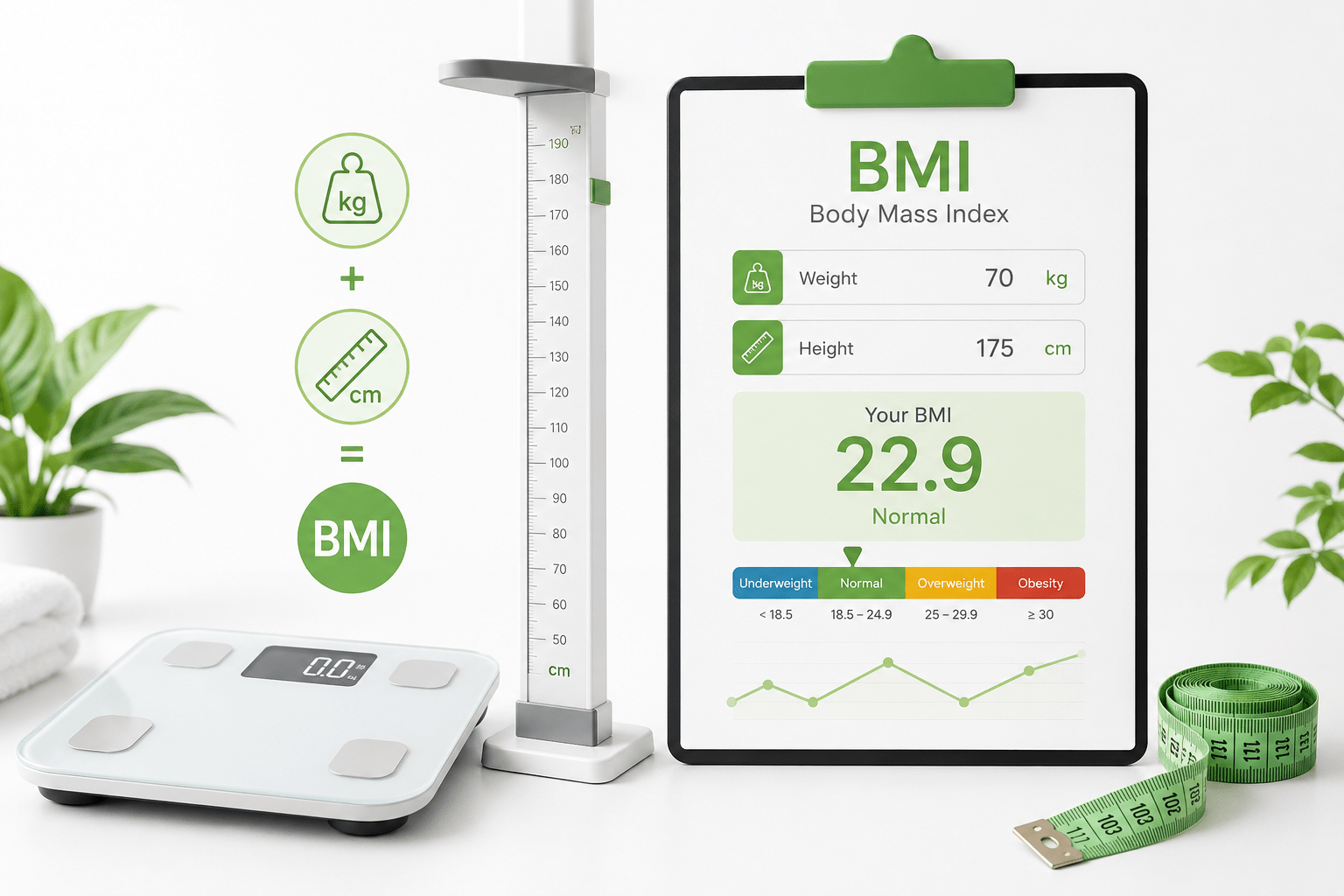
For example, a person who weighs 70 kg and is 175 cm tall has a BMI of approximately 22.9.
Important: BMI is a screening measure, not a medical diagnosis. The adult BMI categories shown by this calculator are intended for adults aged 20 and over. BMI is interpreted differently for children and teenagers.e a period when entering)
Convert kg to BMI: Calculator, Formula and Complete Guide
To convert kg to BMI, your weight in kilograms is only one part of the calculation. Body Mass Index compares your body weight with your height, so you also need an accurate height measurement.
The standard metric formula is:
BMI = weight in kilograms ÷ height in meters²
For example:
70 kg ÷ (1.75 × 1.75) = 22.9 BMI
This page explains how to calculate BMI from kilograms correctly, what an adult BMI result means, where BMI is commonly used, and — equally importantly — what BMI cannot tell you about your health.
What Is BMI?
BMI stands for Body Mass Index. It is a numerical measure that relates a person's weight to their height.
Instead of looking at body weight alone, BMI provides a standardized way to compare weight across people of different heights.
For adults, it is widely used as a screening measure in healthcare and population health research. It is quick to calculate, requires only height and weight, and does not require specialist equipment.
However, BMI does not directly measure body fat, and it cannot distinguish between fat, muscle and bone mass. For that reason, a BMI result should be interpreted as one piece of information rather than a complete assessment of someone's health.
How Do You Convert kg to BMI?
Technically, you cannot directly convert kg to BMI in the same way that you can convert kilograms to pounds or grams.
A kilogram is a unit of mass. BMI is a calculation based on both mass and height.
You therefore need:
- body weight in kilograms;
- height in meters or centimeters.
The metric BMI formula is:
BMI = kg ÷ m²
If your height is measured in centimeters, first divide it by 100 to convert it to meters.
Example: 70 kg and 175 cm
Height:
175 cm = 1.75 m
Square the height:
1.75 × 1.75 = 3.0625
Divide the body weight by the squared height:
70 ÷ 3.0625 = 22.86
Rounded to one decimal place:
BMI = 22.9
This falls within the healthy-weight BMI category for adults.
BMI Formula Using Kilograms and Centimeters
You can also calculate BMI directly from centimeters without manually converting height into meters.
Use:
BMI = [weight (kg) ÷ height (cm)²] × 10,000
For a person weighing 70 kg and measuring 175 cm:
BMI = (70 ÷ 175²) × 10,000
BMI = 22.9
Both formulas produce the same result.
Adult BMI Categories
For adults aged 20 years and older, the U.S. Centers for Disease Control and Prevention uses the following BMI categories:
| BMI | Adult weight category |
|---|---|
| Below 18.5 | Underweight |
| 18.5 to 24.9 | Healthy weight |
| 25.0 to 29.9 | Overweight |
| 30.0 to 34.9 | Obesity, Class 1 |
| 35.0 to 39.9 | Obesity, Class 2 |
| 40.0 or higher | Obesity, Class 3 |
These ranges are screening categories rather than diagnoses. A healthcare professional may consider BMI alongside other information such as medical history, blood pressure, laboratory results, waist measurements and physical examination.
Why Is Height Essential When Converting kg to BMI?
The same body weight can produce very different BMI values depending on height.
Consider two adults who both weigh 70 kg.
At 160 cm:
70 ÷ 1.60² = BMI 27.3
At 180 cm:
70 ÷ 1.80² = BMI 21.6
The weight is identical, but the BMI values are substantially different.
This is why any tool claiming to convert kg to BMI using weight alone would be mathematically incomplete.
Why Is BMI Commonly Used?
BMI is commonly used because it is simple, inexpensive and easy to reproduce.
Only two measurements are needed:
height + weight
This makes BMI useful in several settings.
Healthcare screening
Healthcare professionals may use BMI as one screening measurement when assessing weight relative to height.
It is not intended to diagnose a disease or determine a person's overall health by itself.
Public health and research
BMI is particularly useful when researchers study large populations because height and weight can be collected much more easily than detailed body-composition measurements.
Fitness and weight tracking
Adults may calculate BMI when monitoring changes in body weight over time.
For example, if height remains constant, changes in body weight will also change BMI.
However, people who gain or lose significant muscle mass should remember that BMI does not distinguish muscle from body fat.
Medical and health records
BMI is frequently calculated automatically when height and weight are entered into health-record systems.
When Might You Need to Calculate BMI From kg?
A convert kg to BMI calculator can be useful when:
- you know your weight in kilograms and want to calculate BMI;
- you want to check how a change in weight affects BMI;
- a form asks for BMI but you only know your height and weight;
- you are comparing weight relative to height;
- you need a quick adult BMI screening value;
- you are studying BMI calculations in school or training;
- you are working with metric measurements rather than pounds and inches.
The calculation itself takes only seconds, but correct interpretation matters more than the number alone.
BMI Is Not the Same as Body Fat Percentage
One of the most common misunderstandings about BMI is assuming that it directly measures body fat.
It does not.
Two people can have the same BMI while having different proportions of:
- body fat;
- muscle;
- bone;
- other lean tissue.
A muscular athlete, for example, may have a relatively high BMI because muscle contributes to total body weight.
BMI therefore answers:
“How much does this person weigh relative to their height?”
It does not directly answer:
“What percentage of this person's body is fat?”
Important Limitations of BMI
Understanding these limitations makes a convert kg to BMI calculation more useful and less likely to be misinterpreted.
BMI does not distinguish fat from muscle
BMI is calculated from total body weight. It cannot determine whether that weight comes primarily from fat, muscle or other tissue.
BMI does not show where body fat is located
The formula uses only height and weight. It does not measure fat distribution.
BMI is a screening measure
A BMI number should not be interpreted as a medical diagnosis.
The CDC describes BMI as a screening measure that should be considered together with other health factors.
Adult BMI categories are not for children
BMI interpretation for children and teenagers differs from adult interpretation.
For children and teens, age and sex are used when BMI is assessed against growth charts and percentiles. The CDC's child and teen calculation therefore requires more information than simply height and weight.
Can You Calculate BMI During Pregnancy?
Standard adult BMI categories should not simply be used to interpret changes in body weight during pregnancy.
Pregnancy naturally changes body weight and body composition. If weight or BMI during pregnancy is a concern, appropriate guidance should come from a healthcare professional rather than a general online BMI calculator.
How Accurate Should Your Measurements Be?
A calculator can only work with the values entered into it.
For a more useful BMI result:
- use a recent body-weight measurement;
- enter kilograms rather than pounds;
- measure height without shoes;
- make sure centimeters and meters are not confused;
- use decimal values when appropriate.
For example, accidentally entering 175 meters instead of 175 centimeters would produce a meaningless result.
Our calculator avoids this particular problem by requesting height directly in centimeters.
What Does a BMI Result Actually Tell You?
A BMI result provides a standardized relationship between weight and height.
It can help identify whether an adult's weight-for-height falls within commonly used screening categories.
It does not by itself determine:
- overall fitness;
- body-fat percentage;
- muscle mass;
- cardiovascular fitness;
- metabolic health;
- nutritional status;
- whether someone has a disease.
BMI is therefore best treated as a starting point for context, not the final word on health.
Convert kg to BMI Examples
Here are several examples showing why both kilograms and height matter.
50 kg at 1.60 m
50 ÷ 1.60² = BMI 19.5
60 kg at 1.70 m
60 ÷ 1.70² = BMI 20.8
70 kg at 1.70 m
70 ÷ 1.70² = BMI 24.2
80 kg at 1.80 m
80 ÷ 1.80² = BMI 24.7
90 kg at 1.80 m
90 ÷ 1.80² = BMI 27.8
These examples demonstrate why there is no single BMI value associated with a particular number of kilograms.
How We Calculate the Results
The calculator on Easy Unit Convert uses the standard metric relationship:
BMI = weight (kg) ÷ height (m)²
The result is displayed to one decimal place for readability.
For information about how Easy Unit Convert handles formulas, rounding and reference standards across the website, see our Accuracy & Editorial Policy.
This calculator is intended as a general informational tool. It does not provide a medical diagnosis or replace advice from a qualified healthcare professional.
Authoritative Reference
The formula and adult categories used on this page follow information published by the U.S. Centers for Disease Control and Prevention (CDC).
The CDC defines BMI as body weight in kilograms divided by height in meters squared and emphasizes that BMI is a screening measure that should be considered alongside other health information.
kg to BMI Reference Table
Because kilograms alone cannot determine BMI, a useful kg to BMI table must also include height.
The table below shows BMI values for weights from 10 kg to 100 kg in 10 kg increments, across five example heights.
| Weight | 1.50 m | 1.60 m | 1.70 m | 1.80 m | 1.90 m |
|---|---|---|---|---|---|
| 10 kg | 4.4 | 3.9 | 3.5 | 3.1 | 2.8 |
| 20 kg | 8.9 | 7.8 | 6.9 | 6.2 | 5.5 |
| 30 kg | 13.3 | 11.7 | 10.4 | 9.3 | 8.3 |
| 40 kg | 17.8 | 15.6 | 13.8 | 12.3 | 11.1 |
| 50 kg | 22.2 | 19.5 | 17.3 | 15.4 | 13.9 |
| 60 kg | 26.7 | 23.4 | 20.8 | 18.5 | 16.6 |
| 70 kg | 31.1 | 27.3 | 24.2 | 21.6 | 19.4 |
| 80 kg | 35.6 | 31.2 | 27.7 | 24.7 | 22.2 |
| 90 kg | 40.0 | 35.2 | 31.1 | 27.8 | 24.9 |
| 100 kg | 44.4 | 39.1 | 34.6 | 30.9 | 27.7 |
Important: These numbers are mathematical BMI results only. Adult BMI categories should not be applied to children simply by using this table.
Frequently Asked Questions About Convert kg to BMI
No. To convert kg to BMI, you must also know the person's height. BMI is calculated by dividing weight in kilograms by height in meters squared.
There is no single BMI for 70 kg because BMI depends on height.
For example, 70 kg at 1.60 m gives a BMI of approximately 27.3, while 70 kg at 1.80 m gives approximately 21.6.
The metric formula is:
BMI = weight (kg) ÷ height (m)²
If height is entered in centimeters:
BMI = [weight (kg) ÷ height (cm)²] × 10,000
For adults aged 20 and over, a BMI of 24 falls within the CDC's healthy weight category of 18.5 to 24.9.
BMI is nevertheless a screening measure and should not be interpreted as a complete health assessment.
No. BMI uses only height and weight. It does not directly measure body fat and does not distinguish fat mass from muscle or bone mass.
BMI can still be calculated for athletes, but interpretation may require additional context because BMI cannot distinguish muscle from fat.
Someone with substantial muscle mass may have a higher BMI without having the same body composition as another person with an identical BMI.
The mathematical BMI formula can calculate a number, but children's BMI must be interpreted differently from adult BMI.
For children and teenagers, age- and sex-specific growth information is used. Adult BMI categories should therefore not be applied to children.
No. BMI is a screening measure, not a diagnosis. Other health information may be needed to understand an individual's overall health.
BMI measures body weight relative to height. Two people with identical weights but different heights will have different BMI values.
That is why a reliable convert kg to BMI calculator must ask for both kilograms and height.