Convert Meters to Feet Instantly
Need a quick and accurate measurement? Use our calculator below to convert meters to feet in seconds. Enter any value in meters and the converter will calculate the equivalent length in feet using the official international conversion factor.
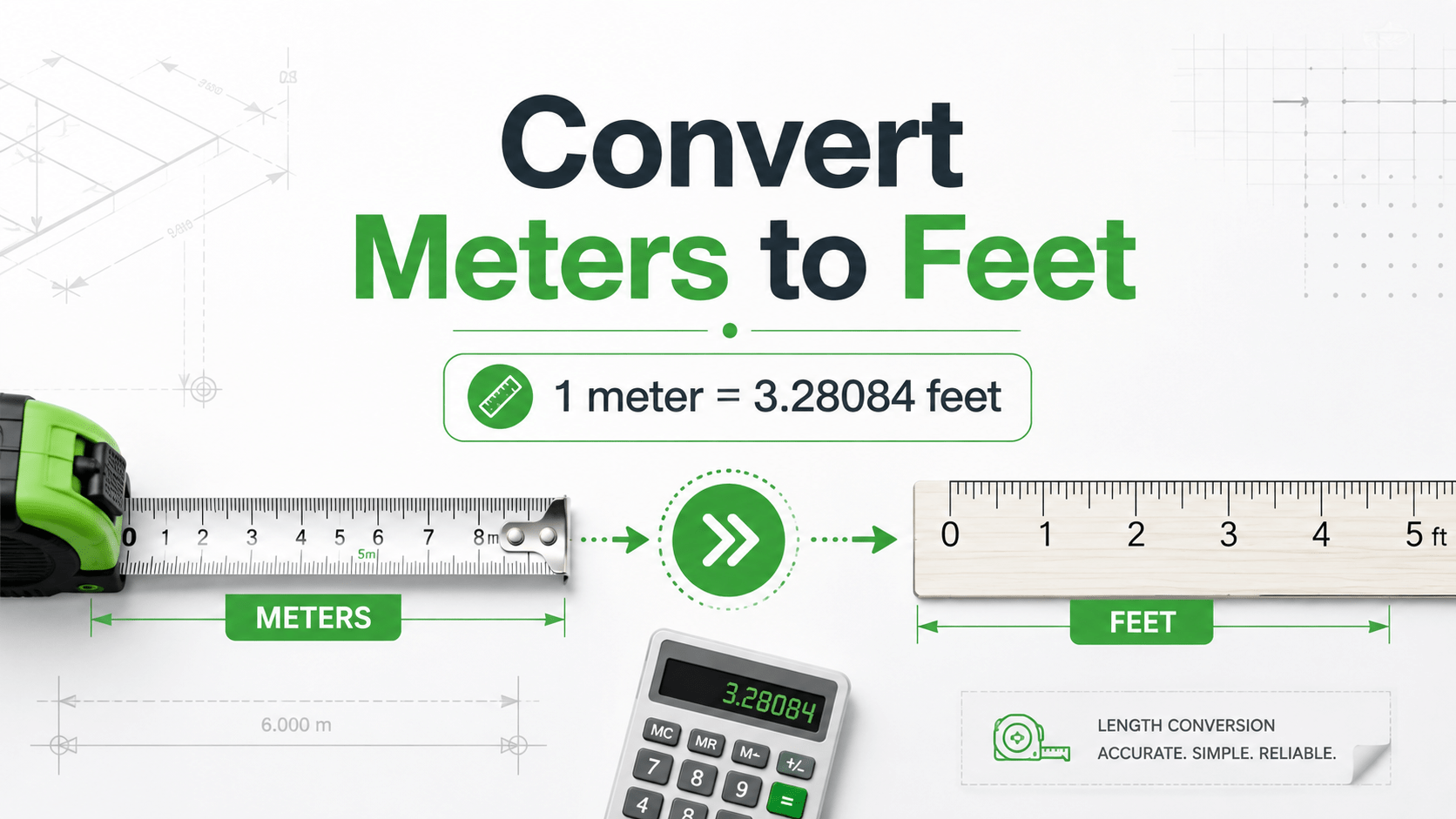
1 meter = 3.280839895 feet
For most everyday calculations, this can be rounded to 1 meter ≈ 3.28084 feet.
Convert Meters to Feet
To convert meters to feet, multiply the number of meters by 3.280839895. In practical calculations, the conversion factor is usually rounded to 3.28084.
Formula:
Feet = Meters × 3.28084
For example:
5 meters × 3.28084 = 16.4042 feet
So, 5 meters is approximately 16.404 feet.
Use the calculator above when you need an immediate result, or continue below to learn how the conversion works, why the units differ, and when converting between meters and feet is useful.
How to Convert Meters to Feet
The conversion is straightforward because the relationship between the meter and the international foot is precisely defined.
1 foot = 0.3048 meters exactly
Therefore:
1 meter = 1 ÷ 0.3048 feet
which equals:
1 meter = 3.280839895… feet
For most everyday calculations, using 3.28084 as the conversion factor provides more than enough precision.
Meters to Feet Formula
To calculate the result manually:
feet = meters × 3.28084
For example, to convert 12 meters:
12 × 3.28084 = 39.37008 feet
Therefore:
12 meters ≈ 39.37 feet
Example: Convert 2 Meters to Feet
Multiply 2 by the conversion factor:
2 × 3.28084 = 6.56168
Therefore:
2 meters ≈ 6.562 feet
Example: Convert 10 Meters to Feet
10 × 3.28084 = 32.8084
Therefore:
10 meters ≈ 32.808 feet
Example: Convert 25 Meters to Feet
25 × 3.28084 = 82.021
Therefore:
25 meters ≈ 82.021 feet
What Is a Meter?
The meter, symbol m, is the SI base unit of length.
It is part of the International System of Units (SI), which provides internationally standardized measurements used in science, engineering, manufacturing, construction and everyday life.
The meter has an exact scientific definition based on the speed of light in a vacuum. This makes it a stable and reproducible unit rather than a measurement based on the dimensions of a physical object.
Meters are commonly used to measure:
- room dimensions;
- building lengths and heights;
- sporting distances;
- swimming pools;
- road and travel distances;
- furniture and construction materials;
- scientific and engineering measurements.
One meter contains 100 centimeters or 1,000 millimeters.
What Is a Foot?
A foot, symbol ft, is a unit of length commonly associated with the U.S. customary and Imperial measurement systems.
The international foot is defined exactly as:
1 foot = 0.3048 meters
A foot contains:
12 inches
and:
3 feet = 1 yard
Feet remain widely used for practical measurements, particularly in the United States. They are also commonly encountered internationally in particular fields, including aviation, where altitude is normally expressed in feet.
This is why people frequently need to convert meters to feet even when they normally work with metric measurements.
Why Is Converting Meters to Feet Important?
Meters and feet measure exactly the same physical quantity—length—but they belong to different measurement traditions.
A measurement written as 3 m may therefore need to be expressed in feet before it can be easily understood or used by somebody working with U.S. customary measurements.
The conversion becomes especially useful when information, plans, specifications or instructions move between countries using different measurement conventions.
Accurate conversion also helps avoid misunderstandings. The difference between an approximate mental estimate and an accurate calculation may be insignificant for estimating the size of a room, but it can become much more important when working with construction measurements, engineering specifications or larger distances.
Where Are Meters to Feet Conversions Commonly Used?
Construction and Home Improvement
Building dimensions may be supplied in meters while tools, materials or plans use feet and inches.
For example, a room measuring 4 meters long is approximately:
4 × 3.28084 = 13.123 feet
Being able to convert between the two systems makes it easier to compare plans, materials and product specifications.
Architecture and Real Estate
Property dimensions can be presented differently depending on the country.
A buyer or professional accustomed to feet may find a room described as 6 meters long difficult to visualize immediately.
Converting the measurement gives:
6 m ≈ 19.685 ft
This provides a more familiar reference.
Travel
Travelers frequently encounter measurements expressed in a system different from the one used at home.
Building heights, walking distances, attraction dimensions and informational signs may be shown in meters, while visitors from countries using feet may prefer the equivalent imperial measurement.
Sports
Many international sports use metric measurements, while audiences in some countries are more familiar with feet.
Track dimensions, swimming pool measurements, jumping distances and other sporting measurements may therefore require conversion.
Aviation
Aviation is an especially interesting example because metric and non-metric units frequently appear together.
Aircraft altitude is commonly stated in feet, even in countries where everyday distances are normally measured using meters.
A person reading an elevation or height in meters may therefore need to convert it into feet for comparison with aviation information.
Engineering and Technical Work
International engineering projects may involve drawings, equipment specifications or documentation using different systems.
Accurate conversion is important because repeatedly rounding measurements too aggressively can introduce avoidable errors.
For technical work, use the calculator or the full conversion factor rather than relying only on a mental approximation.
Quick Way to Estimate Meters in Feet
For a fast mental estimate, you can use:
1 meter ≈ 3.3 feet
For example:
10 meters ≈ 33 feet
The more accurate answer is:
10 meters = 32.8084 feet
The shortcut is useful when you only need a rough idea of a length. For construction, engineering or other situations where precision matters, use 3.28084 or the calculator instead.
Another useful mental reference is:
- 1 m ≈ 3.28 ft
- 3 m ≈ 9.84 ft
- 10 m ≈ 32.81 ft
- 30 m ≈ 98.43 ft
- 100 m ≈ 328.08 ft
Meter vs. Foot: What Is the Difference?
Both meters and feet measure length, but their sizes are different.
One meter is slightly more than three feet:
1 m ≈ 3.281 ft
Conversely:
1 ft = 0.3048 m
This means a numerical value expressed in feet will normally be larger than the same physical distance expressed in meters.
For example:
10 meters = 32.8084 feet
Both values describe exactly the same distance.
International Foot and the Former U.S. Survey Foot
For ordinary conversions today, foot means the international foot, which equals exactly 0.3048 meters.
Historically, the United States also used a slightly different unit known as the U.S. survey foot for certain surveying and mapping applications.
The difference was extremely small, but it could become significant over very large surveying distances.
The U.S. survey foot was retired for normal U.S. applications at the beginning of 2023. Modern conversions should therefore use the international definition unless you are specifically working with historical or legacy surveying data.
This calculator uses the international foot.
How Accurate Should Your Conversion Be?
The appropriate number of decimal places depends on what you are measuring.
For quick everyday estimates, two decimal places are usually sufficient:
5 m ≈ 16.40 ft
For more precise measurements, additional decimal places can be useful:
5 m = 16.40420 ft
Avoid reporting more precision than the original measurement supports. If a length was only measured approximately, displaying many additional decimal places does not make the original measurement more accurate.
The calculator above displays five decimal places so that it remains useful for both everyday and more precise conversions.
Common Mistakes When Converting Meters to Feet
One of the most common mistakes is using the conversion factor in the wrong direction.
To convert meters to feet, you multiply by approximately 3.28084.
Correct:
Meters × 3.28084 = Feet
To convert feet back to meters, you instead multiply by 0.3048.
Another common mistake is confusing feet with feet and inches.
For example:
1.5 meters = 4.92126 feet
This does not mean 4 feet 92 inches.
The decimal part represents a fraction of one foot. Converting the decimal portion separately to inches gives approximately:
1.5 meters ≈ 4 feet 11.1 inches
Use decimal feet when a calculation specifically requires feet, and feet-and-inches notation when that format is more practical for everyday measurements.
Convert Meters to Feet Conversion Table
The following table provides common conversions from 1 to 100 meters.
| Meters (m) | Feet (ft) |
|---|---|
| 1 m | 3.28084 ft |
| 10 m | 32.80840 ft |
| 20 m | 65.61680 ft |
| 30 m | 98.42520 ft |
| 40 m | 131.23360 ft |
| 50 m | 164.04200 ft |
| 60 m | 196.85040 ft |
| 70 m | 229.65880 ft |
| 80 m | 262.46720 ft |
| 90 m | 295.27560 ft |
| 100 m | 328.08400 ft |
For values not listed in the table, enter the measurement into the calculator at the top of this page.
Summary
To convert meters to feet, use this formula:
Feet = Meters × 3.28084
The essential conversions to remember are:
1 meter ≈ 3.28084 feet
and:
1 foot = 0.3048 meters exactly
For quick estimates, multiplying meters by 3.3 is often sufficient. For accurate measurements, use the calculator at the top of the page.
Whether you are working with construction plans, property dimensions, sports measurements, engineering specifications, travel information or international data, an accurate meters-to-feet conversion makes it easier to work confidently between metric and U.S. customary measurements.
Frequently Asked Questions About Converting Meters to Feet
Multiply the number of meters by 3.28084.
Feet = meters × 3.28084
For example:
8 m × 3.28084 = 26.24672 ft
So 8 meters is approximately 26.247 feet.
There are approximately 3.28084 feet in 1 meter.
More precisely:
1 meter = 3.280839895… feet
No. 3.28084 feet is a rounded value.
The exact relationship is based on:
1 foot = 0.3048 meters exactly
Therefore one meter equals the repeating decimal value obtained from 1 ÷ 0.3048, or approximately 3.280839895 feet.
2 meters = 6.56168 feet
Rounded to two decimal places:
2 m ≈ 6.56 ft
5 meters = 16.4042 feet
Rounded to two decimal places:
5 m ≈ 16.40 ft
10 meters = 32.8084 feet
Rounded to two decimal places:
10 m ≈ 32.81 ft
100 meters = 328.084 feet
Yes. For a rough estimate, multiply meters by 3.3.
For example:
20 m × 3.3 ≈ 66 ft
The accurate conversion is:
20 m = 65.6168 ft
This shortcut is useful for mental calculations but should not replace an accurate conversion when precision matters.
To convert meters into feet, multiply by 3.28084.
To convert feet into meters, multiply by 0.3048.
Yes. Both measure length or distance.
The meter is the SI base unit of length, while the foot is a non-SI unit still commonly used in several practical contexts.
No. The calculator uses the modern international foot, where:
1 ft = 0.3048 m exactly
The former U.S. survey foot is now intended only for historical and legacy applications.