Convert Liters to Quarts Instantly
Need a quick liters to quarts conversion? Enter the number of liters in the calculator below to get the equivalent amount in US liquid quarts instantly.
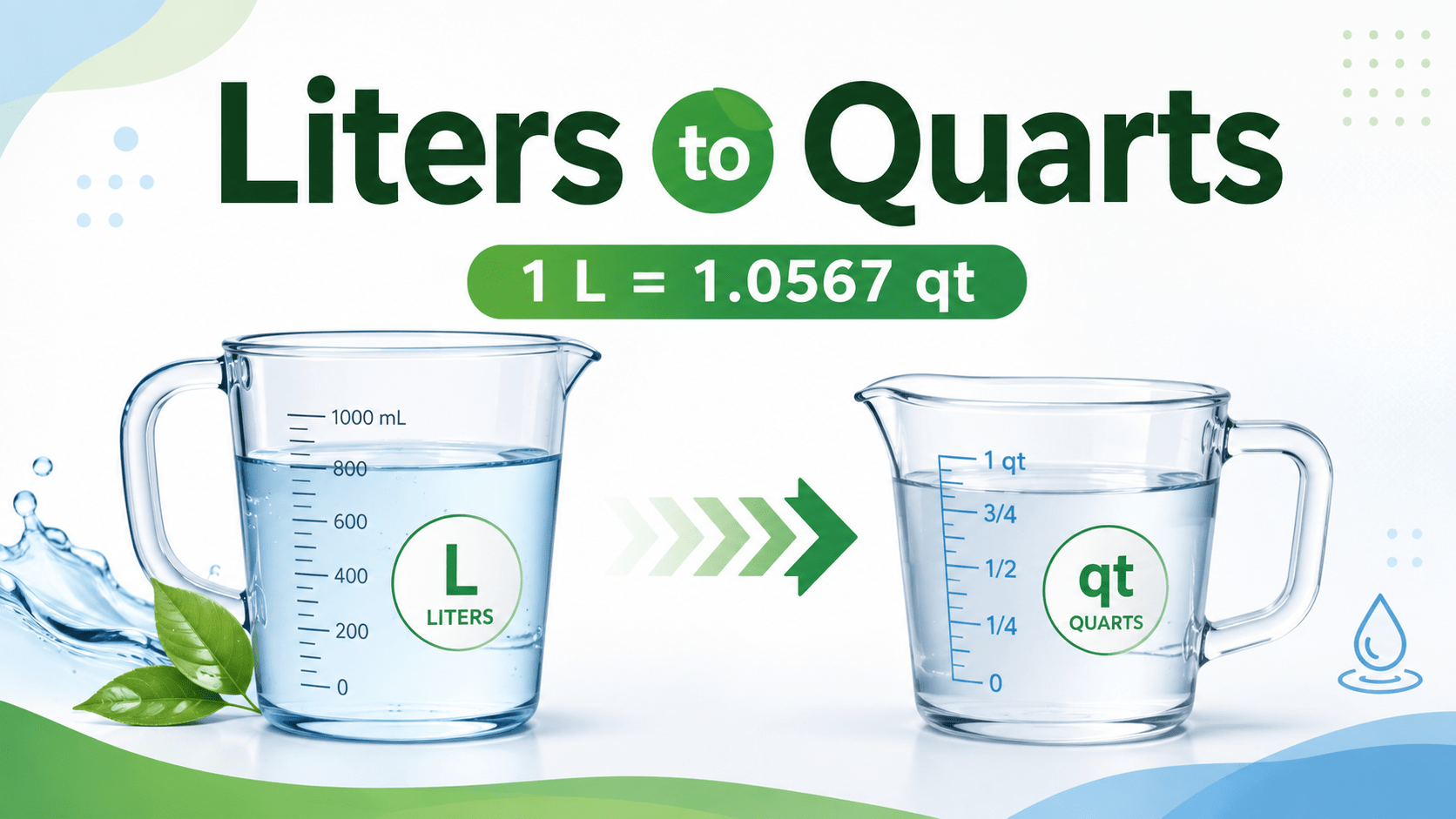
1 liter = 1.056688 US liquid quarts
The calculator uses the standard US liquid quart. If you need UK Imperial quarts, see the US vs. Imperial quart comparison further down the page.
Liters to Quarts Converter: Formula, Examples and Chart
Converting liters to quarts is simple once you know which type of quart you are using. For the US liquid quart, which is the standard used by our calculator:
1 liter = 1.056688 US liquid quarts
To convert any value, multiply the number of liters by 1.056688. For example, 5 liters equals approximately 5.28344 US quarts.
There is one important detail: a US quart and a UK Imperial quart are not the same size. This page explains the difference, provides the conversion formula, practical examples, and a quick-reference chart so you can choose the correct measurement for your situation.
How to Convert Liters to Quarts
The liters to quarts formula for US liquid quarts is:
US quarts = liters × 1.056688209
For everyday calculations, multiplying by 1.0567 is usually accurate enough. For measurements where greater precision is useful, keep more decimal places.
Example: Convert 2 Liters to Quarts
2 × 1.056688209 = 2.113376418
2 liters = approximately 2.11338 US quarts
Example: Convert 5 Liters to Quarts
5 × 1.056688209 = 5.283441045
5 liters = approximately 5.28344 US quarts
Example: Convert 10 Liters to Quarts
10 × 1.056688209 = 10.56688209
10 liters = approximately 10.5669 US quarts
For the reverse calculation, use our quarts to liters converter.
What Is a Liter?
A liter, abbreviated L, is a metric unit of volume widely used around the world. One liter equals:
-
1,000 milliliters
-
1 cubic decimeter
-
approximately 1.056688 US liquid quarts
Liters are commonly used for beverages, cooking ingredients, fuel, household liquids, aquarium capacity, automotive fluids, and product packaging.
Because the metric system is widely used internationally, product specifications and recipes from outside the United States often give liquid volume in liters.
What Is a Quart?
A quart is a unit of volume used primarily in the United States and, less commonly, in countries where Imperial measurements may still appear.
The word quart comes from the idea of one-quarter of a gallon. However, the size of the gallon differs between the US customary and Imperial measurement systems, which means their quarts are also different.
For most American recipes, product labels, automotive specifications, and household measurements, quart normally means the US liquid quart.
US Liquid Quart vs. Imperial Quart
This distinction is one of the most important things to understand when converting liters.
| Unit | Volume of 1 Quart | 1 Liter Equals |
|---|---|---|
| US liquid quart | 0.946352946 L | 1.056688 US qt |
| Imperial quart | 1.1365225 L | 0.879877 Imperial qt |
A US liquid quart is smaller than a liter, while an Imperial quart is larger than a liter.
Therefore:
1 liter = 1.056688 US liquid quarts
but:
1 liter = approximately 0.879877 Imperial quarts
Our calculator uses US liquid quarts because this is the most common interpretation for this conversion, particularly for users dealing with US measurements.
If you are working with a British recipe or an older UK measurement reference, always check whether the value refers to Imperial quarts.
Is One Liter the Same as One Quart?
No. One liter and one US liquid quart are close in size, but they are not identical.
One US liquid quart equals approximately:
0.946353 liters
This means a liter is about 53.65 milliliters larger than one US liquid quart, or roughly 5.7% larger.
For rough estimates, people sometimes treat one liter and one quart as approximately equal. That may be acceptable when precision is not important, but it can create noticeable errors when several liters are being converted.
For recipes, mixing ratios, container capacities, and technical specifications, using the actual conversion factor is better.
Why Liters to Quarts Conversion Matters
A liters to quarts conversion is especially useful when metric and US customary measurements appear in the same context.
An American recipe, product manual, or container may specify capacity in quarts, while an international product may list the same type of measurement in liters. Converting between the two systems makes it easier to compare quantities accurately.
The conversion is particularly useful for:
Cooking and Recipes
Recipes from different countries frequently use different measurement systems. A European recipe may specify liters, while US cookware and measuring containers may use quarts.
Accurate conversion helps maintain the intended ingredient proportions, especially for soups, stocks, sauces, and larger-volume recipes.
Automotive Fluids
Engine coolant, oil, transmission fluid, and other automotive liquids may be sold or specified in liters in one country and quarts in another.
For example, a vehicle specification expressed in liters may need to be compared with a fluid container sold in US quarts.
Beverage and Food Containers
Large beverage bottles, dispensers, storage containers, and commercial food containers may display capacity in either liters or quarts.
Converting the values makes comparing container sizes much easier.
Aquariums and Liquid Storage
Aquariums, tanks, garden containers, and other liquid-storage systems are often described in metric units outside the US. Converting liters into quarts can help when using equipment or instructions based on US customary units.
International Product Specifications
Online shopping makes it common to compare products manufactured in different countries. A container listed as 10 liters on one website may be described in quarts by a US manufacturer.
A reliable converter prevents guesswork when comparing these specifications.
When Do You Need to Convert Liters to Quarts?
You will usually need this conversion when a volume is given in liters but the equipment, recipe, container, or reference you are using is marked in quarts.
For example, imagine that a container holds 20 liters, but you want to compare it with a 20-quart product.
20 liters × 1.056688 = 21.1338 US quarts.
Therefore, the 20-liter container actually holds slightly more than 21 US quarts.
This example also shows why simply assuming that a liter equals a quart can become increasingly inaccurate as the volume increases.
Quick Mental Conversion
If you do not need an exact answer, there is a simple shortcut.
Since:
1 liter ≈ 1.057 US quarts
you can estimate the result by adding roughly 5.7% to the number of liters.
For example:
10 liters is approximately 10 + 0.57 = 10.57 quarts.
For exact or repeated calculations, the calculator at the top of this page is faster and reduces the chance of arithmetic errors.
Common Liters to Quarts Examples
Here are several frequently needed conversions:
1 liter = 1.05669 US quarts
2 liters = 2.11338 US quarts
3 liters = 3.17006 US quarts
4 liters = 4.22675 US quarts
5 liters = 5.28344 US quarts
10 liters = 10.5669 US quarts
20 liters = 21.1338 US quarts
These examples use the US liquid quart.
How Accurate Should the Conversion Be?
The appropriate number of decimal places depends on what you are measuring.
For everyday kitchen or household measurements, two or three decimal places are normally more than sufficient. For example:
5 L ≈ 5.28 qt
For calculations where greater precision is useful, you can retain additional digits:
5 L = 5.283441 US qt
The calculator uses the more precise conversion factor internally and then displays a practical result.
Rounding only at the end of a multi-step calculation is usually preferable to rounding the conversion factor before calculating.
Liters to Quarts Conversion Table
The following table converts common values from liters to quarts using the US liquid quart standard.
| Liters (L) | US Liquid Quarts (qt) |
|---|---|
| 1 L | 1.0567 qt |
| 10 L | 10.5669 qt |
| 20 L | 21.1338 qt |
| 30 L | 31.7006 qt |
| 40 L | 42.2675 qt |
| 50 L | 52.8344 qt |
| 60 L | 63.4013 qt |
| 70 L | 73.9682 qt |
| 80 L | 84.5351 qt |
| 90 L | 95.1019 qt |
| 100 L | 105.6688 qt |
Values are rounded to four decimal places.
Final Conversion Reference
For the standard US liquid measurement:
1 liter = 1.056688 US quarts
1 US liquid quart = 0.946353 liters
For fast and accurate liters to quarts conversions, enter your value in the calculator above. For related volume calculations, you can also use our liters to pints and quarts to liters converters.
Frequently Asked Questions
There are approximately 1.056688 US liquid quarts in 1 liter.
Multiply the volume in liters by 1.056688209:
quarts = liters × 1.056688209
2 liters equals approximately 2.11338 US liquid quarts.
4 liters equals approximately 4.22675 US liquid quarts.
5 liters equals approximately 5.28344 US liquid quarts.
10 liters equals approximately 10.5669 US liquid quarts.
One US liquid quart equals approximately 0.946353 liters.
Yes. One liter is slightly larger than one US liquid quart. A liter is about 5.7% larger than a US liquid quart.
However, an Imperial quart is larger than a liter.
No. A US liquid quart equals approximately 0.946353 liters, while an Imperial quart equals 1.1365225 liters.
This difference is important when converting recipes or measurements originating from different countries.
The calculator on this page uses US liquid quarts, the standard most commonly intended in US recipes, product measurements, and everyday liquid-volume conversions.
Yes. The conversion works for any liquid volume measured in liters and US liquid quarts. When following an international recipe, first check whether the recipe uses US customary or Imperial measurements.