Convert Pints to Liters Instantly
Need a quick and accurate pints to liters conversion? Enter the number of pints below and choose whether you are using a US liquid pint or an Imperial pint. The two units are different sizes, so selecting the correct pint type is essential for an accurate result.
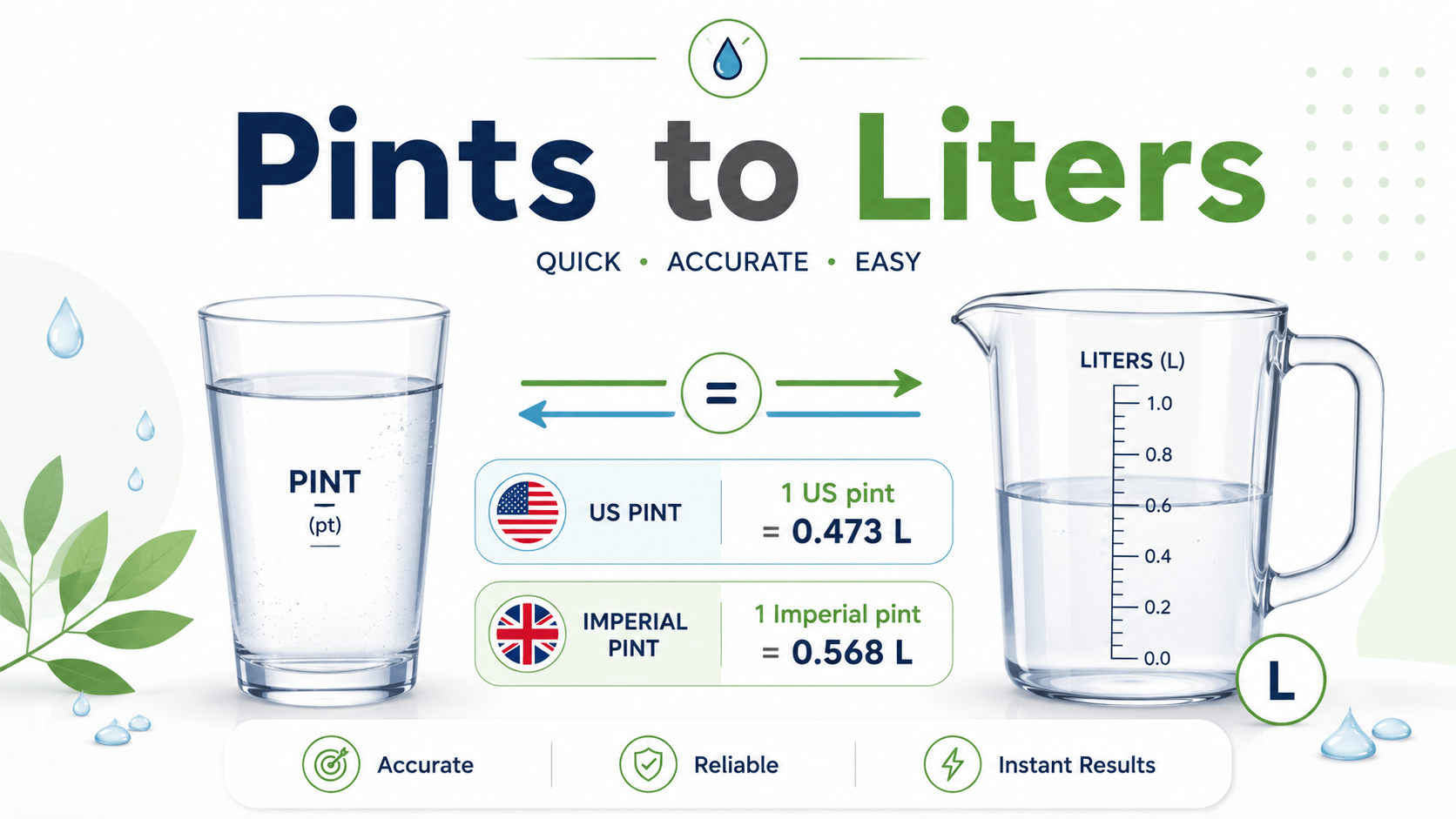
For reference, 1 US liquid pint = 0.473176473 liters, while 1 Imperial pint = 0.56826125 liters.
Use the calculator for recipes, beverages, container capacities, product specifications, or any situation where you need to convert pint measurements into liters.
Pints to Liters: The Quick Answer
If you need to convert pints to liters, the most important question is which type of pint you are using. A pint does not represent exactly the same volume in the United States and the United Kingdom.
1 US liquid pint = 0.473176473 liters
1 Imperial pint = 0.56826125 liters
For a US liquid measurement, multiply the number of pints by 0.473176473. For an Imperial measurement, multiply by 0.56826125. These values reflect the different definitions of the US and Imperial pint.
Our converter above lets you select either system, which is useful when working with recipes, beverages, product specifications, container sizes, or measurements from different countries.
What Is a Pint?
A pint is a unit of volume. However, there is no single pint size used everywhere.
In the US customary system, two liquid pints equal one liquid quart and eight liquid pints equal one gallon. NIST also distinguishes the US liquid pint from the separate dry pint, which is why identifying the type of measurement matters.
The Imperial system also divides a gallon into eight pints, but the Imperial gallon itself is larger. As a result, an Imperial pint contains more liquid than a US liquid pint.
This difference is one of the most important details to understand when converting pints to liters. Simply entering a number without knowing the pint system can produce a noticeably different result.
What Is a Liter?
The liter, symbol L, is a metric unit of volume. One liter contains 1,000 milliliters.
Liters and milliliters are widely used for liquid measurements, which makes pint-to-liter conversion especially useful when measurements from US customary or Imperial sources need to be compared with metric values.
Because both pints and liters measure volume, the conversion does not depend on the liquid being measured. A pint of water and a pint of milk occupy the same volume even though they do not necessarily have the same mass.
How to Convert Pints to Liters
The pints to liters calculation is a simple multiplication once you know which pint definition applies.
US Pints to Liters Formula
For US liquid pints, use:
liters = pints × 0.473176473
For example, to convert 5 US pints:
5 × 0.473176473 = 2.365882365 liters
Rounded to three decimal places:
5 US pints ≈ 2.366 liters
Another common example is 2 US pints:
2 × 0.473176473 = 0.946352946 liters
So 2 US pints are approximately 0.946 liters, which is slightly less than one liter.
Imperial Pints to Liters Formula
For Imperial pints, use:
liters = pints × 0.56826125
For example:
5 × 0.56826125 = 2.84130625 liters
Therefore:
5 Imperial pints ≈ 2.841 liters
This is why specifying the measurement system is important. Five US pints and five Imperial pints do not represent the same amount of liquid.
US Pint vs Imperial Pint
One of the most common mistakes when converting pints to liters is assuming that all pints are identical.
A US liquid pint contains approximately 0.473 liters, while an Imperial pint contains approximately 0.568 liters. The difference is large enough to matter in recipes, beverage measurements and other situations where accuracy is important.
If a measurement comes from a US recipe, product or source, the US liquid pint is normally the appropriate choice. If the measurement comes from the UK and specifically refers to traditional pint measurements, the Imperial pint may be appropriate.
When the source does not specify the system, check the country or context before converting.
Why Is Converting Pints to Liters Important?
Pints and liters belong to different measurement systems, so conversions are often necessary when information crosses national or industry standards.
Cooking is a common example. A recipe may specify a liquid quantity in pints while your measuring jug is marked in liters or milliliters. Accurate conversion prevents you from adding too much or too little liquid.
Beverage measurements are another common use. Pint measurements still appear in everyday language and commercial contexts, while bottles, containers and product specifications may use metric volume.
Conversions are also useful when comparing storage containers, liquid ingredients, equipment capacities or packaging specifications from different countries.
The calculation itself is easy. The more important part is selecting the correct pint.
When Should You Use a Pints to Liters Converter?
A pints to liters converter is especially useful when you are working with a measurement that needs to be interpreted quickly without manually calculating the conversion factor.
For example, you might need it when following an international recipe, comparing beverage volumes, checking container capacity, converting a product specification, preparing a shopping list, or translating a measurement for someone using the metric system.
Using a calculator is also helpful for decimal values such as 1.5, 2.75 or 6.25 pints, where mental conversion becomes less convenient.
Simply enter the quantity, choose the correct pint type, and the converter will calculate the equivalent number of liters.
Common Pint-to-Liter Conversion Mistakes
The biggest potential error is selecting the wrong pint system. A US liquid pint and an Imperial pint have different volumes, so the same numerical input can produce different answers.
Another mistake is confusing a liquid pint with the US dry pint. NIST treats dry and liquid volume measurements separately, so the dry pint should not automatically be converted using the US liquid pint factor.
It is also important not to confuse volume with mass. Pints and liters measure volume, while pounds, ounces, kilograms and grams measure mass or weight. Converting between volume and mass requires additional information such as the density of the substance.
Finally, avoid rounding too early during a calculation. NIST recommends retaining the necessary digits through the calculation and performing rounding at the end.
How Accurate Should Your Conversion Be?
The amount of precision you need depends on the purpose of the measurement.
For everyday cooking or household measurements, two or three decimal places are usually practical. For example, 3 US pints can conveniently be shown as approximately 1.420 liters.
For technical calculations or situations where the result will be used in another calculation, retaining more digits reduces cumulative rounding error.
Our calculator uses the full conversion factor internally and rounds only the displayed result.
Quick Examples
Here are several useful US liquid pint conversions:
1 pint = 0.473176473 L
2 pints = 0.946352946 L
4 pints = 1.892705892 L
5 pints = 2.365882365 L
8 pints = 3.785411784 L
Notice that eight US liquid pints equal one US liquid gallon, and NIST gives the gallon as 3.785411784 liters.
For most everyday purposes, these values can be rounded to an appropriate number of decimal places.
Pints to Liters Conversion Chart
The table below shows common values from pints to liters. Because the US and Imperial pint are different units, both results are included.
| Pints | US Liquid Pints to Liters | Imperial Pints to Liters |
|---|---|---|
| 1 | 0.473176 L | 0.568261 L |
| 10 | 4.731765 L | 5.682613 L |
| 20 | 9.463529 L | 11.365225 L |
| 30 | 14.195294 L | 17.047838 L |
| 40 | 18.927059 L | 22.730450 L |
| 50 | 23.658824 L | 28.413063 L |
| 60 | 28.390588 L | 34.095675 L |
| 70 | 33.122353 L | 39.778288 L |
| 80 | 37.854118 L | 45.460900 L |
| 90 | 42.585883 L | 51.143513 L |
| 100 | 47.317647 L | 56.826125 L |
The values in the table are rounded for readability. For calculations where greater precision is required, use the converter or the full conversion factors shown above.
Frequently Asked Questions
One US liquid pint equals 0.473176473 liters. One Imperial pint equals 0.56826125 liters. Always check which pint system your measurement uses.
Multiply the number of US liquid pints by 0.473176473. For Imperial pints, multiply the number of pints by 0.56826125.
For example, 3 US pints equal approximately 1.419529 liters.
Not exactly.
Two US liquid pints equal approximately 0.946353 liters, so they are slightly less than one liter.
Two Imperial pints equal approximately 1.136523 liters, which is more than one liter.
One liter is approximately 2.113376 US liquid pints.
Using Imperial measurements, one liter is approximately 1.759754 Imperial pints.
Four US liquid pints equal approximately 1.892706 liters.
Four Imperial pints equal approximately 2.273045 liters.
No. A US liquid pint and an Imperial pint are different volume units. The US liquid pint is approximately 0.473 liters, while the Imperial pint is approximately 0.568 liters.
The calculator allows you to choose between US liquid pints and Imperial pints, so you can use the correct conversion for your measurement.
The default setting is the US liquid pint.
No. In the US measurement system, dry and liquid pints are separate volume measures. NIST specifically distinguishes the dry pint from the liquid pint.
This converter is designed for US liquid pints and Imperial pints, not US dry pints.
No. A pint measures volume, while units such as pounds, ounces, kilograms and grams measure mass or weight.
You can convert pints directly to liters because both are volume units. Converting pints to a weight unit requires knowing the density of the substance being measured.
For normal household use, rounding to two or three decimal places is usually sufficient. For technical calculations, retain more digits and round only the final result.