Convert Celsius to Fahrenheit Instantly
Use this Celsius to Fahrenheit calculator to change any temperature from degrees Celsius (°C) into degrees Fahrenheit (°F). Enter a whole number, decimal value, zero or a negative temperature, then select Convert to see the result. For a manual calculation, multiply the Celsius value by 9/5 and add 32.
How to Convert Celsius to Fahrenheit
The exact Celsius to Fahrenheit formula is:
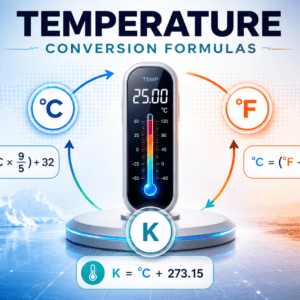
°F = (°C × 9/5) + 32
You can also write 9/5 as 1.8:
°F = (°C × 1.8) + 32
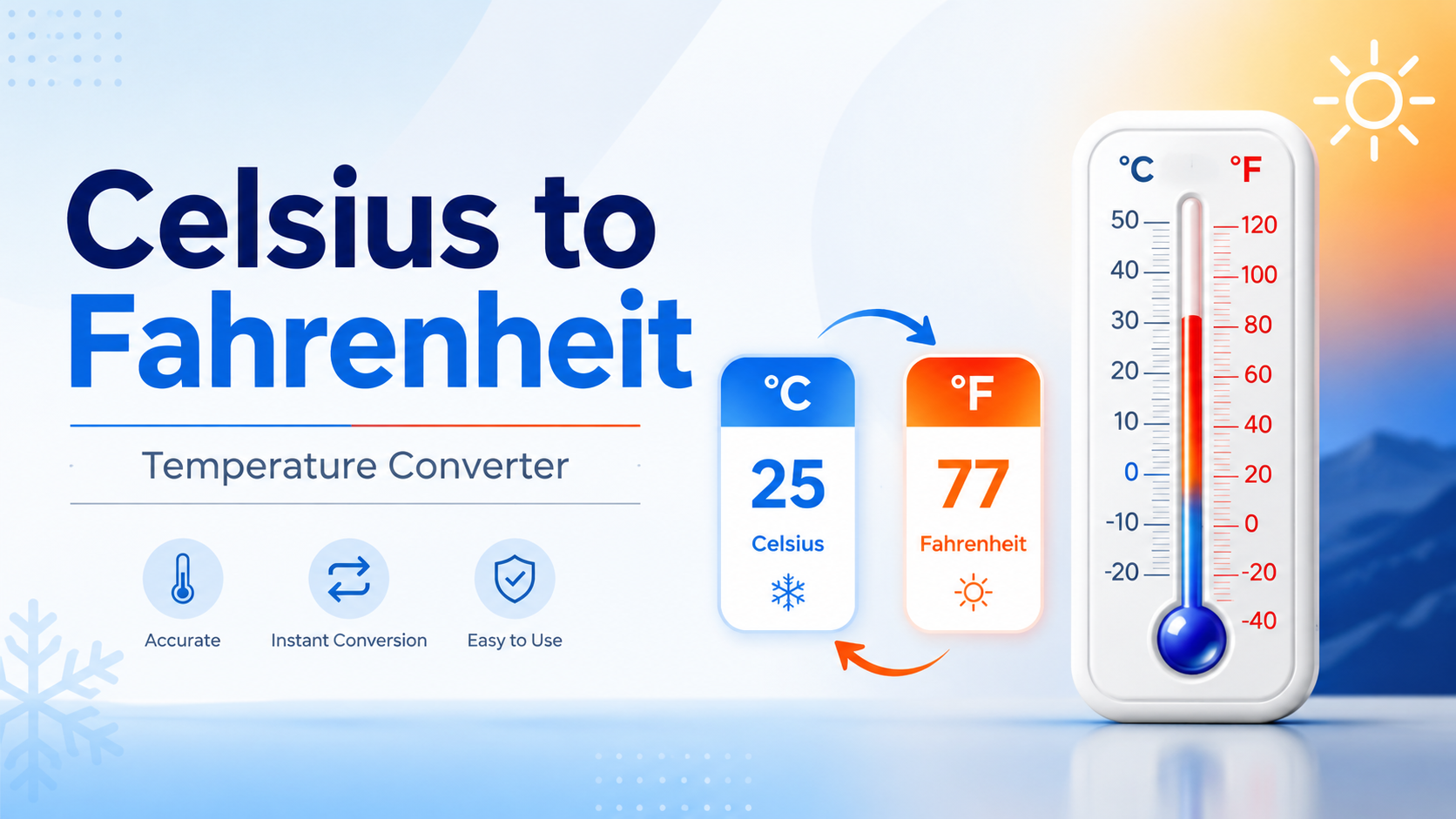
For example, to convert 25°C:
- Multiply 25 by 1.8: 25 × 1.8 = 45.
- Add 32: 45 + 32 = 77.
Therefore, 25°C equals 77°F.
The multiplication is necessary because one Celsius degree and one Fahrenheit degree are not the same size. A change of 1°C is equal to a change of 1.8°F. The addition of 32 aligns the two scales at the freezing point of water.
Why Celsius and Fahrenheit Conversion Is Important
Celsius is used as the everyday temperature scale in most countries and is also widely used in science. Fahrenheit remains the standard scale for everyday weather reporting in the United States and is used in some other locations and applications.
Because both systems remain in active use, temperature values often need to be translated before they can be understood or applied correctly. A visitor reading a U.S. weather forecast, a cook following an American recipe or a student comparing scientific data may all need a reliable Celsius to Fahrenheit conversion.
Accurate conversion is especially useful when a small temperature difference matters. An approximate result may be enough for casual weather comparisons, but cooking instructions, laboratory work and technical specifications usually require the exact formula.
Where Is Celsius to Fahrenheit Used Most Often?
Weather and international travel
Weather forecasts are one of the most common reasons to convert temperatures. A forecast of 30°C describes a hot day and equals 86°F. A winter temperature of -10°C equals 14°F.
Converting the value helps travelers choose suitable clothing, understand heat or frost warnings and compare conditions with temperatures they already know.
Cooking and oven temperatures
Many recipes published in the United States give oven settings in Fahrenheit, while ovens and recipes in Europe and many other regions use Celsius. For example, 180°C equals 356°F. In practical cooking, this may be rounded to 350°F or 355°F depending on the recipe and the oven controls.
Always follow the temperature stated by the recipe when possible. Oven calibration, fan-assisted settings and recipe rounding can affect the required setting, so a mathematical conversion does not automatically account for differences between oven types.
Body temperature and healthcare information
Body temperatures may be displayed in either scale depending on the thermometer, country or source. A commonly used reference value of 37°C equals 98.6°F, while 38°C equals 100.4°F.
Temperature alone does not provide a diagnosis, but correct conversion helps people understand measurements and instructions written in the other scale.
Education, science and technical work
Students frequently convert between the two scales in mathematics and science exercises. Temperature conversion can also appear in engineering documentation, manufacturing instructions, equipment manuals and international datasets.
In these settings, decimals and correct rounding are often important.
Key Celsius and Fahrenheit Reference Points
Several reference values make the relationship between the scales easier to remember:
- Water freezes at 0°C or 32°F under standard reference conditions.
- Water boils at 100°C or 212°F under standard atmospheric pressure.
- The two scales show the same number at -40°, so -40°C equals -40°F.
- A temperature difference of 1°C equals 1.8°F.
These reference points are useful for checking whether a result is reasonable. For example, any Celsius temperature between 0°C and 100°C should convert to a Fahrenheit value between 32°F and 212°F.
A Quick Mental Conversion
For a fast estimate, you can double the Celsius temperature and add 30:
Estimated °F ≈ (°C × 2) + 30
For 20°C, this shortcut gives 70°F, while the exact result is 68°F. For 30°C, it gives 90°F instead of the exact 86°F.
This method is convenient for casual travel or weather conversations, but it is only an approximation. Use the exact Celsius to Fahrenheit formula or the calculator when accuracy matters.
Accuracy, Decimals and Rounding
The mathematical conversion can produce a whole number or a decimal. For instance:
- 21°C = 69.8°F
- 36.5°C = 97.7°F
- -17.8°C ≈ 0°F
The calculator displays results to a practical level of precision and removes unnecessary trailing zeros.
When using a converted value in a recipe, report, experiment or technical document, round it only to the precision that the original measurement supports. A Celsius measurement given to the nearest whole degree should not normally be presented as an excessively precise Fahrenheit measurement.
Celsius to Fahrenheit Conversion Table
The following chart provides frequently needed values from 1°C to 100°C.
| Celsius (°C) | Fahrenheit (°F) |
|---|---|
| 1°C | 33.8°F |
| 10°C | 50°F |
| 20°C | 68°F |
| 30°C | 86°F |
| 40°C | 104°F |
| 50°C | 122°F |
| 60°C | 140°F |
| 70°C | 158°F |
| 80°C | 176°F |
| 90°C | 194°F |
| 100°C | 212°F |
Multiply the temperature in Celsius by 9/5, then add 32. The formula is:
°F = (°C × 9/5) + 32
0°C equals 32°F. This is the freezing point of water under standard reference conditions.
100°C equals 212°F. This is the boiling point of water at standard atmospheric pressure.
The two scales are equal at -40 degrees. Therefore:
-40°C = -40°F
Use the exact formula by multiplying the Celsius value by 1.8 and adding 32. For a rough mental estimate, double the Celsius value and add 30.
Yes. The Celsius scale includes negative temperatures. The calculator accepts values below zero, such as -10°C, which equals 14°F.
No. Fahrenheit has a higher numerical value than Celsius for temperatures above -40 degrees. Below -40 degrees, the Fahrenheit number is lower. At -40 degrees, the values are identical.