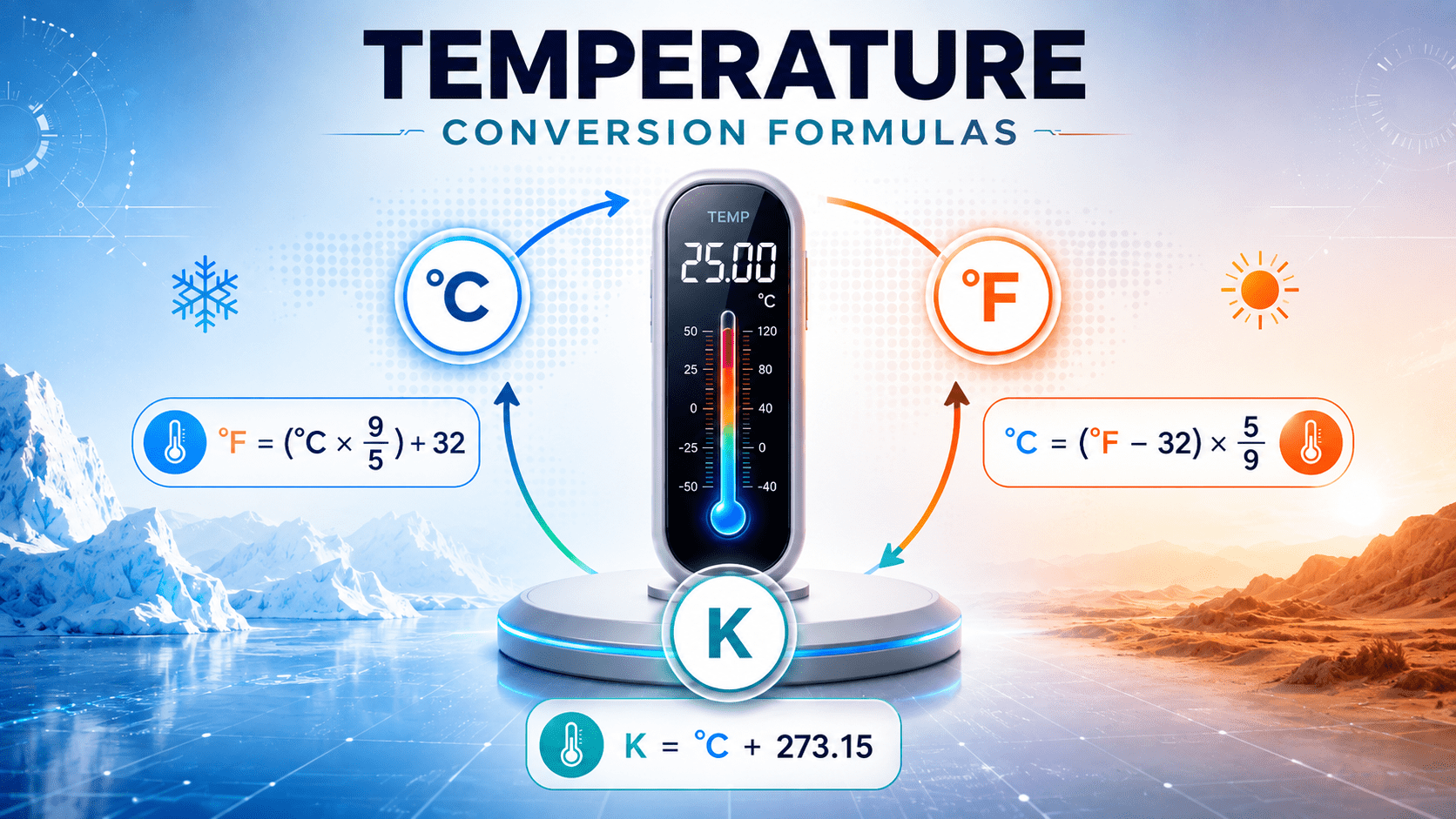
A temperature conversion formula changes a value from one temperature scale to another. For the three most widely used scales, the essential equations are:
| Convert from | Convert to | Formula |
|---|---|---|
| Celsius | Fahrenheit | °F = (°C × 9/5) + 32 |
| Fahrenheit | Celsius | °C = (°F − 32) × 5/9 |
| Celsius | Kelvin | K = °C + 273.15 |
| Kelvin | Celsius | °C = K − 273.15 |
| Fahrenheit | Kelvin | K = (°F − 32) × 5/9 + 273.15 |
| Kelvin | Fahrenheit | °F = (K − 273.15) × 9/5 + 32 |
These equations provide exact mathematical conversions. Therefore, they are suitable for weather readings, cooking references, laboratory work, school problems, and everyday comparisons. The formulas have also been checked against educational and official measurement references.
How Does a Temperature Conversion Formula Work?
Celsius, Fahrenheit, and Kelvin do not all begin at the same zero point. In addition, a Fahrenheit degree is smaller than a Celsius degree or a kelvin. As a result, some conversions require both multiplication and an offset.
Celsius and Kelvin use equal-sized intervals. However, their zero points differ by 273.15. Fahrenheit uses a different interval size and a different starting point. Consequently, converting Fahrenheit requires an additional factor of 9/5 or 5/9.
The order of operations matters. First, complete the calculation inside parentheses. Next, multiply or divide. Finally, add the required offset.
Celsius to Fahrenheit Formula
Use this temperature conversion formula to change Celsius into Fahrenheit:
°F = (°C × 9/5) + 32
For example, convert 25°C to Fahrenheit:
- Multiply 25 by 9/5: 25 × 9/5 = 45.
- Add 32: 45 + 32 = 77.
- Therefore, 25°C = 77°F.
You can also multiply the Celsius value by 1.8 and then add 32.
Fahrenheit to Celsius Formula
To convert Fahrenheit into Celsius, reverse the process:
°C = (°F − 32) × 5/9
For example, convert 86°F to Celsius:
- Subtract 32: 86 − 32 = 54.
- Multiply by 5/9: 54 × 5/9 = 30.
- Consequently, 86°F = 30°C.
Subtracting 32 must come first. Otherwise, the result will be incorrect.
Celsius and Kelvin Conversion Formulas
The Celsius and Kelvin scales have the same interval size. Therefore, conversion between them only requires adding or subtracting 273.15.
Celsius to Kelvin
Use the following equation:
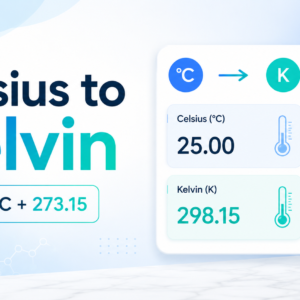
K = °C + 273.15
For example:
20°C + 273.15 = 293.15 K
Thus, 20°C = 293.15 K.
Kelvin to Celsius
Use the reverse equation:
°C = K − 273.15
For example:
310.15 K − 273.15 = 37°C
Therefore, 310.15 K = 37°C.
Kelvin is written with the symbol K, not °K. Unlike Celsius and Fahrenheit, the unit name does not use the word “degree.” The kelvin is the SI unit of thermodynamic temperature, while one kelvin has the same interval size as one degree Celsius.
Fahrenheit and Kelvin Conversion Formulas
Fahrenheit and Kelvin differ in both interval size and zero point. Although you can convert through Celsius, a direct equation is usually faster.
Fahrenheit to Kelvin
The direct temperature conversion formula is:
K = (°F − 32) × 5/9 + 273.15
For example, convert 68°F to kelvins:
- Subtract 32: 68 − 32 = 36.
- Multiply by 5/9: 36 × 5/9 = 20.
- Add 273.15: 20 + 273.15 = 293.15.
- Therefore, 68°F = 293.15 K.
Kelvin to Fahrenheit
Use this equation:
°F = (K − 273.15) × 9/5 + 32
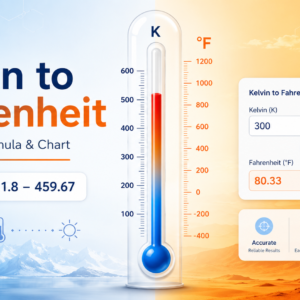
For example, convert 300 K to Fahrenheit:
- Subtract 273.15: 300 − 273.15 = 26.85.
- Multiply by 9/5: 26.85 × 9/5 = 48.33.
- Add 32: 48.33 + 32 = 80.33.
- Consequently, 300 K = 80.33°F.
How to Choose the Correct Formula
First, identify the unit you already have. Next, decide which unit you need. Then, select the row in the formula table that matches that direction.
For instance, a value in Fahrenheit that must become Kelvin needs the Fahrenheit-to-Kelvin equation. Reversing the formula will not produce the correct answer.
After calculating, label the result with the correct symbol. Finally, use an appropriate number of decimal places. Everyday weather values may only need one decimal place, while scientific work may require greater precision.
Temperature Values and Temperature Differences Are Not Converted the Same Way
A common mistake is using a full temperature conversion formula for a temperature change. The +32 and −32 offsets apply to actual scale readings, not to differences between two readings.
For temperature intervals:
- A change of 1°C equals a change of 1 K.
- A change of 1°C equals a change of 1.8°F.
- A change of 1°F equals a change of 5/9°C.
For example, an increase from 20°C to 30°C is a change of 10°C. That change equals 18°F, not 50°F. The offset is omitted because only the size of the interval is being converted.
Official SI guidance also distinguishes absolute temperature values from temperature intervals. In particular, Celsius and kelvin intervals have the same numerical size, although their scale readings have different zero points.
Useful Temperature Reference Points
The following values make it easier to check whether a result is reasonable:
| Reference point | Celsius | Fahrenheit | Kelvin |
|---|---|---|---|
| Absolute zero | −273.15°C | −459.67°F | 0 K |
| Water freezes | 0°C | 32°F | 273.15 K |
| Celsius and Fahrenheit are equal | −40°C | −40°F | 233.15 K |
| Water boils at standard atmospheric pressure | 100°C | 212°F | 373.15 K |
For example, a converted freezing-point value should be close to 0°C, 32°F, or 273.15 K. If it is not, review the formula and the order of operations.
Quick Mental Estimates
Exact formulas are best when accuracy matters. However, a simple estimate can help with everyday weather temperatures.
To estimate Celsius in Fahrenheit:
Approximate °F = (°C × 2) + 30
For example, 20°C is approximately 70°F. The exact result is 68°F.
To estimate Fahrenheit in Celsius:
Approximate °C = (°F − 30) ÷ 2
For example, 70°F is approximately 20°C. The exact result is about 21.1°C.
These shortcuts are convenient, although they should not replace the exact temperature conversion formula in scientific, technical, or safety-related calculations.
Common Temperature Conversion Mistakes
Applying the Steps in the Wrong Order
When converting Fahrenheit to Celsius, subtract 32 before multiplying by 5/9. Similarly, when converting Celsius to Fahrenheit, multiply first and add 32 afterward.
Using 273 Instead of 273.15
Using 273 may be acceptable for a rough classroom estimate. Nevertheless, 273.15 is the correct offset for accurate Celsius–Kelvin conversions.
Writing Degrees Kelvin
The correct notation is K, not °K. By contrast, Celsius and Fahrenheit use °C and °F.
Rounding Too Early
Keep extra decimal places during the calculation. Then, round the final value. Early rounding can create a larger error, especially in multi-step conversions.
Converting an Interval as an Absolute Value
A temperature difference does not use the 32-degree offset. Therefore, convert the interval using only the scale factor.
Why Use a Temperature Converter?
Manual equations show how the scales are related. Moreover, they are useful when you need to show your work. An online converter is faster when you have several values or need an immediate result.
For the best experience, use the calculator for speed and this guide for verification. Together, they reduce mistakes and make each temperature conversion formula easier to understand.
Final Summary
Choosing the correct equation depends on the starting unit and the required unit. Celsius and Kelvin differ only by 273.15, while Fahrenheit conversions also require a scale factor. Therefore, check the direction, follow the correct order, and round only at the end. With these steps, every temperature conversion formula becomes straightforward and reliable.
There is no single equation for every direction. The most common formulas are °F = (°C × 9/5) + 32 and °C = (°F − 32) × 5/9. Kelvin conversions use an offset of 273.15.
Multiply the Celsius value by 9/5, and then add 32. For example, 10°C becomes 50°F.
Subtract 32 from the Fahrenheit value. Next, multiply the result by 5/9. For example, 95°F becomes 35°C.
Add 273.15 to the Celsius value. Therefore, 0°C equals 273.15 K.
The Celsius and Kelvin scales use equal-sized intervals, but their zero points are separated by exactly 273.15 units. Consequently, Celsius values become kelvins by adding 273.15.
No. Write kelvin values as K, such as 300 K. The forms °C and °F are correct for Celsius and Fahrenheit.
The two scales show the same numerical value at −40. Therefore, −40°C equals −40°F.
A shortcut is useful for quick estimates. However, use the exact temperature conversion formula whenever precision is important.