Fahrenheit to Kelvin Converter: Formula, Examples and Chart

fahrenheit to kelvin

Convert Fahrenheit to Kelvin Instantly

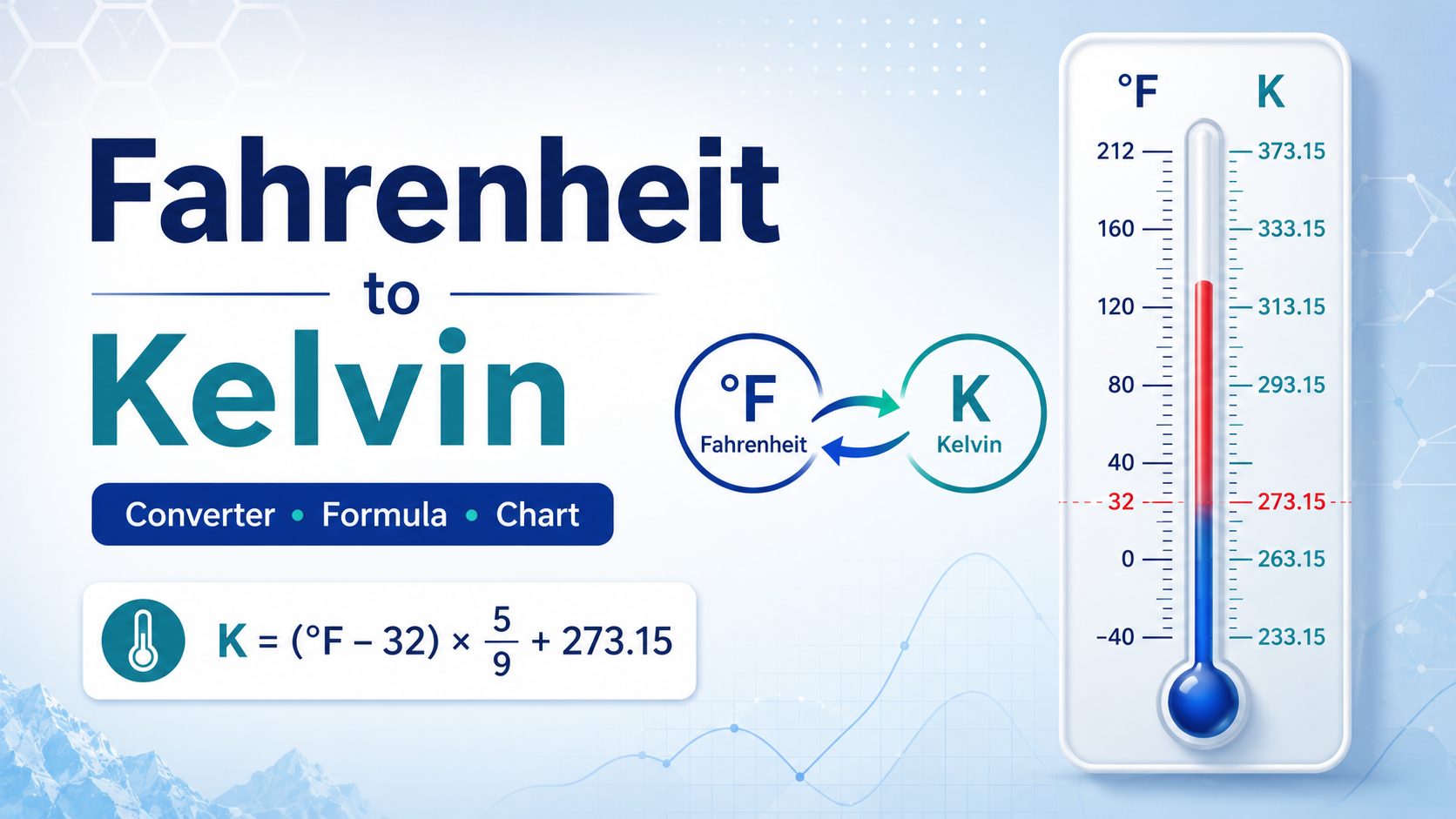
Enter a temperature in Fahrenheit below and select Convert °F to K to receive an immediate Kelvin result. The calculator uses the accurate formula K = (°F − 32) × 5/9 + 273.15 and accepts whole numbers, decimals, zero, and negative Fahrenheit temperatures down to absolute zero.

Convert Fahrenheit to Kelvin

°F

Fahrenheit to Kelvin Converter: Formula and Examples

Converting Fahrenheit to Kelvin is necessary when a temperature is provided in Fahrenheit but must be expressed on an absolute scientific scale. Although both units measure temperature, they use different zero points and different interval sizes. Therefore, a Fahrenheit value cannot be converted to Kelvin by simply adding a fixed number.

Instead, you must first convert the Fahrenheit value to its Celsius equivalent. Afterward, you can shift the result to the Kelvin scale by adding 273.15.

Fahrenheit to Kelvin formula:

K = (°F − 32) × 5/9 + 273.15

For example, 68°F equals 293.15 K. While you can calculate this value manually, the calculator above provides the result instantly and reduces the risk of arithmetic errors.

How to Convert Fahrenheit to Kelvin

The Fahrenheit to Kelvin conversion requires three mathematical steps. However, the process is straightforward when you follow the correct order of operations.

First, subtract 32 from the Fahrenheit temperature. Next, multiply the result by 5/9. Finally, add 273.15 to obtain the temperature in Kelvin.

In other words, the calculation first converts Fahrenheit to Celsius and then converts Celsius to Kelvin. Therefore, each part of the formula has a specific purpose.

Worked Example: Convert 68°F to Kelvin

Begin with the standard conversion formula:

K = (°F − 32) × 5/9 + 273.15

Next, insert 68°F into the formula:

K = (68 − 32) × 5/9 + 273.15

First, subtract 32 from 68:

K = 36 × 5/9 + 273.15

Afterward, multiply 36 by 5/9:

K = 20 + 273.15

Finally, add 273.15:

K = 293.15

Therefore:

68°F = 293.15 K

Consequently, a common indoor temperature of 68°F corresponds to 293.15 kelvins.

Why Is Fahrenheit to Kelvin Conversion Important?

Fahrenheit and Kelvin are designed for different purposes. While Fahrenheit is commonly used for everyday temperature readings in the United States, Kelvin is mainly used in science, engineering, and technical calculations.

As a result, a Fahrenheit to Kelvin conversion is often necessary when an American temperature source must be compared with scientific or international data. For instance, a weather report, machine specification, laboratory record, or historical document may provide a value in Fahrenheit. However, the related equation or dataset may require Kelvin.

Moreover, Kelvin is an absolute temperature scale. Its starting point, 0 K, represents absolute zero, which is the theoretical lowest possible temperature. Therefore, Kelvin is especially useful in calculations involving thermal energy, gas pressure, radiation, and thermodynamics.

Accurate unit conversion also helps prevent significant mistakes. For example, inserting a Fahrenheit value directly into an equation that requires Kelvin can produce an incorrect result. Consequently, the temperature should always be converted before further scientific calculations are performed.

In addition, using a standard unit makes it easier to compare measurements from different sources. Although two laboratories may collect similar data, one may use Fahrenheit while the other uses Kelvin. By converting the values, researchers can analyse the results consistently.

Where Is Fahrenheit to Kelvin Conversion Used?

Scientific Research and Laboratory Work

Scientists frequently use Kelvin because it is the SI base unit of thermodynamic temperature. However, some instruments, older documents, or imported datasets may still provide readings in Fahrenheit.

In these situations, researchers must convert the original values before using them in formulas or scientific reports. Otherwise, the different temperature scales could lead to inaccurate conclusions.

Furthermore, many equations involving gases require absolute temperature. Therefore, a value given in Fahrenheit must first be converted to Kelvin before it can be used correctly.

Engineering and Manufacturing

Engineering projects often combine equipment and technical documentation from several countries. While an American manufacturer may list operating temperatures in Fahrenheit, an international engineering calculation may require Kelvin.

Therefore, conversion is important when comparing material limits, machine tolerances, heating systems, or cooling requirements. In addition, consistent units make technical documentation easier to understand and reduce the risk of communication errors.

For example, an industrial component may be rated for a maximum temperature in Fahrenheit. However, simulation software may require the same value in Kelvin. As a result, engineers must complete the conversion before entering the data.

Meteorology and Climate Analysis

Public weather forecasts in the United States usually display Fahrenheit. Scientific weather models, on the other hand, commonly process temperature data in Celsius or Kelvin.

Consequently, meteorologists may need to convert Fahrenheit observations before combining them with atmospheric datasets. Similarly, climate researchers may convert older Fahrenheit records to ensure that all measurements use a consistent scale.

Moreover, satellite data and atmospheric models often rely on Kelvin because it works well in scientific equations. Therefore, converting public-facing Fahrenheit values is sometimes necessary for further analysis.

Physics and Chemistry Education

Students commonly encounter Fahrenheit to Kelvin problems in physics, chemistry, and general science courses. Although the calculation itself is useful, it also demonstrates the difference between relative and absolute temperature scales.

For instance, Fahrenheit uses familiar reference points for weather and everyday life. Kelvin, however, begins at absolute zero. Therefore, the conversion helps students understand why scientific equations often require an absolute temperature.

In addition, working through the formula reinforces the correct order of mathematical operations. As a result, these exercises support both scientific understanding and calculation skills.

Software and Data Processing

Modern applications may receive temperature data from several sensors, devices, or online services. For example, one source may report Fahrenheit, while another system stores all temperature values in Kelvin.

Therefore, developers often convert every reading into a standard unit before comparing or processing the data. By doing so, they can prevent errors and simplify later calculations.

Moreover, automated conversion is important in weather applications, scientific databases, smart-home systems, and industrial monitoring software. Although users may see Fahrenheit on the screen, the program may store or process the underlying value in Kelvin.

Understanding the Fahrenheit and Kelvin Scales

The Fahrenheit scale places the freezing point of water at 32°F and the boiling point of water at 212°F under standard atmospheric pressure. Therefore, there are 180 Fahrenheit degrees between these two reference points.

Kelvin uses the same interval size as Celsius. However, its zero point is located at absolute zero rather than at the freezing point of water.

For example, the freezing point of water is 273.15 K. Meanwhile, the boiling point of water is 373.15 K under standard atmospheric pressure.

Absolute zero is exactly 0 K, which equals approximately −459.67°F. Consequently, valid Kelvin temperatures cannot fall below zero.

Another important difference concerns notation. Kelvin is written without a degree symbol. Therefore, the correct form is 293.15 K, not 293.15°K.

Although this difference may appear small, correct unit notation is important in scientific and technical writing. Moreover, it helps distinguish Kelvin from temperature scales that use the degree symbol.

When Do You Need a Fahrenheit to Kelvin Calculator?

A calculator is particularly useful when you need a quick answer or must convert several values. Although the formula is manageable, repeated manual calculations can increase the risk of mistakes.

For example, you may need the converter for laboratory measurements, engineering specifications, scientific homework, weather datasets, programming projects, or equipment documentation. In each case, the calculator saves time and provides a consistent result.

Furthermore, the calculator accepts whole numbers, decimals, zero, and negative Fahrenheit values. This is important because temperatures below 0°F are still valid and can be converted normally.

However, the entered value must not be lower than absolute zero. Since −459.67°F is equal to 0 K, any Fahrenheit temperature below that point would produce an invalid negative Kelvin value.

In addition, an online converter is helpful when the final answer must be rounded consistently. While scientific work may require several decimal places, everyday conversions often use two decimal places.

Common Fahrenheit to Kelvin Conversion Mistakes

One common mistake is adding 273.15 directly to the Fahrenheit value. However, this method is incorrect because 273.15 can only be added after the temperature has been converted to Celsius.

For example, adding 273.15 directly to 68°F would produce 341.15, which is not the correct Kelvin result. Instead, 68°F must first be converted to 20°C. Afterward, adding 273.15 gives the correct result of 293.15 K.

Another frequent error involves ignoring the parentheses in the formula. Because subtraction must happen before multiplication, the order of operations is essential.

Correct formula:

K = (°F − 32) × 5/9 + 273.15

By contrast, calculating 32 × 5/9 before subtracting it from the Fahrenheit value produces an incorrect answer. Therefore, always complete the calculation inside the parentheses first.

Rounding too early can also reduce accuracy. For instance, intermediate results may contain repeating decimals. Consequently, it is better to keep the full value throughout the calculation and round only the final answer.

In addition, some users incorrectly assume that a negative Fahrenheit temperature must produce a negative Kelvin value. However, −40°F equals 233.15 K, which is still well above absolute zero.

Finally, remember that Kelvin does not use a degree symbol. Although “degrees Kelvin” was used historically, modern scientific notation uses only the unit name kelvin and the symbol K. Therefore, write 250 K instead of 250°K.

Fahrenheit to Kelvin Conversion Table

The following Fahrenheit to Kelvin chart is rounded to two decimal places.

Fahrenheit (°F) Kelvin (K)
1°F 255.93 K
10°F 260.93 K
20°F 266.48 K
30°F 272.04 K
40°F 277.59 K
50°F 283.15 K
60°F 288.71 K
70°F 294.26 K
80°F 299.82 K
90°F 305.37 K
100°F 310.93 K
What is the formula for Fahrenheit to Kelvin?

Use K = (°F − 32) × 5/9 + 273.15. Subtract 32, multiply by 5/9, and add 273.15.

What is 0°F in Kelvin?

0°F is approximately 255.37 K.

What is 32°F in Kelvin?

32°F is exactly 273.15 K.

What is 100°F in Kelvin?

100°F is approximately 310.93 K.

Does Kelvin use a degree symbol?

No. Kelvin is written with the unit symbol K, without a degree symbol.

Are Kelvin degrees the same size as Celsius degrees?

Yes. A temperature change of 1 K is equal in size to a temperature change of 1°C. The scales differ only in their zero points.

Can negative Fahrenheit values be converted to Kelvin?

Yes. Negative Fahrenheit values can still produce positive Kelvin temperatures. The practical lower limit is absolute zero, approximately −459.67°F or 0 K.

Why is Kelvin used in science?

Why is Kelvin used in science?
Kelvin begins at absolute zero, so it works directly in equations involving thermodynamic temperature, gases, energy, and radiation. It is also the SI base unit for thermodynamic temperature.