Convert Kelvin to Fahrenheit Instantly
Need a fast and accurate temperature conversion? Enter any Kelvin value of 0 or higher into the calculator below. The tool applies the exact kelvin to fahrenheit formula and displays the result in degrees Fahrenheit to two decimal places.
Whether you are working with scientific data, engineering specifications, astronomy measurements, or educational material, the calculator gives you an immediate answer without manual arithmetic.
Kelvin to Fahrenheit Converter
Use this kelvin to fahrenheit guide to convert any temperature quickly and accurately. Enter a Kelvin value in the calculator above for an instant result, or use the formula and examples below when you need to understand the calculation. The conversion is especially useful when scientific data recorded in kelvins must be compared with weather, engineering, or everyday temperature information expressed in degrees Fahrenheit.
Quick answer: Multiply the Kelvin temperature by 1.8, then subtract 459.67.
How to Convert Kelvin to Fahrenheit
The kelvin to fahrenheit formula is:
°F = (K − 273.15) × 9/5 + 32
You can also use the simplified version:
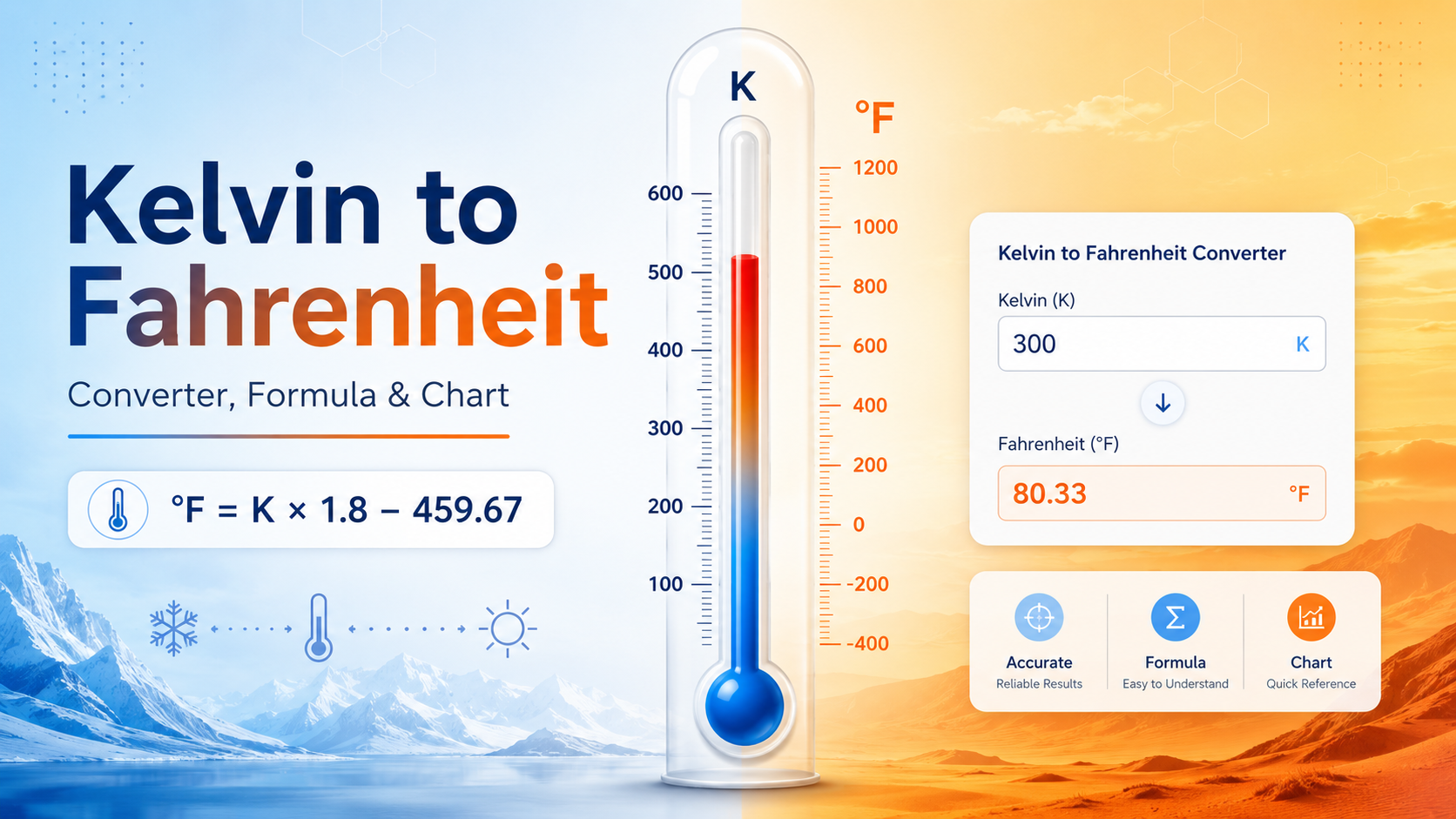
°F = K × 1.8 − 459.67
Both formulas produce the same result. First, the longer version converts Kelvin to Celsius by subtracting 273.15. Next, it converts Celsius to Fahrenheit by multiplying by 9/5 and adding 32. The simplified equation combines those operations into one step. NIST lists the exact conversion from Kelvin to Fahrenheit as (K − 273.15) × 1.8 + 32.
For example, convert 300 K as follows:
300 × 1.8 − 459.67 = 80.33°F
Therefore, 300 K equals 80.33°F.
Worked Conversion Examples
Example 1: Convert 273.15 K to Fahrenheit
273.15 × 1.8 − 459.67 = 32°F
Consequently, 273.15 K is equal to 32°F, which is the freezing point of water on the standard temperature scale.
Second example: Convert 310.15 K to Fahrenheit
310.15 × 1.8 − 459.67 = 98.6°F
Thus, 310.15 K equals 98.6°F.
Third example: Convert 373.15 K to Fahrenheit
373.15 × 1.8 − 459.67 = 212°F
At standard atmospheric pressure, 373.15 K corresponds approximately to the boiling point of water, or 212°F.
Why Is Kelvin to Fahrenheit Conversion Important?
Kelvin and Fahrenheit serve different purposes. As the SI unit of thermodynamic temperature, Kelvin is widely used in scientific measurement and technical calculations. Fahrenheit, however, remains familiar in everyday American contexts, including weather reports, household temperature settings, and cooking.
As a result, a conversion may be necessary when scientific measurements need to be communicated to a general audience. It is also useful when laboratory data, equipment specifications, astronomy records, or engineering documents use Kelvin while a reader or device expects Fahrenheit.
Because the two scales have different zero points and interval sizes, you cannot convert them accurately by adding or subtracting a single number. Instead, the calculation must include both multiplication and subtraction.
Where Are Kelvin and Fahrenheit Used Most Often?
Kelvin is commonly used in physics, chemistry, astronomy, thermodynamics, materials science, and engineering. Scientists prefer it for many calculations because the scale begins at absolute zero. NASA also identifies Kelvin as a scale frequently used in sciences such as astronomy.
In addition, temperature differences expressed in kelvins correspond directly to Celsius-sized intervals, even though the two scales begin at different points. A temperature interval of 1 K is equal in size to an interval of 1°C.
Fahrenheit is most frequently encountered in the United States and in related everyday applications. For example, American weather reports commonly provide outdoor temperatures in degrees Fahrenheit, while many ovens and cooking instructions use the same scale. Some industrial systems and technical manuals also retain Fahrenheit-based measurements.
Therefore, the need to convert kelvin to fahrenheit often appears when information moves between scientific and everyday settings.
When Do You Need This Conversion?
You may need this calculation when:
- reading a scientific paper that lists temperature in kelvins;
- comparing laboratory results with a Fahrenheit-based instrument;
- converting astronomy or space-science data;
- checking an engineering specification for a U.S. audience;
- translating educational material between measurement systems;
- interpreting a product datasheet or technical manual.
Although online calculators provide the fastest answer, knowing the formula helps you verify the result. Moreover, it makes unusual values easier to understand, especially when the Fahrenheit result is far below zero.
Understanding the Kelvin Scale
The Kelvin scale is an absolute temperature scale. Its zero point, 0 K, represents absolute zero, the lower limit of the standard thermodynamic temperature scale. Accordingly, 0 K equals −459.67°F.
Kelvin values are written with the symbol K and without a degree sign. For instance, the correct notation is 300 K, not 300°K. The Bureau International des Poids et Mesures identifies the kelvin, symbol K, as the SI base unit of thermodynamic temperature.
A change of one kelvin has the same magnitude as a change of one degree Celsius; however, the two scales begin at different points. Negative Kelvin values are not valid on the ordinary thermodynamic scale used by this calculator. For that reason, the input field accepts zero and positive values only.
Understanding the Fahrenheit Scale
The Fahrenheit scale uses the symbol °F. Water freezes at 32°F and boils at approximately 212°F under standard reference conditions, creating 180 Fahrenheit degrees between those familiar points.
Unlike Kelvin, Fahrenheit is not an absolute scale. Its zero point does not represent absolute zero. Consequently, low Kelvin temperatures convert to large negative Fahrenheit values.
Accuracy, Decimal Places, and Rounding
The calculator uses the exact relationship between the temperature scales and displays the result to two decimal places. For most everyday comparisons, two decimals provide more precision than necessary. However, scientific work may require retaining additional digits until the final calculation is complete.
When calculating manually, avoid rounding the Kelvin value before applying the formula. Instead, use the full input value and round only the final Fahrenheit result. This approach reduces cumulative rounding error.
Kelvin to Fahrenheit Conversion Table
The following kelvin to fahrenheit chart converts selected values from 1 K to 100 K. Because these temperatures are close to absolute zero, every Fahrenheit result is negative.
| Kelvin | Fahrenheit |
|---|---|
| 1 K | −457.87°F |
| 10 K | −441.67°F |
| 20 K | −423.67°F |
| 30 K | −405.67°F |
| 40 K | −387.67°F |
| 50 K | −369.67°F |
| 60 K | −351.67°F |
| 70 K | −333.67°F |
| 80 K | −315.67°F |
| 90 K | −297.67°F |
| 100 K | −279.67°F |
Multiply the Kelvin value by 1.8 and subtract 459.67. For example:
300 K × 1.8 − 459.67 = 80.33°F
Absolute zero, or 0 K, is equal to −459.67°F.
Not exactly. A temperature of 273 K equals approximately 31.73°F, while 273.15 K equals exactly 32°F according to the standard conversion relationship
No. Write Kelvin temperatures as 300 K rather than 300°K. In contrast, Fahrenheit uses the degree symbol, as in 80°F.
Not on the standard thermodynamic scale used for ordinary temperature conversion. The lowest value accepted by this calculator is 0 K.
The scales begin at different zero points. Since 0 K equals −459.67°F, many Kelvin values below typical room temperature correspond to negative Fahrenheit temperatures.
The calculator applies the exact kelvin to fahrenheit equation and rounds the displayed answer to two decimal places. Therefore, it is suitable for everyday, educational, and general technical conversions.