Convert Milliliters to Fluid Ounces Instantly
Need a quick milliliters to fluid ounces conversion? Enter the volume in milliliters below and the calculator will instantly convert it to US fluid ounces (US fl oz).
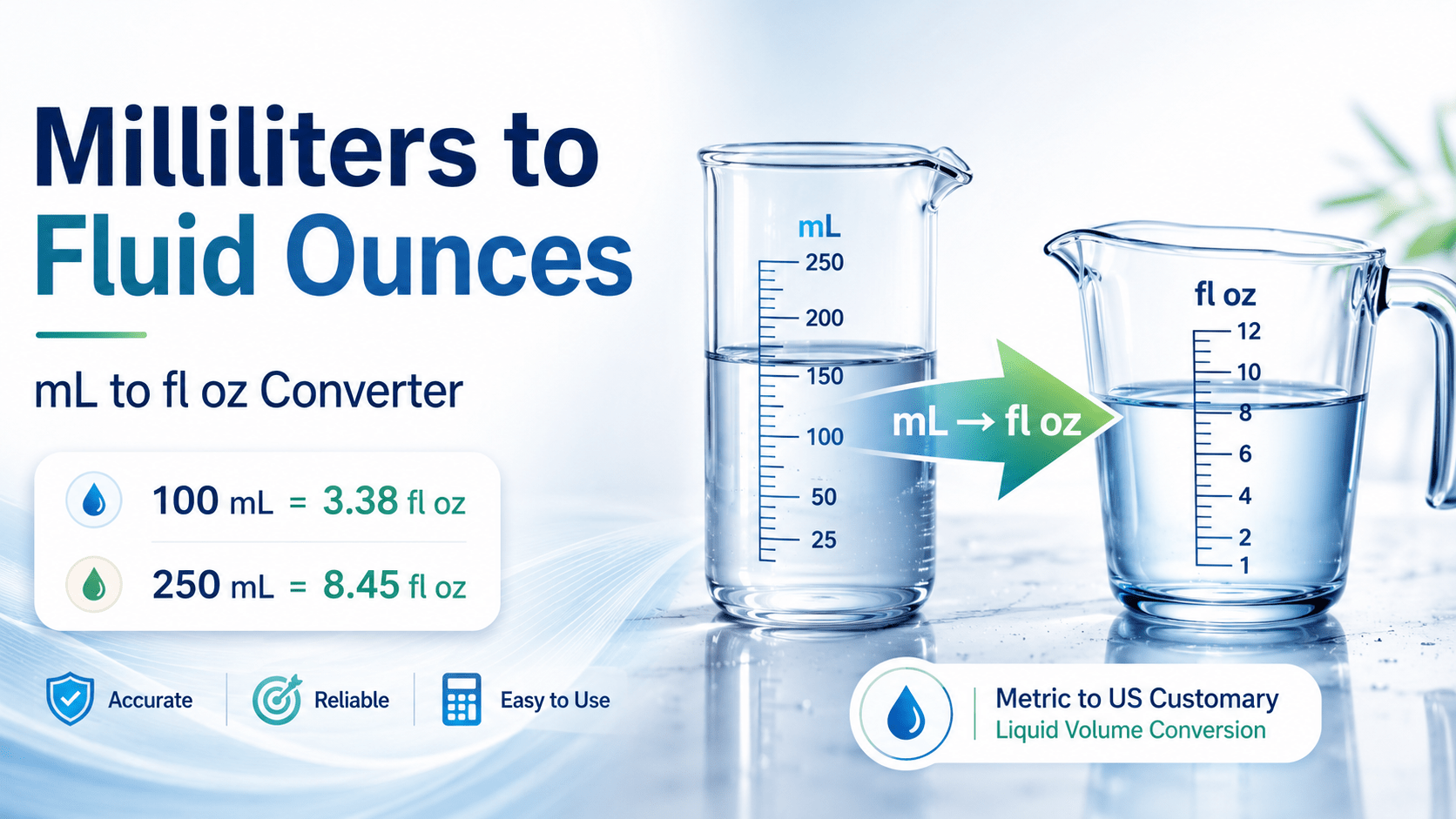
The calculator uses the standard conversion 1 US fluid ounce = 29.57353 milliliters. Therefore, simply enter your mL value and select Convert mL to fl oz to get the result. For example, 100 mL is approximately 3.3814 US fl oz.
Important: US fluid ounces and UK Imperial fluid ounces are not the same. This calculator uses US fluid ounces, which are most commonly intended in US recipes, product measurements, and beverage quantities.
Converting milliliters to fluid ounces is useful whenever you need to compare metric volume measurements with US customary units. The basic conversion is simple: 1 milliliter equals approximately 0.033814 US fluid ounces. Therefore, 100 mL equals approximately 3.3814 US fl oz.
Use the calculator above when you need a fast result. Simply enter the volume in milliliters, and it will convert the amount to US fluid ounces automatically.
One detail is especially important, however: US fluid ounces and Imperial fluid ounces are different units. Unless otherwise stated, the calculations and conversion chart on this page use US fluid ounces.
How to Convert Milliliters to Fluid Ounces
To convert milliliters to fluid ounces, divide the number of milliliters by 29.57353.
The formula is:
US fluid ounces = milliliters ÷ 29.57353
Alternatively, you can multiply by approximately 0.033814:
US fluid ounces = milliliters × 0.033814
NIST conversion tables give one US fluid ounce as approximately 29.57353 milliliters.
For example, suppose you want to convert 250 mL to fluid ounces:
250 ÷ 29.57353 = 8.4535 US fl oz
Therefore:
250 mL ≈ 8.454 US fl oz.
For most everyday uses, rounding the result to two or three decimal places provides a practical answer.
What Is a Milliliter?
A milliliter, abbreviated mL, is a metric unit of volume. It is equal to one-thousandth of a liter:
1,000 mL = 1 liter
Milliliters are especially convenient for measuring relatively small volumes. As a result, you will frequently see mL on beverage containers, food packaging, measuring cups, cosmetics, toiletries, and recipes.
Because the metric system is widely used internationally, milliliters commonly appear on products and recipes outside the United States.
What Is a Fluid Ounce?
A fluid ounce is a unit used to measure volume, not weight. The abbreviation is usually fl oz.
This distinction matters because an ordinary ounce (oz) usually describes mass or weight, while a fluid ounce (fl oz) describes volume.
Therefore, converting mL to fl oz is a volume conversion. It does not depend on whether the liquid is water, milk, juice, oil, or another substance.
If you are converting ounces by weight instead, you need a different calculation because the density of the substance becomes relevant.
US Fluid Ounces vs Imperial Fluid Ounces
One of the most important details in any milliliters to fluid ounces conversion is identifying which fluid ounce you need.
A US fluid ounce is approximately:
1 US fl oz = 29.57353 mL.
An Imperial fluid ounce, historically used in the UK system, is:
1 Imperial fl oz = 28.4130625 mL.
Consequently, the two units produce slightly different answers.
For example:
100 mL ≈ 3.3814 US fl oz
but:
100 mL ≈ 3.5195 Imperial fl oz.
Therefore, always check whether a recipe, measuring container, or product specification refers to US fl oz or Imperial fl oz.
The calculator on this page uses US fluid ounces.
Why Is Converting Milliliters to Fluid Ounces Important?
Volume measurement systems vary between countries. Consequently, a recipe, product label, or container may use a different unit from the one you normally use.
Being able to convert milliliters to fluid ounces makes these measurements easier to understand and compare.
Cooking and baking
Recipes are one of the most common situations where mL-to-fl-oz conversions are useful.
For example, a recipe written using metric measurements may list liquids in milliliters. However, a US measuring cup or kitchen container may display fluid ounces.
Instead of estimating the quantity, you can convert the exact mL measurement into US fluid ounces.
Drinks and beverage sizes
Bottled drinks may display their volume in milliliters, fluid ounces, or both. Converting between the two units makes it easier to compare container and serving sizes.
For instance, a 500 mL bottle contains approximately 16.907 US fluid ounces.
Product packaging
Milliliters are also frequently used for liquid products such as shampoo, lotion, cleaning liquids, sauces, and other packaged goods.
If you are comparing products sold using different measurement systems, converting the volume gives you a much clearer comparison.
International recipes and products
Metric measurements are widely used around the world, while US fluid ounces remain common in the United States.
Therefore, this conversion is particularly useful when reading international recipes, buying imported products, or comparing packaging from different markets.
When Do You Need an mL to fl oz Conversion?
You may need this conversion when:
- following a metric recipe with US measuring equipment;
- comparing bottles or containers labeled in different units;
- converting beverage serving sizes;
- interpreting cosmetic or personal-care product volumes;
- comparing international food packaging;
- adapting cooking instructions from another country.
In each case, the important first step is to determine whether the fluid ounce refers to the US or Imperial system.
How Accurate Should the Conversion Be?
The amount of precision you need depends on the situation.
For everyday cooking or comparing container sizes, two decimal places are usually easy to read. However, you can keep more decimal places when you need a more precise numerical conversion.
For example:
100 mL = 3.381402… US fl oz
A practical rounded result is:
100 mL ≈ 3.38 US fl oz.
The calculator above displays additional decimal precision while still keeping the result easy to understand.
Common Milliliters to Fluid Ounces Examples
A few common values make the relationship easier to remember.
1 mL ≈ 0.033814 US fl oz
30 mL ≈ 1.0144 US fl oz
100 mL ≈ 3.3814 US fl oz
250 mL ≈ 8.4535 US fl oz
500 mL ≈ 16.9070 US fl oz.
Therefore, if you only need an estimate, you can remember that 30 mL is just over one US fluid ounce.
For a more accurate result, use the converter at the top of this page.
Milliliters to Fluid Ounces Conversion Chart
The following milliliters to fluid ounces chart uses US fluid ounces and rounds the results to four decimal places.
| Milliliters (mL) | US Fluid Ounces (fl oz) |
|---|---|
| 1 mL | 0.0338 fl oz |
| 10 mL | 0.3381 fl oz |
| 20 mL | 0.6763 fl oz |
| 30 mL | 1.0144 fl oz |
| 40 mL | 1.3526 fl oz |
| 50 mL | 1.6907 fl oz |
| 60 mL | 2.0288 fl oz |
| 70 mL | 2.3670 fl oz |
| 80 mL | 2.7051 fl oz |
| 90 mL | 3.0433 fl oz |
| 100 mL | 3.3814 fl oz |
Frequently Asked Questions
One milliliter equals approximately 0.033814 US fluid ounces. Therefore, you can convert any number of milliliters by multiplying it by 0.033814.
100 mL is approximately 3.3814 US fluid ounces. Rounded to two decimal places, that is 3.38 fl oz.
250 mL is approximately 8.4535 US fluid ounces, or about 8.45 fl oz when rounded to two decimal places
500 mL is approximately 16.907 US fluid ounces, which can be rounded to 16.91 fl oz.
Not exactly. 30 mL is approximately 1.0144 US fluid ounces. Therefore, 30 mL is very close to one US fluid ounce, but it is slightly larger.
No. A US fluid ounce is approximately 29.57353 mL, while an Imperial fluid ounce is 28.4130625 mL. Therefore, it is important to identify which system is being used before converting.
No. Fluid ounces measure volume, whereas ordinary ounces generally measure mass or weight. As a result, you cannot use an mL-to-fluid-ounce formula to convert milliliters directly into ounces by weight.
For US fluid ounces, multiply the number of fluid ounces by approximately 29.57353:
milliliters = US fluid ounces × 29.57353.
For example, 10 US fluid ounces is approximately 295.735 mL.