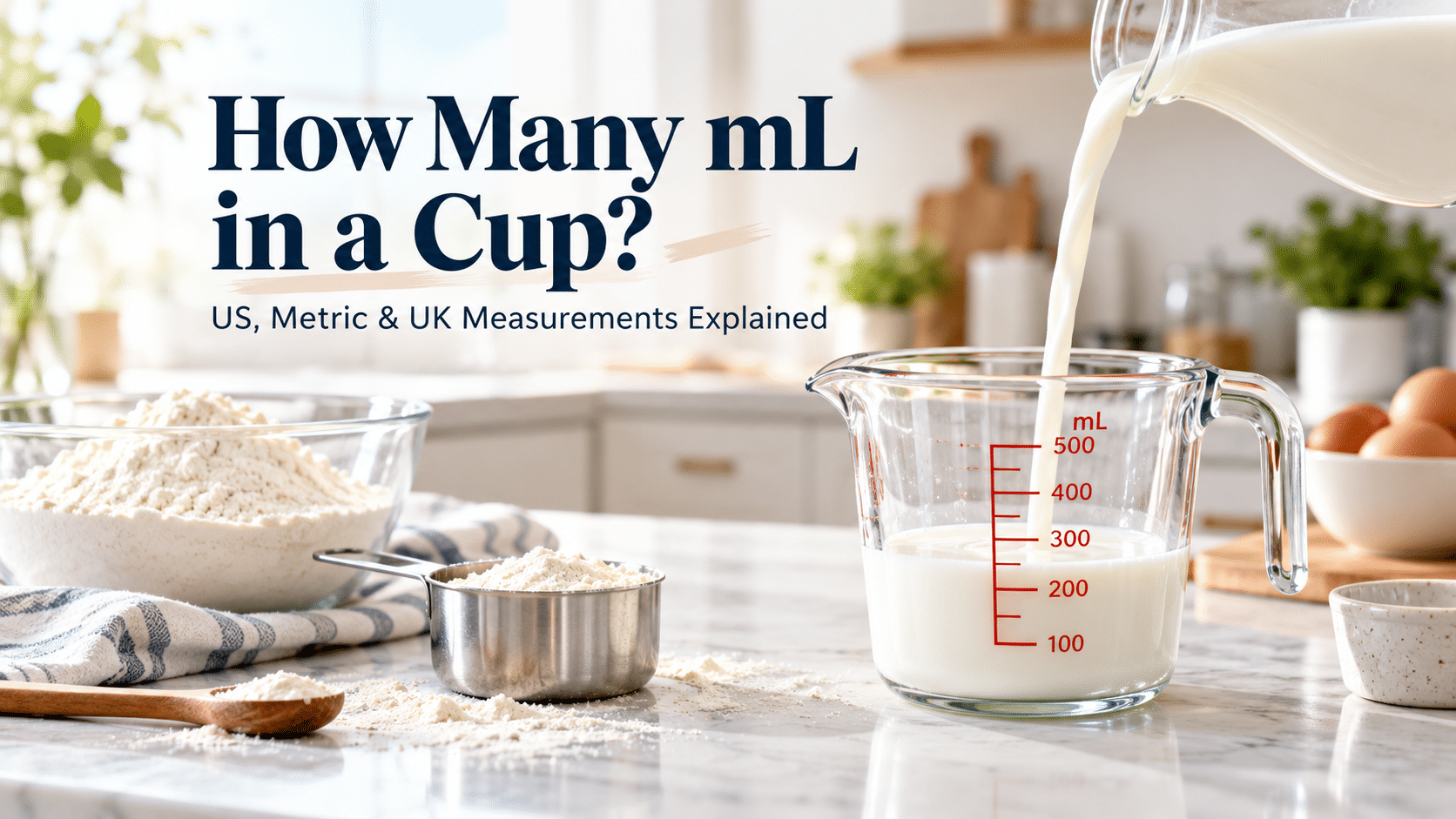
How many mL in a cup? One US customary cup contains approximately 236.59 milliliters (mL). However, you may also see 240 mL in American recipes and food labeling, or 250 mL in recipes using metric cups. There is no single cup size used in every country.
The difference may seem small, but choosing the wrong measuring cup can change the proportions of a recipe, particularly when baking or preparing larger quantities.
This guide explains the differences between US, metric, and UK cup measurements, provides practical conversion charts, and helps you choose the right measurement when cooking from international recipes.
How Many mL Are in a Cup? Quick Answer
The answer depends on which measurement system you are using.
| Cup type | Milliliters | Typical context |
|---|---|---|
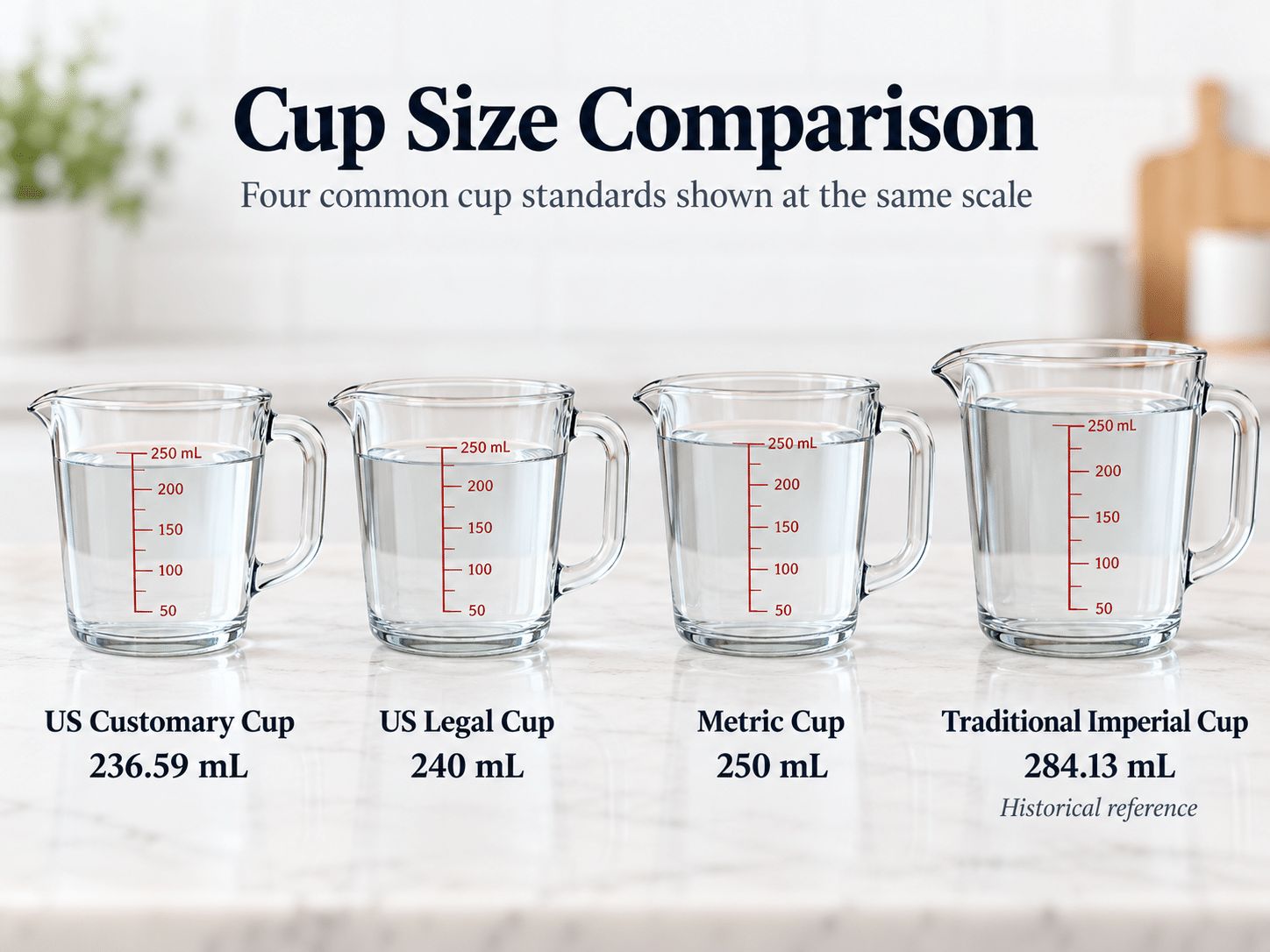
| US customary cup | 236.588 mL | Traditional American cooking measurements |
| US legal cup | 240 mL | US nutrition labeling |
| Metric cup | 250 mL | Australian, Canadian, and other metric recipes |
| Traditional Imperial cup | Approximately 284.131 mL | Historical Imperial measurement references |
For a traditional American recipe, use approximately 237 mL per cup. For an Australian or modern Canadian metric recipe, use 250 mL unless the recipe specifies otherwise.
For UK recipes, check the original publisher’s measurement convention rather than automatically assuming that a cup means 250 mL or the historical Imperial cup.
The distinction between 236.59 mL and 240 mL is usually minor for everyday cooking. However, the difference between an American customary cup and a metric cup becomes more noticeable when several cups are involved.
Why Does One Cup Have Different Measurements?
A cup is a traditional household measurement of volume. Unlike the milliliter, which belongs to the metric system, the size associated with a cooking cup has developed differently across measurement systems and regional practices.
As a result, recipes may use the same word but refer to different volumes.
This can be confusing when:
- An American recipe is prepared in a British kitchen.
- A Canadian recipe is followed using US measuring cups.
- An Australian cookbook is used with American measuring equipment.
- A recipe includes both milliliters and cups without explaining the conversion standard.
- Measurements are copied from older cookbooks with historical units.
Identifying the correct cup size before converting ingredients is more reliable than assuming that every cup represents an identical volume.
US Customary Cup: 236.588 mL
The traditional US customary cup is based on the US fluid ounce.
1 US customary cup = 8 US fluid ounces
Since one US fluid ounce is approximately 29.57353 mL:
8 × 29.57353 ≈ 236.58824 mL
Therefore, a US customary cup is approximately 236.59 mL.
For everyday cooking, the measurement is often rounded to 237 mL.
The US National Institute of Standards and Technology (NIST) provides approximate cooking equivalencies, including 240 mL for one cup. This is a practical kitchen approximation rather than the exact customary-cup volume.
When should you use the US customary cup?
It is an appropriate starting point when interpreting traditional American cooking measurements, especially if the recipe uses US cups and fluid ounces.
For example, if an American recipe requires two cups of milk:
2 × 236.5882365 = 473.176473 mL
Therefore:
2 US customary cups ≈ 473.18 mL
If you need to convert any specific amount, use our Cups to Milliliters Converter, which uses the US customary cup as its calculation standard.
Why Is a Cup Sometimes Listed as 240 mL?
Another familiar value is 240 mL per cup.
For US nutrition-labeling purposes, the Food and Drug Administration (FDA) specifies a cup as 240 mL under 21 CFR 101.9(b)(5)(viii).
This provides a consistent household measurement for food-labeling calculations.
The difference between the two US values is:
240 − 236.5882365 = 3.4117635 mL
That means the legal cup is approximately 3.41 mL larger than a US customary cup.
In everyday cooking, this difference is often smaller than the practical uncertainty involved in filling and reading a measuring cup. Nevertheless, using the correct convention is helpful for consistent calculations.
Important: When a product’s Nutrition Facts information uses a cup measurement, do not assume that it represents exactly the same volume as a traditional US customary measuring cup.
Metric Cup: How Many mL in a Cup in Australia and Canada?
A metric cup contains exactly 250 milliliters.
Metric measuring cups are commonly used in Australian recipes, and Health Canada’s cooking guidance also uses 250 mL as one cup.
This makes conversions straightforward:
- 1/4 metric cup = 62.5 mL
- 1/2 metric cup = 125 mL
- 3/4 metric cup = 187.5 mL
- 1 metric cup = 250 mL
- 2 metric cups = 500 mL
- 4 metric cups = 1,000 mL (1 liter)
The exact decimal relationship can be particularly convenient when resizing recipes.
Is a metric cup bigger than a US cup?
Yes. One metric cup is approximately 13.41 mL larger than one US customary cup.
Relative to the customary US cup, that represents an increase of approximately 5.67%.
With only a small amount of liquid, the difference may be insignificant. Across several cups, however, the discrepancy accumulates.
For example, four cups represent:
- US customary: approximately 946.35 mL
- Metric: exactly 1,000 mL
The difference is approximately 53.65 mL.
That is a meaningful quantity when following a baking recipe with carefully balanced liquid and dry ingredients.
How Many mL in a Cup in the UK?
For UK cooking, the most useful answer is that you should identify the cup measurement used by the original recipe.
Modern British recipes commonly use grams for dry ingredients and milliliters for liquids. However, British cooks frequently encounter cup measurements in American, Australian, and other international recipes.
Consequently, there is no safe universal assumption that every cup in a UK kitchen means one particular number of milliliters.
Using American recipes in the UK
If you are following an American recipe, use the American cup convention specified by the recipe.
For traditional US customary measurements, one cup is approximately 236.59 mL. Many practical kitchen references round this to 240 mL.
For example, an American recipe calling for 1.5 cups of water corresponds to:
1.5 × 236.5882365 ≈ 354.88 mL
Using 240 mL per cup would give 360 mL, a small difference for many everyday preparations.
Using Australian or Canadian metric recipes in the UK
If the recipe uses a 250 mL metric cup, the same 1.5 cups would equal:
1.5 × 250 = 375 mL
This is different from the approximately 355 mL obtained using the US customary cup.
Checking the recipe’s origin and any measurement notes helps prevent unintended substitutions.
What about the traditional Imperial cup?
Historical Imperial measurement references also describe a cup equivalent to 10 Imperial fluid ounces, or approximately 284.13 mL.
This should not be assumed to represent the cup used in a modern British recipe.
The historical Imperial cup differs from the US customary and metric cups. It is worth recognizing when interpreting older measurement references, but for contemporary recipes the publisher’s stated convention is more useful than applying a historical conversion automatically.
US vs. Metric vs. Imperial Cup Conversion Chart
The following reference table shows how familiar cup fractions differ between three measurement conventions.
| Cup amount | US customary | Metric | Traditional Imperial |
|---|---|---|---|
| 1/4 cup | 59.15 mL | 62.50 mL | 71.03 mL |
| 1/3 cup | 78.86 mL | 83.33 mL | 94.71 mL |
| 1/2 cup | 118.29 mL | 125 mL | 142.07 mL |
| 2/3 cup | 157.73 mL | 166.67 mL | 189.42 mL |
| 3/4 cup | 177.44 mL | 187.50 mL | 213.10 mL |
| 1 cup | 236.59 mL | 250 mL | 284.13 mL |
| 1 1/2 cups | 354.88 mL | 375 mL | 426.20 mL |
| 2 cups | 473.18 mL | 500 mL | 568.26 mL |
| 3 cups | 709.76 mL | 750 mL | 852.39 mL |
| 4 cups | 946.35 mL | 1,000 mL | 1,136.52 mL |
Note: Values are rounded for display. The traditional Imperial column is a historical reference, not a recommended default for present-day UK recipes. The separate 240 mL US legal cup is explained earlier in this guide.
The table makes one important point clear: using the correct numerical formula is not enough if the wrong definition of a cup has been selected.
How Many Cups Are Common Milliliter Amounts?
If your recipe already lists ingredients in milliliters, you can convert those quantities into cups by dividing the volume by the size of the relevant cup.
For a US customary cup:
US cups = milliliters ÷ 236.5882365
For a metric cup:
Metric cups = milliliters ÷ 250
Here are several common examples:
| Milliliters | US customary cups | Metric cups |
|---|---|---|
| 60 mL | 0.254 | 0.240 |
| 100 mL | 0.423 | 0.400 |
| 120 mL | 0.507 | 0.480 |
| 125 mL | 0.528 | 0.500 |
| 150 mL | 0.634 | 0.600 |
| 180 mL | 0.761 | 0.720 |
| 200 mL | 0.845 | 0.800 |
| 240 mL | 1.014 | 0.960 |
| 250 mL | 1.057 | 1.000 |
| 500 mL | 2.113 | 2.000 |
| 750 mL | 3.170 | 3.000 |
| 1,000 mL | 4.227 | 4.000 |
For other amounts, use the Milliliters to Cups Converter. Its results use the US customary cup of approximately 236.588 mL.
Which Cup Standard Should You Use for Your Recipe?
The best way to avoid measurement errors is to determine the recipe’s intended system before calculating any conversion.
Use the following practical decision guide:
| Situation | Recommended approach |
|---|---|
| Traditional American recipe | Use US customary cups unless another definition is specified. |
| US food nutrition label | Recognize the FDA’s 240 mL cup convention. |
| Australian recipe | Use 250 mL metric cups unless the author states otherwise. |
| Modern Canadian metric recipe | Use the stated metric measurement; Health Canada’s cooking chart uses 250 mL per cup. |
| British recipe with metric quantities | Follow the grams and milliliters provided. |
| British recipe adapted from an American source | Check whether the author uses approximately 237 mL or a rounded 240 mL cup. |
| Recipe with an unidentified cup standard | Check the author’s measurement notes or original source before making a precise conversion. |
A useful rule: If a recipe provides a value in milliliters as well as cups, use that milliliter value directly whenever possible. It removes ambiguity about which cup size the author intended.
Real-World Examples: When Cup Size Changes a Recipe
Understanding the calculations is helpful, but seeing how different cup sizes affect actual recipes makes the distinction easier to remember.
Example 1: Making a cake with 2 cups of milk
Imagine a cake recipe that requires two cups of milk.
If the recipe uses US customary cups:
2 × 236.5882365 = 473.18 mL
If the recipe uses metric cups:
2 × 250 = 500 mL
The difference is approximately 26.82 mL.
In a flexible preparation such as soup, this difference may have little noticeable effect. However, in a baking recipe with a carefully balanced ratio of flour, eggs, fat, and liquid, an unintended change in liquid quantity can affect consistency.
The safest choice is to preserve the original recipe’s measurement system.
Example 2: Scaling a sauce recipe to four times its original size
Suppose a sauce recipe contains one cup of liquid and you want to prepare four batches.
Using US customary cups, you need:
4 × 236.5882365 ≈ 946.35 mL
Using metric cups, you need:
4 × 250 = 1,000 mL
That is a difference of approximately 54 mL.
Scaling makes small measurement differences more significant, which is why using consistent measuring units becomes increasingly important for larger quantities.
Example 3: Following an Australian recipe with American measuring spoons
International recipes may also differ in their spoon measurements.
In common Australian metric cooking measurements:
- 1 metric cup = 250 mL
- 1 Australian tablespoon = 20 mL
- 1 metric teaspoon = 5 mL
Meanwhile, US kitchen guidance commonly uses approximately 15 mL per tablespoon and 5 mL per teaspoon.
This difference is particularly relevant for smaller ingredients such as baking powder, vinegar, seasonings, and extracts.
For example, two Australian tablespoons represent 40 mL, whereas two rounded 15 mL tablespoons represent 30 mL.
That’s a difference of 10 mL.
Although both systems use the words tablespoon and teaspoon, their relationships are not always identical.
For related conversions, see our Teaspoons to Tablespoons Converter.
How to Measure Cups and Milliliters Accurately
Even if your conversion formula is mathematically correct, the result in the kitchen depends on how accurately the ingredients are measured.
1. Use a proper liquid measuring jug
For water, milk, oil, juice, stock, and other liquids, a graduated measuring jug with milliliter markings is usually the simplest option.
Place the jug on a flat, level surface and read the markings at eye level.
For many clear liquids, the surface curves slightly near the container walls. Read the bottom of the meniscus when that is how the measuring device is calibrated.
2. Measure dry ingredients correctly
When measuring flour, sugar, cocoa powder, or other dry ingredients with cups, use an appropriate dry measuring cup and follow the method specified by the recipe.
For ingredients that are meant to be measured level, use a straight edge to remove the excess.
A heaped cup, a tightly packed cup, and a loosely filled cup can hold noticeably different amounts of an ingredient.
This is one reason baking recipes often provide ingredient weights in grams.
3. Avoid using ordinary drinking cups
A coffee mug, teacup, or drinking glass is not necessarily the same size as a standardized measuring cup.
Some hold less than 200 mL, while others hold considerably more than 300 mL.
For repeatable measurements, use kitchen equipment with a known capacity rather than estimating with a drinking cup.
4. Do not round too early
When calculating several ingredient quantities, use the appropriate full conversion factor and round the final value.
For example, using 236.5882365 mL per US customary cup is more precise than repeatedly calculating with a rounded 237 mL factor.
For ordinary cooking, however, there is usually no practical benefit to measuring liquids to many decimal places when the measuring jug itself is marked in increments of several milliliters.
5. Use grams when the recipe requires weight
For many dry baking ingredients, measuring by weight is more repeatable than measuring by volume.
If a recipe provides grams, using a kitchen scale allows you to follow the stated quantity directly.
For practical guidance on measuring liquid, dry, and thick ingredients, see Health Canada’s ingredient-measuring guide.
Cups vs. Milliliters vs. Grams: What’s the Difference?
One of the most common sources of confusion in cooking is the difference between volume and mass.
Milliliters and cups measure volume, while grams measure mass.
A cup always represents a particular volume under the chosen cup standard, regardless of what ingredient fills it.
For example, 250 mL of water and 250 mL of honey both occupy the same volume.
However, those quantities do not have the same mass because water and honey have different densities.
The same principle applies to dry ingredients.
One cup of flour does not weigh the same as one cup of sugar, even when both ingredients occupy the same cup volume.
Therefore:
- Cups to mL: a direct volume conversion.
- mL to cups: a direct volume conversion.
- Cups to grams: depends on the ingredient and how it is measured.
- Grams to cups: requires ingredient-specific information.
This distinction explains why you cannot use a universal cups-to-grams formula for every ingredient.
If you’re converting a liquid quantity expressed in milliliters, the mL to Cups Calculator is appropriate. If you need an ingredient’s mass, use a reliable ingredient-specific weight reference or measure it with a scale.
How Do Cups Relate to Fluid Ounces?
Another important difference between measurement systems involves fluid ounces.
In the US customary system:
1 cup = 8 US fluid ounces
But US fluid ounces and Imperial fluid ounces are not identical.
One US fluid ounce contains approximately 29.5735 mL, while one Imperial fluid ounce contains approximately 28.4131 mL.
Consequently, converting recipes between countries requires identifying the appropriate fluid-ounce standard, just as it does with cups.
It is also important to distinguish a fluid ounce (fl oz), which measures volume, from an ounce (oz), which normally describes mass.
For example, eight fluid ounces of milk measure a volume, not necessarily a mass of eight ounces.
More volume-related conversion tools are available in our Volume Converters section.
Five Common Cup Conversion Mistakes
Mistake 1: Assuming every cup equals 250 mL
A 250 mL metric cup is common in several countries, but it is not the same size as a US customary cup.
Mistake 2: Assuming every US cup equals exactly 240 mL
The 240 mL figure is used for US nutrition labeling and practical kitchen approximations. The traditional US customary cup is approximately 236.588 mL.
Mistake 3: Treating every British recipe as an Imperial-cup recipe
Modern UK cooking frequently uses metric measurements. Do not automatically apply a historical Imperial cup to a contemporary recipe without checking its source.
Mistake 4: Converting cups directly into grams without considering the ingredient
Cups measure volume, while grams measure mass. An accurate weight conversion requires the ingredient’s density or a reliable ingredient-specific reference value.
Mistake 5: Combining different measuring systems in one recipe
Using US cups for some ingredients and metric cups for others can unintentionally alter proportions.
Choose the intended measurement system and apply it consistently throughout the recipe.
Frequently Asked Questions
How many mL in 1 cup?
One US customary cup equals approximately 236.588 mL. The US legal cup used for nutrition labeling equals 240 mL, while a metric cup equals 250 mL. The correct value depends on the measurement convention.
Is 250 mL equal to 1 cup?
Yes, 250 mL equals exactly one metric cup. However, it equals approximately 1.057 US customary cups.
Is 240 mL equal to 1 cup?
Yes, 240 mL equals one US legal cup for nutrition-labeling purposes. It is also a common practical US cooking equivalent. It equals approximately 1.014 US customary cups.
How many mL are in half a cup?
Half a US customary cup equals approximately 118.29 mL. Half a metric cup equals exactly 125 mL.
How many mL are in a quarter cup?
A quarter US customary cup contains approximately 59.15 mL. A quarter metric cup contains exactly 62.5 mL.
How many mL are in 3/4 cup?
Three-quarters of a US customary cup equals approximately 177.44 mL. Three-quarters of a metric cup equals exactly 187.5 mL.
How many cups is 500 mL?
500 mL equals exactly 2 metric cups or approximately 2.113 US customary cups.
How many cups are in 1 liter?
One liter contains exactly 4 metric cups or approximately 4.227 US customary cups.
How many mL in a cup of water?
The volume depends on the cup standard, not the ingredient. A US customary cup of water contains approximately 236.59 mL, while a metric cup of water contains 250 mL.
How many mL in a cup of milk?
The conversion is the same as for water because both cups and milliliters measure volume. A US customary cup of milk contains approximately 236.59 mL, while a metric cup contains 250 mL.
How many mL in a cup of flour?
One cup of flour occupies the volume of the measuring cup being used. That is approximately 236.59 mL for a US customary cup or 250 mL for a metric cup. However, its mass in grams depends on the flour and how it is measured.
Are US and UK cups the same size?
There is no single cup size that should be assumed for every modern UK recipe. American recipes commonly use US customary or rounded US kitchen measurements, whereas British recipes often provide metric quantities. Always check the source’s measurement convention.
What is the easiest way to convert cups to milliliters?
Identify the relevant cup standard and multiply the number of cups by its milliliter value. For US customary cups, multiply by approximately 236.5882365. For metric cups, multiply by 250.
The Bottom Line: How Many Milliliters Are in a Cup?
If you’re looking for a single, practical answer, one US customary cup is approximately 237 mL.
However, international recipe measurements require a little more care:
- US customary cup: approximately 236.59 mL
- US legal cup: 240 mL
- Metric cup: 250 mL
- Traditional Imperial cup: approximately 284.13 mL, used here as a historical reference
Before converting ingredients, identify the cup standard used by the recipe. If an exact milliliter measurement is provided, following that value directly is often the simplest and most reliable approach.
For quick calculations, visit the Cups to Milliliters Converter or the Milliliters to Cups Converter. Both calculators use the US customary cup, so their results remain consistent.
Sources and Measurement Methodology
This guide distinguishes exact measurement definitions from practical cooking approximations. Calculations retain the appropriate conversion factors before the displayed results are rounded.
The principal reference sources are:
- National Institute of Standards and Technology (NIST) – Metric Kitchen: Cooking Measurement Equivalencies. Official US kitchen measurement equivalents, including cups, tablespoons, teaspoons, and milliliters.
- US Food and Drug Administration (FDA) – Guidelines for Determining Metric Equivalents of Household Measures. Defines 240 mL per cup for US nutrition-labeling purposes.
- Health Canada – Measure Ingredients Like a Pro. Practical metric cooking equivalents, including 250 mL per cup.
- Easy Unit Convert – Accuracy & Editorial Policy. Information about the site’s approach to measurement standards, conversion accuracy, and rounding.
Editorial note: Unless otherwise specified, US customary cup examples in this article use approximately 236.5882365 mL per cup. Metric cup examples use exactly 250 mL. Figures in comparison tables are rounded for readability. Historical measurement conventions are identified separately and should not be substituted automatically into contemporary recipes.