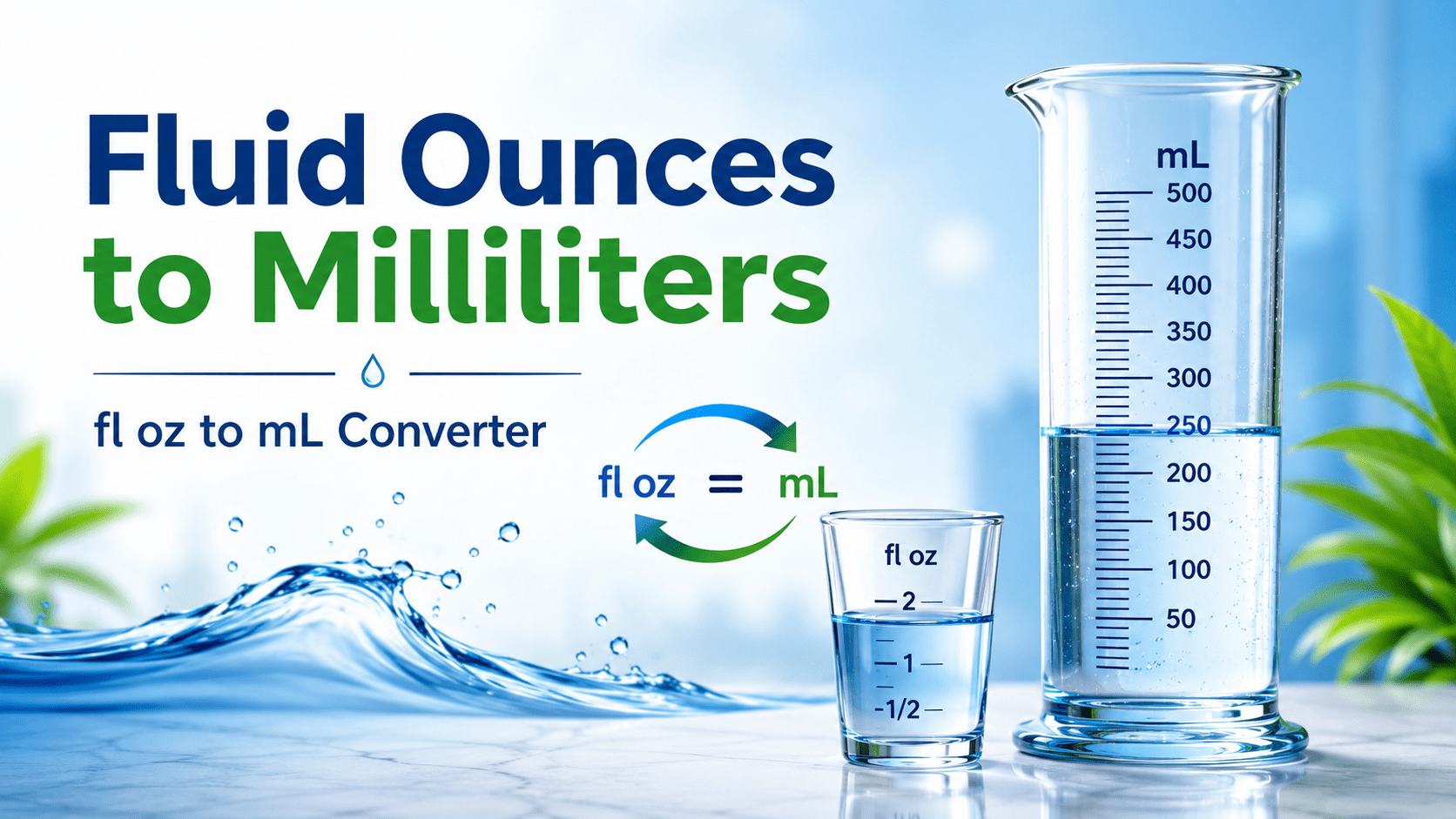
Converting fluid ounces to milliliters is simple: 1 U.S. fluid ounce equals exactly 29.5735295625 milliliters. Therefore, multiply the number of U.S. fluid ounces by 29.5735295625 to get the volume in milliliters.
For everyday use, you can usually round the conversion factor to 29.5735 mL. For example, 8 fl oz equals approximately 236.59 mL, while 16 fl oz equals approximately 473.18 mL.
This page uses the U.S. customary fluid ounce unless otherwise stated. Imperial fluid ounces use a different conversion factor, which is explained below.
Convert Fluid Ounces to Milliliters Instantly
Need the answer right away? Use the calculator below to convert U.S. fluid ounces to milliliters in seconds. Simply enter the amount in fluid ounces and select Convert fl oz to mL.
The calculator uses the precise conversion factor 1 U.S. fl oz = 29.5735295625 mL, so you can use it for recipes, drink measurements, product sizes, and other everyday volume conversions.
How to Convert Fluid Ounces to Milliliters
To convert fluid ounces to milliliters, multiply the number of U.S. fluid ounces by 29.5735295625.
The formula is:
Milliliters = Fluid Ounces × 29.5735295625
For most everyday calculations, however, using 29.5735 is more than precise enough.
For example:
| Fluid Ounces | Calculation | Milliliters |
|---|---|---|
| 4 fl oz | 4 × 29.5735295625 | 118.29 mL |
| 8 fl oz | 8 × 29.5735295625 | 236.59 mL |
| 12 fl oz | 12 × 29.5735295625 | 354.88 mL |
| 16 fl oz | 16 × 29.5735295625 | 473.18 mL |
Therefore, you do not need a complicated formula. You only need to know which type of fluid ounce you are converting.
U.S. Fluid Ounces and Imperial Fluid Ounces Are Different
One important detail is often overlooked: U.S. and Imperial fluid ounces are not the same unit.
A U.S. customary fluid ounce equals:
1 U.S. fl oz = 29.5735295625 mL
In contrast, an Imperial fluid ounce equals:
1 Imperial fl oz = 28.4130625 mL
This page and the calculator above use U.S. fluid ounces.
Therefore, if you are working with an older British recipe or another source that specifically says “Imperial fl oz,” you should use the Imperial conversion factor instead.
This distinction becomes more important as the quantity increases. Consequently, checking which measurement system a source uses can prevent noticeable errors.
Why Fluid Ounces to Milliliters Conversion Matters
The fluid ounces to milliliters conversion is especially useful because fluid ounces remain common in some measurement systems, while milliliters are part of the metric system.
As a result, the same product or recipe may use different units depending on where it was created or sold.
Cooking and Baking
Recipes are one of the most common situations where volume conversion is useful.
For example, an American recipe may call for 8 fluid ounces of milk. A metric measuring cup, however, will usually display milliliters. In that case, 8 U.S. fl oz converts to approximately 236.59 mL.
For normal cooking, rounding this to about 237 mL is generally practical.
However, more precise conversion may be useful when scaling recipes or working with quantities where consistency matters.
Drinks and Beverage Sizes
Fluid ounces frequently appear when describing beverage quantities.
For example, a drink listed as 12 U.S. fl oz contains approximately 354.88 mL. Similarly, 16 fl oz is about 473.18 mL.
Therefore, conversion makes it easier to compare beverage sizes when one label uses fluid ounces and another uses milliliters.
Product Packaging
Personal-care products, household liquids, cosmetics, and other packaged goods may display fluid ounces, milliliters, or both.
As a result, converting between the two units makes international product comparison easier.
For example, a bottle containing 3.4 U.S. fl oz holds approximately 100.55 mL.
Online Shopping and International Products
Measurement systems often differ between markets. Therefore, online shoppers may encounter a product described in fluid ounces even when they normally use milliliters.
Converting the value makes the actual product size much easier to understand.
This can be particularly useful when comparing two products that appear similar but use different units on their packaging.
When Do You Need to Convert fl oz to mL?
You may need this conversion whenever a volume is given in U.S. fluid ounces but your measuring container, recipe, product information, or preferred measurement system uses milliliters.
For example, you may be following an American recipe with a metric measuring jug. Alternatively, you may be comparing beverage sizes or checking the volume of an imported product.
In each case, the same calculation applies:
fl oz × 29.5735295625 = mL
Because milliliters are much smaller units, the numerical value in milliliters will always be larger than the corresponding number of fluid ounces.
How Accurate Should the Conversion Be?
The level of precision you need depends on the task.
For everyday cooking and general volume comparisons, two decimal places are usually enough. Therefore, you can use 29.57 mL per U.S. fluid ounce for a quick estimate.
If greater numerical precision is useful, use 29.5735 mL or the full conversion factor.
For example:
10 fl oz × 29.5735295625 = 295.735295625 mL
You can therefore report the result as 295.74 mL for normal use.
The calculator above keeps additional precision during the calculation and then displays a practical result.
A Simple Way to Estimate the Conversion
If you need a quick mental estimate, you can treat one U.S. fluid ounce as approximately 30 mL.
For example, 10 fl oz is roughly 300 mL.
However, this shortcut is only an estimate. The more fluid ounces you convert, the more the rounding difference increases.
Therefore, use 29.5735 or the calculator when you want a more accurate result.
Fluid Ounces, Ounces, and Milliliters: Do Not Confuse Them
A fluid ounce measures volume. An ounce without the word “fluid,” however, normally refers to weight or mass.
Therefore, you cannot generally convert ordinary ounces to milliliters with one universal formula. The result would depend on the density of the substance.
For example, 8 fluid ounces of a liquid describes its volume. In contrast, 8 ounces by weight describes how heavy something is.
This page specifically converts fluid ounces, abbreviated fl oz, to milliliters.
Fluid Ounces to Milliliters Conversion Table
The following fluid ounces to milliliters chart uses U.S. customary fluid ounces. Values are rounded to two decimal places for easier everyday use.
| Fluid Ounces (fl oz) | Milliliters (mL) |
|---|---|
| 1 fl oz | 29.57 mL |
| 10 fl oz | 295.74 mL |
| 20 fl oz | 591.47 mL |
| 30 fl oz | 887.21 mL |
| 40 fl oz | 1,182.94 mL |
| 50 fl oz | 1,478.68 mL |
| 60 fl oz | 1,774.41 mL |
| 70 fl oz | 2,070.15 mL |
| 80 fl oz | 2,365.88 mL |
| 90 fl oz | 2,661.62 mL |
| 100 fl oz | 2,957.35 mL |
One U.S. fluid ounce equals exactly 29.5735295625 milliliters. For everyday use, this is commonly rounded to 29.57 mL.
Not exactly. One U.S. fluid ounce is approximately 29.57 mL. However, 30 mL is a convenient estimate for quick calculations.
Multiply the number of U.S. fluid ounces by 29.5735295625.
For example:
8 × 29.5735295625 = 236.5882365 mL
Therefore, 8 U.S. fl oz is approximately 236.59 mL.
Eight U.S. fluid ounces equal approximately 236.59 mL.
Sixteen U.S. fluid ounces equal approximately 473.18 mL.
No. A U.S. fluid ounce equals 29.5735295625 mL, while an Imperial fluid ounce equals 28.4130625 mL.
Therefore, you should check which fluid-ounce system your source uses before converting.
Yes, if you only need a quick estimate. However, multiplying by 30 introduces a small rounding difference. For greater accuracy, multiply by 29.5735295625 instead.
fl oz is the standard abbreviation for fluid ounce, which is a unit of volume. It should not be confused with the ordinary ounce, or oz, which is normally a unit of weight.