Convert Square Miles to Acres Instantly
Need a quick square miles to acres conversion? Enter the area in square miles in the calculator below and get the equivalent number of acres instantly.
The calculator uses the exact conversion:
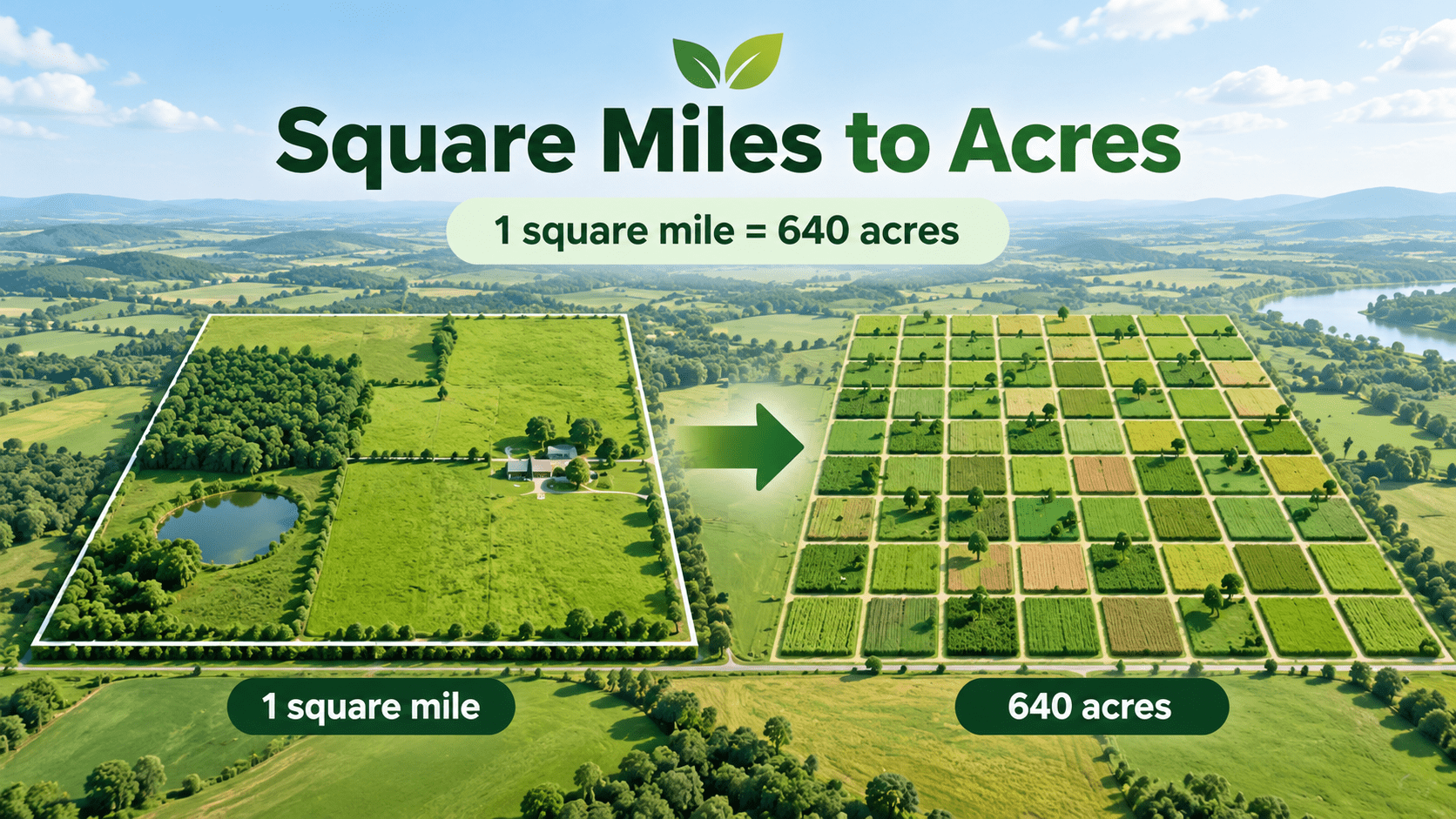
1 square mile = 640 acres
This conversion is useful for comparing large land areas, agricultural properties, forests, parks, conservation areas, and other locations where square miles and acres are commonly used.
How to Convert Square Miles to Acres
Converting square miles to acres is straightforward because the relationship between the two units is fixed:
1 square mile = 640 acres
To convert an area from square miles to acres, multiply the number of square miles by 640.
Formula:
Acres = Square miles × 640
For example, if a piece of land covers 5 square miles:
5 × 640 = 3,200 acres
Therefore:
5 square miles = 3,200 acres
Because the conversion factor is exact, you do not need an approximation when converting standard square miles into acres.
Why Does One Square Mile Equal 640 Acres?
The relationship becomes clear when both units are expressed in square feet.
One mile contains 5,280 feet, so one square mile contains:
5,280 × 5,280 = 27,878,400 square feet
One acre contains:
43,560 square feet
Dividing the area of one square mile by the area of one acre gives:
27,878,400 ÷ 43,560 = 640
This is why there are exactly 640 acres in one square mile.
Understanding the relationship is useful because it makes the conversion easy to verify rather than relying only on a calculator.
Square Miles to Acres Formula
For any square miles to acres calculation, use:
acres = mi² × 640
Here are a few practical examples:
0.5 square miles × 640 = 320 acres
2 square miles × 640 = 1,280 acres
7.5 square miles × 640 = 4,800 acres
25 square miles × 640 = 16,000 acres
For the opposite conversion, divide the number of acres by 640:
Square miles = acres ÷ 640
For example:
1,920 acres ÷ 640 = 3 square miles
What Is a Square Mile?
A square mile, usually written as mi² or sq mi, is a unit of area. It represents the area of a square measuring one mile on each side.
It is important not to confuse a mile with a square mile. A mile measures distance, while a square mile measures area.
Square miles are particularly useful for describing relatively large areas, such as cities, counties, lakes, forests, parks, and geographic regions.
One square mile is equal to:
- 640 acres
- 27,878,400 square feet
- approximately 2.59 square kilometers
For smaller pieces of land, acres are often more convenient because they provide a more practical-sized number.
What Is an Acre?
An acre is a unit used to measure land area. One acre contains exactly 43,560 square feet.
Unlike a square-shaped unit such as a square foot or square mile, an acre does not require the land itself to have any particular shape. A rectangular, triangular, or irregular parcel can still have an area of one acre.
Acres are widely used when discussing farmland, residential and commercial properties, woodland, development sites, and other land parcels.
The relationship you need to remember is:
640 acres = 1 square mile
When Is a Square Miles to Acres Conversion Useful?
A square miles to acres conversion becomes especially useful when two sources describe land using different units.
For example, a regional map may describe an area in square miles while a property listing, agricultural report, or land-management document expresses the same type of area in acres. Converting the figures into the same unit makes them much easier to compare.
Common situations include land and property measurement, agriculture, forestry, conservation, mapping, regional planning, and large development projects.
Agriculture and farmland
Agricultural properties are frequently discussed in acres. If a broader geographic source gives an area in square miles, converting it to acres makes the number easier to compare with individual farms or fields.
For example:
4 square miles = 2,560 acres
Forestry and conservation
Large forests, wildlife areas, parks, and protected habitats may be measured in square miles, while management plans may refer to individual sections in acres.
Using the same unit helps when comparing the total area with smaller management zones.
Property and land development
Large estates or development areas can also require conversion between the two units. Acres are often more intuitive for individual parcels, whereas square miles become more convenient as the total area increases.
Maps and geographic data
Maps and geographic databases often describe larger regions in square miles. Converting those values into acres can provide a more useful figure when the area needs to be compared with land parcels.
Square Miles vs. Acres: Which Unit Should You Use?
Both units measure area, but they are generally useful at different scales.
Square miles are convenient for large geographic areas. A city or large nature reserve, for example, may be much easier to describe as 20 square miles than as 12,800 acres.
Acres are usually more practical for smaller land areas, especially individual farms, fields, estates, and property parcels.
There is no mathematical difference in the area being described. The choice of unit simply changes how the value is expressed.
For example:
10 square miles = 6,400 acres
Both figures represent exactly the same area.
Common Mistakes When Converting Square Miles to Acres
The most common mistake is confusing miles with square miles. A mile is a unit of length and cannot be directly converted into acres because acres measure area.
Another mistake is using 640 in the wrong direction.
Remember:
Square miles → acres: multiply by 640
Acres → square miles: divide by 640
For example, 15 square miles is:
15 × 640 = 9,600 acres
But 15 acres expressed in square miles is:
15 ÷ 640 = 0.0234375 square miles
Keeping the direction of the conversion clear prevents most errors.
Accuracy of This Conversion
The square miles to acres calculator on this page uses the exact relationship of 1 square mile = 640 acres.
The calculation is therefore:
input value × 640
The result is not based on an estimated conversion factor. Decimal square-mile values can also be converted using exactly the same formula.
For example:
1.75 × 640 = 1,120 acres
This makes the converter suitable both for quick everyday calculations and for checking land-area figures where greater precision is useful.
Square Miles to Acres Conversion Table
| Square miles (mi²) | Acres |
|---|---|
| 1 | 640 |
| 10 | 6,400 |
| 20 | 12,800 |
| 30 | 19,200 |
| 40 | 25,600 |
| 50 | 32,000 |
| 60 | 38,400 |
| 70 | 44,800 |
| 80 | 51,200 |
| 90 | 57,600 |
| 100 | 64,000 |
Frequently Asked Questions
There are exactly 640 acres in one square mile.
Multiply the number of square miles by 640.
For example:
3 square miles × 640 = 1,920 acres
Two square miles equal 1,280 acres.
2 × 640 = 1,280 acres
Ten square miles equal 6,400 acres.
One hundred square miles equal 64,000 acres.
Half a square mile equals 320 acres.
0.5 × 640 = 320 acres
There are 1,600 acres in 2.5 square miles.
2.5 × 640 = 1,600 acres
One square mile contains 27,878,400 square feet, while one acre contains 43,560 square feet. Dividing 27,878,400 by 43,560 gives exactly 640 acres.
No. A mile measures distance, while a square mile measures area. Acres also measure area, so square miles can be converted directly into acres.
Divide the number of acres by 640.
For example:
3,200 acres ÷ 640 = 5 square miles
Acres are generally more convenient for individual farms, fields, estates, development sites, and property parcels. Square miles are usually easier to use for larger geographic areas such as cities, forests, parks, and regions.