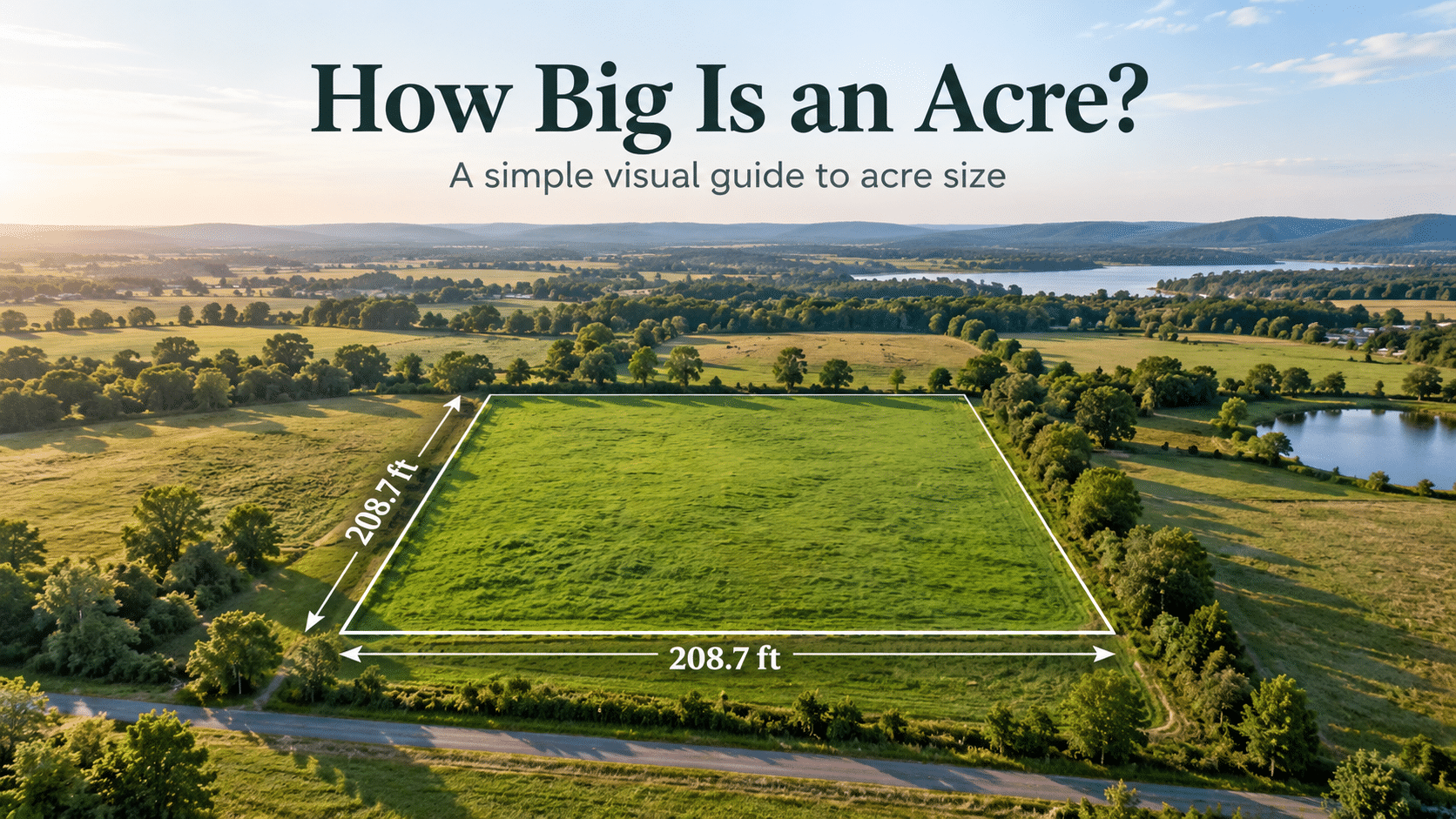
How big is an acre? One acre is exactly 43,560 square feet, equivalent to approximately 4,047 square meters or 0.405 hectares. If an acre were a perfect square, each side would measure about 208.71 feet (63.61 meters). To picture that size, imagine roughly three-quarters of an American football field, including both end zones.
But an acre isn’t a fixed length or a particular shape. A long, narrow field and a nearly square residential property can both contain exactly one acre.
Whether you’re comparing real estate listings, planning a garden, buying rural land, or simply curious about land measurements, this guide explains what an acre looks like, how its dimensions work, and how to calculate acreage for a property.
How Big Is an Acre? Quick Facts
An acre is a unit of area commonly used to measure land in the United States and the United Kingdom. It describes the total surface area of a piece of land, not the distance across it.
| Measurement | Equivalent to 1 acre |
|---|---|
| Square feet | 43,560 sq ft |
| Square yards | 4,840 sq yd |
| Square meters | 4,046.8564224 m² |
| Hectares | 0.40468564224 ha |
| Square miles | 0.0015625 sq mi |
| Square-shaped acre | Approximately 208.71 × 208.71 ft |
These measurements use the international foot and acre definitions. The underlying conversions are established in measurement references published by the National Institute of Standards and Technology (NIST).
The easiest number to remember is 43,560. That’s the number of square feet in one acre. It also provides a convenient starting point for calculating the acreage of a residential lot, garden, or field.
How Big Is an Acre Visually?
Numbers alone don’t always make land sizes easy to imagine. The most useful way to understand an acre is to compare it with familiar spaces.
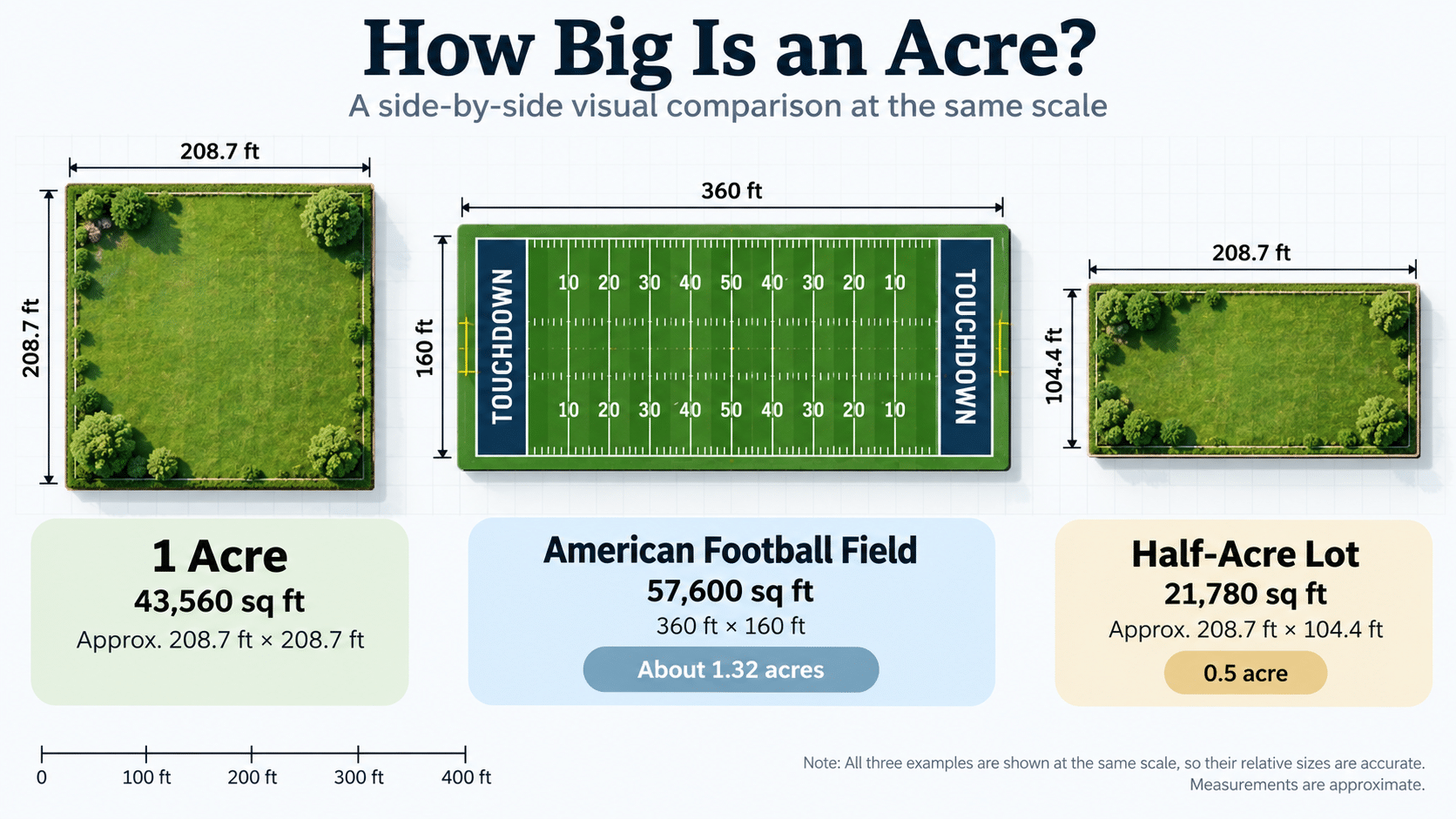
1. An acre compared with an American football field
A standard American football field, including both end zones but excluding the surrounding sidelines and safety areas, measures 360 feet long by 160 feet wide.
Its total marked area is:
360 × 160 = 57,600 square feet
Since one acre contains 43,560 square feet:
43,560 ÷ 57,600 × 100 = 75.625%
That means one acre covers approximately 76% of a complete American football field, including the end zones.
Without the two end zones, the playing area between the goal lines measures 300 × 160 feet, or 48,000 square feet. An acre is approximately 91% of that smaller area.
| Area | Square feet | Acres |
|---|---|---|
| One acre | 43,560 | 1.00 |
| Football playing area, without end zones | 48,000 | 1.10 |
| Full football field, including end zones | 57,600 | 1.32 |
This comparison is useful because football field dimensions are standardized. The field measurements are also documented by NC State University Extension.
2. Imagine a square measuring about 209 feet on each side
For an easier mental picture, imagine standing at one corner of a square property. Each boundary stretches approximately 209 feet (64 meters) before reaching the next corner.
The square contains nearly 4,047 square meters of land.
You could also picture a large, open grassy area where all four sides are equal. This gives you a much clearer sense of an acre than trying to imagine 43,560 individual square feet.
3. Picture forty 10-by-10-meter squares
For readers more familiar with metric measurements, imagine dividing a large field into sections measuring 10 meters by 10 meters.
Each section covers 100 square meters. Forty such sections cover 4,000 square meters, which is slightly less than one acre.
In other words, an acre is a little larger than forty 100-square-meter plots combined.
This comparison can be particularly helpful when comparing American land listings with properties advertised in square meters.
What Are the Dimensions of One Acre?
An acre doesn’t have one fixed set of dimensions. Any shape with a total area of 43,560 square feet qualifies as one acre.
For example, all the following rectangles cover exactly one acre:
| Width | Length | Total area |
|---|---|---|
| 66 ft | 660 ft | 43,560 sq ft |
| 100 ft | 435.6 ft | 43,560 sq ft |
| 132 ft | 330 ft | 43,560 sq ft |
| 165 ft | 264 ft | 43,560 sq ft |
| 200 ft | 217.8 ft | 43,560 sq ft |
A square-shaped acre would have sides measuring approximately 208.71 feet. The exact side length is the square root of 43,560 feet squared.
Why does the shape matter? Two one-acre properties may offer very different possibilities for construction, gardening, landscaping, or agricultural use.
A narrow plot might be suitable for long planting rows, while a more compact property may be easier to divide into functional areas.
A practical example: fencing two one-acre properties
Consider two plots that each contain one acre.
The first is almost square, with sides approximately 208.71 feet long. Its total perimeter is about 835 feet.
The second is a long rectangle measuring 66 feet by 660 feet. Its perimeter is:
2 × (66 + 660) = 1,452 feet
Both properties have exactly the same land area, but the narrow rectangular plot requires more than 600 additional feet of fencing to enclose its boundary.
This illustrates an important distinction: equal acreage doesn’t mean equal boundary length or equal development costs.
How Big Are Different Acre Sizes?
Land listings often describe smaller properties as a quarter acre or half acre, while agricultural and rural properties may contain several acres.
The following table helps you compare these sizes.
| Acres | Square feet | Square meters (approx.) |
|---|---|---|
| 0.10 acre | 4,356 | 405 |
| 0.25 acre | 10,890 | 1,012 |
| 0.50 acre | 21,780 | 2,023 |
| 1 acre | 43,560 | 4,047 |
| 2 acres | 87,120 | 8,094 |
| 5 acres | 217,800 | 20,234 |
| 10 acres | 435,600 | 40,469 |
How big is a quarter acre?
A quarter acre contains 10,890 square feet, or approximately 1,012 square meters.
A square quarter-acre lot would measure approximately 104.36 feet on each side.
Whether this is sufficient for a particular house, garage, garden, or outdoor project depends on the property’s shape and local building requirements.
How big is half an acre?
Half an acre contains 21,780 square feet, or approximately 2,023 square meters.
For example, a rectangular lot measuring 120 feet by 180 feet contains 21,600 square feet, which is approximately 0.496 acres—very close to half an acre.
How big are five acres?
Five acres contain 217,800 square feet, equivalent to approximately 20,234 square meters or 2.02 hectares.
This amount of land may be used for a range of purposes, including agriculture, woodland, recreational space, or a rural residential property. What can legally or practically be done with the land depends on its location, terrain, access, and restrictions.
How Big Is an Acre of Land for a House?
When buying a residential property, knowing the lot’s acreage helps you understand the total amount of land included in the listing.
However, the total lot area and the amount of usable land are not necessarily the same.
For example, a one-acre property may contain:
- a house and its foundation;
- a driveway and parking spaces;
- a garden, lawn, or landscaped areas;
- trees or wooded sections;
- sloped or difficult-to-access terrain;
- areas affected by easements, setbacks, or other restrictions.
Imagine a one-acre property with a house occupying 2,000 square feet of ground area and a driveway covering another 1,000 square feet.
Subtracting those footprints from the total gives:
43,560 − 2,000 − 1,000 = 40,560 square feet
That is the remaining surface area before accounting for other structures, landscaping, access requirements, setbacks, and unusable sections.
The example is illustrative, not a building plan or an estimate of how much of a real property can legally be developed.
Important: An advertised one-acre lot does not automatically mean an acre of buildable land. For property decisions, check the recorded boundaries, applicable zoning rules, access arrangements, and any environmental or legal restrictions.
How to Calculate Acres from Land Dimensions
If you know a property’s length and width, you can estimate its acreage using a simple formula.
Calculating acres from feet
For a rectangular property:
Area in square feet = Length × Width
Then:
Acres = Square feet ÷ 43,560
Worked example: Suppose a rectangular parcel measures 150 feet long and 200 feet wide.
Step 1: Calculate the surface area.
150 × 200 = 30,000 square feet.
Step 2: Divide by 43,560.
30,000 ÷ 43,560 ≈ 0.689 acres.
The property therefore covers approximately 0.69 acres.
For different measurements, use our Square Feet to Acres Converter to perform the conversion without calculating it manually.
Calculating acres from meters
If a property is measured in meters, first calculate its area in square meters.
Square meters = Length in meters × Width in meters
Then divide by the exact metric area of one international acre:
Acres = Square meters ÷ 4,046.8564224
For example, a rectangular plot measuring 50 meters by 80 meters has an area of 4,000 m².
4,000 ÷ 4,046.8564224 ≈ 0.9884 acres.
That means a 50-by-80-meter field is just slightly smaller than one acre.
You can also use our Square Meters to Acres Converter for this calculation.
What if the property has an irregular shape?
Many properties aren’t perfect rectangles. They may have angled boundaries, curves, or several connected sections.
For a rough estimate, you can divide a relatively simple plot into smaller shapes:
- Sketch the boundary and mark the available measurements.
- Divide the shape into rectangles, triangles, or other measurable sections.
- Calculate each section’s area using the appropriate geometric formula.
- Add the areas together without double-counting overlapping sections.
- Convert the total square feet or square meters into acres.
For example, a triangle’s area equals half its base multiplied by its perpendicular height.
However, complicated boundaries, slopes, and inaccurate distance measurements can make manual estimates unreliable. For property transactions, legal boundaries, and precise land records, use authoritative survey data rather than a rough calculation.
Acre vs. Hectare: What’s the Difference?
Acres and hectares both describe land area, but they come from different measurement systems.
The acre is traditionally associated with imperial and US customary land measurement. The hectare is a metric unit widely used in agriculture, land management, and property records around the world.
One hectare is larger than one acre.
The main conversions are:
- 1 acre = 0.40468564224 hectares
- 1 hectare ≈ 2.47105 acres
- 1 hectare = exactly 10,000 square meters
A hectare can be visualized as a square measuring 100 meters by 100 meters. An acre is approximately 40.47% of that area.
For international real estate listings and agricultural measurements, our Acres to Hectares Converter helps compare these two land units accurately.
How Many Acres Are in a Square Mile?
One square mile contains exactly 640 acres.
A square mile measures 5,280 feet on each side. Its total area is 27,878,400 square feet.
Dividing by 43,560 gives:
27,878,400 ÷ 43,560 = 640 acres
This relationship is particularly useful when comparing extensive agricultural properties, woodland, public land, or geographical areas.
To convert between the two units, visit our Square Miles to Acres Converter.
Where Does the Acre Measurement Come From?
The acre is a traditional land measurement with roots in historical agricultural practices.
Rather than beginning as a modern metric unit, it developed from older systems used to describe agricultural land.
A traditional rectangular acre can be represented as a strip measuring one chain (66 feet) wide and one furlong (660 feet) long.
Multiplying those dimensions gives:
66 × 660 = 43,560 square feet
That historical relationship helps explain the seemingly unusual number of square feet in an acre.
Today, an acre is defined by its area, not by any required shape or agricultural use. The modern international-acre conversion can be expressed exactly in square meters.
Common Mistakes When Comparing Acre Sizes
Several misunderstandings can make a property appear larger or smaller than it really is.
Confusing area with length
An acre measures area. Asking how many feet long an acre is doesn’t have a single answer unless a shape is specified.
Assuming every acre is square
A square acre is useful for visualization, but real land parcels can be rectangular, triangular, curved, or irregular.
Confusing acres and hectares
One acre is approximately 0.405 hectares, not one hectare. A hectare is about 2.47 times as large.
Using rounded conversions too early
Rounding one acre to 4,000 square meters can be useful for mental estimates, but the exact international-acre measurement is 4,046.8564224 m².
For technical calculations, use the precise conversion factor and round the final result rather than repeatedly rounding intermediate values.
Equating total acreage with usable land
A property’s recorded area may include steep slopes, wooded land, easements, restricted areas, or other features that affect how the land can be used.
Always distinguish the total parcel area from its practical and legally permitted uses.
Frequently Asked Questions About Acre Size
How big is 1 acre in feet?
One acre contains exactly 43,560 square feet. If shaped as a square, each side measures approximately 208.71 feet. An acre has no fixed length or width unless its shape is specified.
How big is an acre in meters?
One international acre equals exactly 4,046.8564224 square meters. A square acre measures approximately 63.61 meters on each side.
Is an acre bigger than a football field?
No. A standard American football field, including both end zones, covers approximately 1.32 acres. One acre is about 76% of that marked field area.
Is one acre the same as one hectare?
No. One acre equals approximately 0.405 hectares, while one hectare equals approximately 2.471 acres.
How many square feet are in half an acre?
Half an acre contains exactly 21,780 square feet, equivalent to approximately 2,023.43 square meters.
How many houses can fit on one acre?
There is no universal answer. The number depends on local zoning, minimum lot sizes, setbacks, road access, building dimensions, utilities, and other development requirements. One acre of total land does not automatically mean one acre of buildable space.
Can an irregularly shaped property contain exactly one acre?
Yes. Any property shape can contain one acre if its total measured area is 43,560 square feet. Shape and perimeter do not change the total area.
Understanding the True Size of an Acre
An acre is more than a number on a property listing. Understanding its size helps you compare land, evaluate potential uses, and interpret measurements from different countries.
For a quick reference, remember these three facts:
- 1 acre = 43,560 square feet
- 1 acre ≈ 4,047 square meters
- A square acre is approximately 209 feet on each side
For a visual comparison, think of roughly three-quarters of an American football field, including its end zones.
And remember that two properties containing the same acreage can have very different shapes, boundaries, and practical uses.
If you already know your property’s size, use the Acres to Square Feet Converter or browse our Area Conversion Tools to compare it with other measurement units.
Measurement Sources and Methodology
The numerical conversions in this guide are based on standard area relationships and international-foot definitions. Exact conversion factors are retained in calculations; rounded values are identified where appropriate.
- National Institute of Standards and Technology (NIST) — Handbook 133, Appendix E: General Tables of Units of Measurement (2026). Reference for the acre, square-foot and metric-area conversions.
- NC State University Extension — Carolina Athletic Fields: A Guide to Maintaining Quality Turf on Athletic Fields. Reference for American football field dimensions and surface area.
- Easy Unit Convert — Accuracy & Editorial Policy. Information about the website’s conversion methodology and editorial approach.
Note: The property-size examples are illustrative calculations, not land surveys, legal boundary determinations, or development approvals. Older surveying records may use historical unit definitions; consult the applicable survey documentation when exact legal measurements matter.