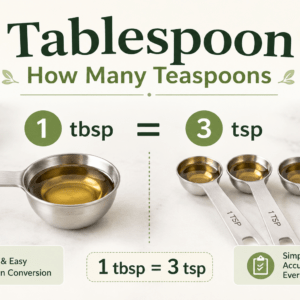
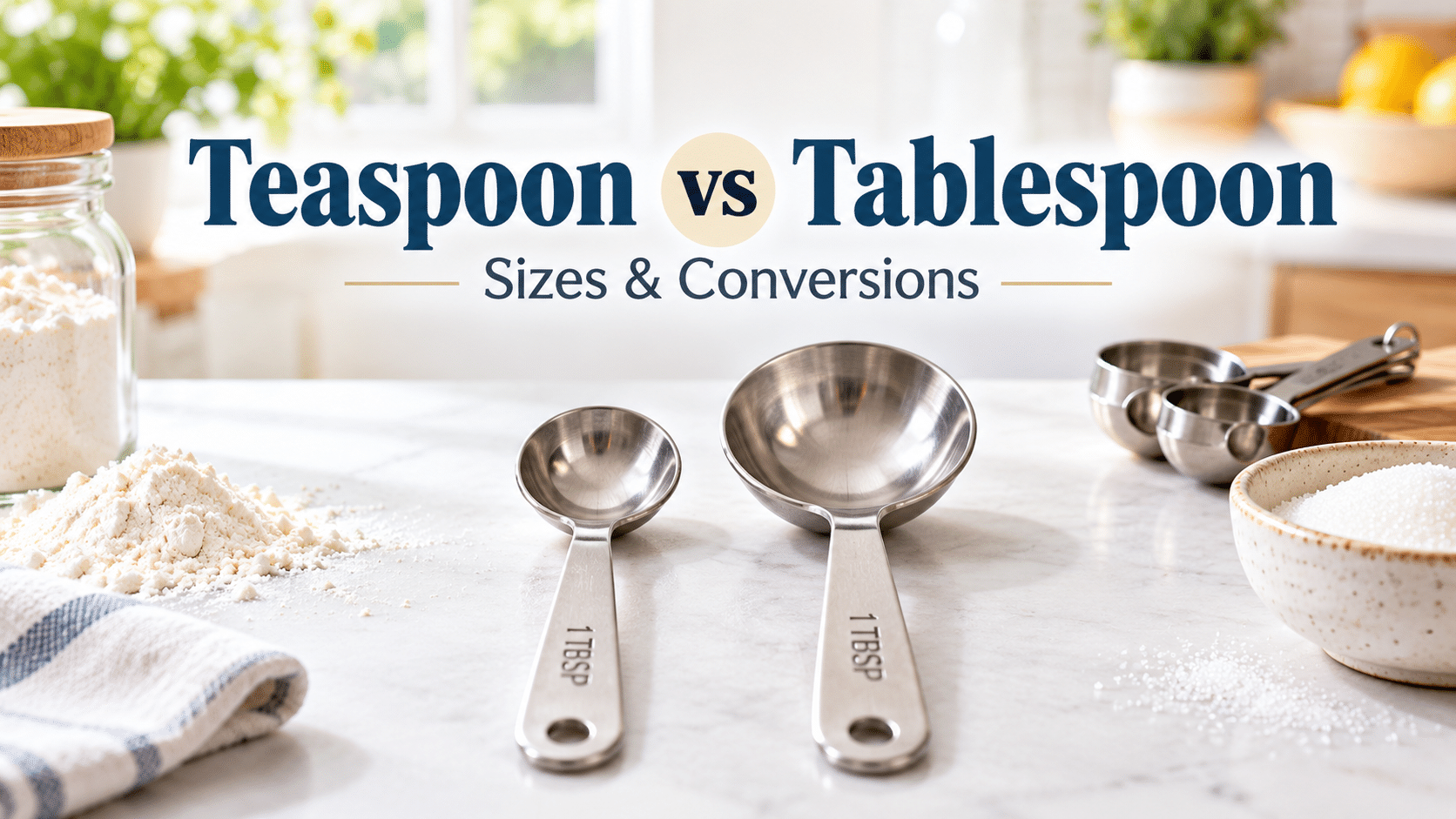
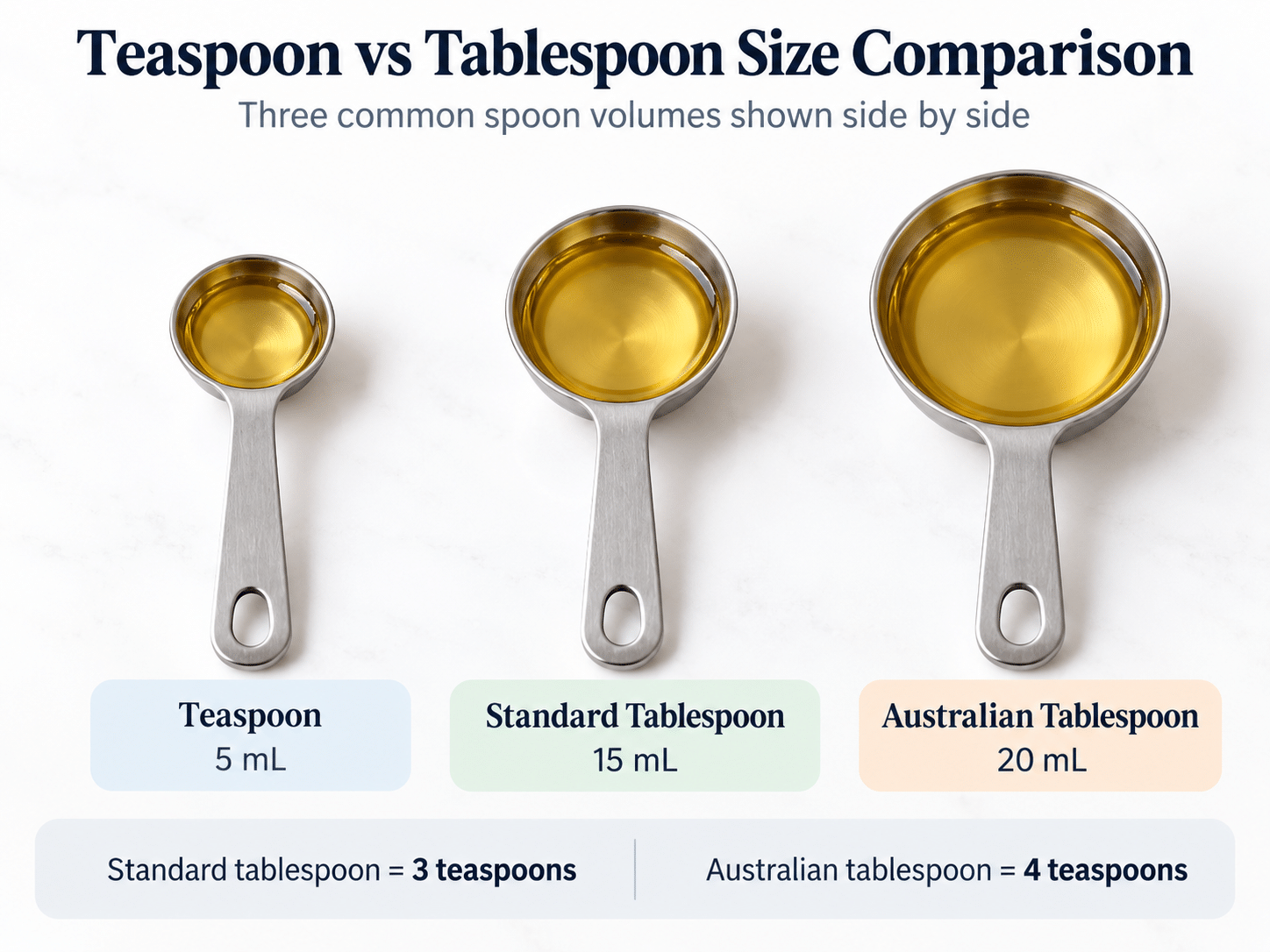
Teaspoon vs tablespoon: what’s the difference? A tablespoon is larger than a teaspoon. In standard US cooking measurements, 1 tablespoon (tbsp) equals 3 teaspoons (tsp). For everyday kitchen conversions, a teaspoon is approximately 5 milliliters (mL), while a tablespoon is approximately 15 mL.
However, there is an important exception: in Australian metric cooking, a tablespoon commonly holds 20 mL, equivalent to four 5 mL teaspoons.
Understanding the difference matters when baking, measuring spices, preparing sauces, or following recipes from other countries. Mixing up the two measurements can change an ingredient quantity by a factor of three—or lead to other errors when different national measurement systems are combined.
This guide explains teaspoon and tablespoon sizes, compares US and international standards, provides accurate conversion charts, and shows how to measure ingredients consistently.
Teaspoon vs Tablespoon: Quick Comparison
Teaspoons and tablespoons are both units of volume used for measuring relatively small ingredient quantities.
The most important conversion to remember for standard US recipes is:
1 tablespoon = 3 teaspoons
Or, using common rounded metric kitchen measurements:
1 tbsp = 15 mL
1 tsp = 5 mL
| Feature | Teaspoon | Tablespoon |
|---|---|---|
| Common abbreviation | tsp | tbsp |
| Relative size | Smaller | Three times a teaspoon in standard US cooking |
| Common rounded kitchen equivalent | 5 mL | 15 mL |
| US customary volume | Approx. 4.929 mL | Approx. 14.787 mL |
| Australian metric volume | 5 mL | 20 mL |
| Typical uses | Spices, extracts, salt, baking powder | Oils, dressings, sauces, larger ingredient quantities |
These distinctions are based on measurement information published by the National Institute of Standards and Technology (NIST) and official Australian Government cooking guidance.
Remember: For a standard US recipe, three level teaspoons provide the same volume as one level tablespoon.
What Is a Teaspoon?
A teaspoon is a small unit of volume commonly used in recipes, particularly when an ingredient is needed in relatively small quantities.
Its usual abbreviation is tsp.
Common examples include:
- 1 teaspoon of vanilla extract;
- 1/2 teaspoon of salt;
- 1 teaspoon of baking powder;
- 1/4 teaspoon of ground cinnamon;
- 2 teaspoons of lemon juice;
- 1 teaspoon of dried herbs.
In everyday metric kitchen measurements, a teaspoon is usually treated as 5 mL.
The traditional US customary teaspoon is slightly smaller, at approximately 4.92892 mL. The rounded 5 mL equivalent is widely used in practical cooking guides because it is convenient and generally sufficient for household recipes.
How much is half a teaspoon?
Using a 5 mL metric teaspoon:
1/2 teaspoon = 2.5 mL
Similarly:
- 1/4 teaspoon = 1.25 mL
- 1/2 teaspoon = 2.5 mL
- 3/4 teaspoon = 3.75 mL
- 1 teaspoon = 5 mL
- 2 teaspoons = 10 mL
These values are especially useful when your measuring equipment is marked in milliliters instead of teaspoons.
What Is a Tablespoon?
A tablespoon is a larger unit of volume commonly used for cooking and baking.
Its most recognizable abbreviation is tbsp.
Depending on the recipe, you may also see Tbsp or other capitalization conventions. Using the full word is preferable when an abbreviation could be misunderstood.
Tablespoons are often used for ingredients such as:
- olive oil and other cooking oils;
- vinegar and lemon juice;
- honey and syrup;
- sugar and cocoa powder;
- butter and other fats;
- salad dressings, marinades, and sauces.
In standard US cooking, a tablespoon contains three teaspoons.
A traditional US customary tablespoon is approximately 14.78676 mL. Practical kitchen references generally round this to 15 mL.
However, an Australian metric tablespoon is commonly defined as 20 mL, making it larger than its US counterpart.
How Much Bigger Is a Tablespoon Than a Teaspoon?
For the standard US measurement relationship, a tablespoon has three times the capacity of a teaspoon.
If a recipe calls for one teaspoon of an ingredient and you accidentally add a full tablespoon, you have measured three times the intended volume.
That difference may be particularly noticeable with strongly flavored or concentrated cooking ingredients.
For example, consider a recipe that requires one teaspoon of ground cinnamon.
Using a tablespoon instead would increase the quantity from approximately 5 mL to 15 mL.
Similarly, confusing one tablespoon with one teaspoon when preparing a dressing would reduce the intended volume to one-third.
However, the result depends on the measurement system. With Australian metric tablespoons, one tablespoon contains four metric teaspoons rather than three.
Are tablespoons physically three times as large?
In standardized US measuring sets, the relevant capacity is three times as large.
But an ordinary eating tablespoon may not look three times the size of an ordinary teaspoon, and its actual capacity can vary.
Volume depends on the shape and depth of a spoon, not just its visible length or width.
For accurate recipe measurements, choose calibrated measuring spoons rather than relying on the appearance of household cutlery.
US vs Australian Teaspoons and Tablespoons
One of the most easily overlooked differences in international cooking is the size of a tablespoon.
In standard US cooking and common 15 mL metric conventions:
1 tablespoon = 3 teaspoons
In Australian metric cooking:
1 tablespoon = 4 teaspoons
Why? The Australian tablespoon is commonly 20 mL, while the Australian teaspoon remains 5 mL.
| Measurement | US customary | 15 mL metric convention | Australian metric |
|---|---|---|---|
| 1 teaspoon | Approx. 4.929 mL | 5 mL | 5 mL |
| 1 tablespoon | Approx. 14.787 mL | 15 mL | 20 mL |
| Teaspoons per tablespoon | 3 | 3 | 4 |
| 2 tablespoons | Approx. 29.574 mL | 30 mL | 40 mL |
The US customary values are based on US fluid-volume definitions. The 15 mL and 5 mL values represent common metric kitchen measures. The Australian values follow the convention used in Australian Government recipe guidance.
For example, the Australian Government’s Get Up & Grow cooking materials specify 5 mL teaspoons, 20 mL tablespoons, and 250 mL metric cups.
A real example: converting an Australian dressing recipe
Suppose an Australian recipe calls for two tablespoons of lemon juice.
Using Australian measuring spoons:
2 × 20 mL = 40 mL
But using two standard 15 mL tablespoons would provide:
2 × 15 mL = 30 mL
That’s 10 mL less than the intended volume, or 25% below the amount specified by the Australian measurement convention.
To measure the equivalent using 15 mL metric tablespoons and 5 mL teaspoons, you could use:
2 tablespoons + 2 teaspoons = 40 mL
Alternatively, measure 40 mL directly with a suitable metric measuring device.
Practical tip: When a recipe originates in Australia, check whether the author uses a 20 mL tablespoon before converting spoon measurements.
Are UK Teaspoons and Tablespoons the Same as US Measurements?
Modern UK recipes frequently use metric quantities, especially grams and milliliters. When standardized metric cooking spoons are used, a teaspoon is commonly 5 mL and a tablespoon is commonly 15 mL.
This gives the familiar relationship:
1 tablespoon = 3 teaspoons
However, UK recipes may be adapted from American or Australian sources. In these cases, the original recipe’s measurement conventions matter more than the country where you are preparing it.
For example, a recipe originally published in Australia might still intend a 20 mL tablespoon even if a British cook is preparing the dish.
If the recipe provides milliliter measurements alongside spoons, follow the explicit milliliter quantities whenever possible.
How to Convert Teaspoons to Tablespoons
For standard US cooking measurements, converting between teaspoons and tablespoons requires only a simple calculation.
Teaspoons to tablespoons formula
Tablespoons = Teaspoons ÷ 3
For example, suppose you need to convert 9 teaspoons into tablespoons.
9 ÷ 3 = 3
Therefore:
9 teaspoons = 3 tablespoons
Another example:
2 teaspoons ÷ 3 = 0.6667 tablespoon
Therefore, two teaspoons equal approximately two-thirds of a standard tablespoon.
For values not listed in the charts below, use our Teaspoons to Tablespoons Converter. It uses the standard three-teaspoons-per-tablespoon relationship.
Tablespoons to teaspoons formula
For the opposite conversion, multiply the number of tablespoons by three.
Teaspoons = Tablespoons × 3
For example:
2.5 tablespoons × 3 = 7.5 teaspoons
Therefore:
2.5 tablespoons = 7.5 teaspoons
If you frequently need the reverse calculation, our Tablespoons to Teaspoons Calculator provides the result directly.
Important: These formulas apply to the standard 3:1 conversion. For the Australian 20 mL tablespoon convention, divide or multiply by four instead.
Teaspoon to Tablespoon Conversion Chart
The following table provides common kitchen fractions and their equivalents using a 5 mL teaspoon and 15 mL tablespoon.
| Teaspoons (tsp) | Tablespoons (tbsp) | Metric volume |
|---|---|---|
| 1/4 tsp | 1/12 tbsp | 1.25 mL |
| 1/2 tsp | 1/6 tbsp | 2.5 mL |
| 3/4 tsp | 1/4 tbsp | 3.75 mL |
| 1 tsp | 1/3 tbsp | 5 mL |
| 1 1/2 tsp | 1/2 tbsp | 7.5 mL |
| 2 tsp | 2/3 tbsp | 10 mL |
| 3 tsp | 1 tbsp | 15 mL |
| 4 tsp | 1 1/3 tbsp | 20 mL |
| 4 1/2 tsp | 1 1/2 tbsp | 22.5 mL |
| 6 tsp | 2 tbsp | 30 mL |
| 9 tsp | 3 tbsp | 45 mL |
| 12 tsp | 4 tbsp | 60 mL |
| 15 tsp | 5 tbsp | 75 mL |
The table uses common 5 mL and 15 mL metric kitchen equivalents, not the slightly smaller exact US customary volumes.
For larger quantities, converting to tablespoons makes measurements easier to manage. For example, instead of counting twelve separate teaspoons, you can measure four tablespoons.
Australian Tablespoon Conversion Chart
Because Australian tablespoons are larger, their conversion table differs from the standard US chart.
| Australian tablespoons | Australian teaspoons | Milliliters |
|---|---|---|
| 1/4 tbsp | 1 tsp | 5 mL |
| 1/2 tbsp | 2 tsp | 10 mL |
| 3/4 tbsp | 3 tsp | 15 mL |
| 1 tbsp | 4 tsp | 20 mL |
| 1 1/2 tbsp | 6 tsp | 30 mL |
| 2 tbsp | 8 tsp | 40 mL |
| 3 tbsp | 12 tsp | 60 mL |
| 4 tbsp | 16 tsp | 80 mL |
This chart is particularly helpful when converting an Australian cookbook for use with other measuring equipment.
For a more reliable international conversion, identify the intended milliliter volume first, then measure that volume using your available equipment.
Real-World Examples: Why Spoon Measurements Matter
A small measuring error can have different effects depending on the ingredient and the recipe.
Example 1: Adding vanilla extract to cookies
Imagine a cookie recipe that calls for 1 teaspoon of vanilla extract.
Under a standard 5 mL teaspoon convention, the intended volume is approximately 5 mL.
If you accidentally measure 1 tablespoon instead, the quantity becomes approximately 15 mL.
That is three times the intended volume.
Whether this significantly changes the final flavor depends on the recipe and extract, but the measurement itself is clearly incorrect.
Example 2: Scaling a salad dressing recipe
Suppose a dressing uses:
- 2 teaspoons of mustard;
- 3 teaspoons of vinegar;
- 6 teaspoons of olive oil.
Using the standard 3:1 conversion:
- 2 tsp mustard = 2/3 tbsp;
- 3 tsp vinegar = 1 tbsp;
- 6 tsp olive oil = 2 tbsp.
Converting the larger quantities makes preparation simpler while preserving the intended ingredient ratios.
Example 3: Tripling a baking recipe
Suppose a baking recipe requires 2.5 teaspoons of an ingredient per batch.
To make three batches:
2.5 × 3 = 7.5 teaspoons
Converting the result:
7.5 ÷ 3 = 2.5 tablespoons
Therefore:
7.5 teaspoons = 2 1/2 tablespoons
This method can simplify repeated measurements when a recipe is multiplied.
However, it is important to check whether the original recipe uses standard US spoon measurements or another national convention.
Example 4: An Australian sauce recipe
A recipe calls for 3 Australian tablespoons of a liquid ingredient.
Because each tablespoon contains 20 mL:
3 × 20 = 60 mL
If you only have 15 mL metric tablespoons, the equivalent is:
60 ÷ 15 = 4 tablespoons
Therefore:
3 Australian tablespoons = 4 standard 15 mL tablespoons
Both measurements represent 60 mL.
This example shows why converting through milliliters can be more dependable than assuming every tablespoon is the same size.
How Many Teaspoons and Tablespoons Are in a Cup?
Understanding how spoons relate to cups is useful when you don’t have the exact measuring tool available.
In the US customary measurement system:
- 1 cup = 16 tablespoons
- 1 cup = 48 teaspoons
- 1 tablespoon = 3 teaspoons
These relationships are internally consistent because:
16 tablespoons × 3 teaspoons = 48 teaspoons
For example, a quarter of a US customary cup contains four tablespoons, equivalent to twelve teaspoons.
| Cups | Tablespoons | Teaspoons |
|---|---|---|
| 1/8 cup | 2 tbsp | 6 tsp |
| 1/4 cup | 4 tbsp | 12 tsp |
| 1/3 cup | 5 1/3 tbsp | 16 tsp |
| 1/2 cup | 8 tbsp | 24 tsp |
| 3/4 cup | 12 tbsp | 36 tsp |
| 1 cup | 16 tbsp | 48 tsp |
These relationships should not automatically be applied to every national metric cup-and-spoon combination.
For example, an Australian metric cup contains 250 mL and an Australian tablespoon contains 20 mL. Therefore, one metric cup represents 12.5 Australian tablespoons, not sixteen.
For a detailed explanation of how cup sizes vary internationally, read our guide to US, metric, and UK cup measurements.
You can also use our Tablespoons to Cups Converter for direct calculations using US customary measurements.
Teaspoon vs Tablespoon: Volume Is Not the Same as Weight
Another important distinction is that teaspoons and tablespoons measure volume, not mass.
A teaspoon of water, sugar, cinnamon, and honey represents the same volume when measured using the same standardized spoon.
However, those ingredients do not necessarily have the same mass in grams.
Different ingredients have different densities. Some dry ingredients also settle or compact differently depending on how they are handled.
Therefore, statements such as “one tablespoon always equals a specific number of grams” are generally inaccurate unless the ingredient is identified.
Why is this important for baking?
Consider two ingredients measured with the same tablespoon:
- A level tablespoon of granulated sugar
- A level tablespoon of cocoa powder
Both occupy the same nominal spoon volume under the chosen standard.
But their masses can differ because of their physical properties and how they fill the spoon.
For recipes that require precise quantities, a kitchen scale may provide a more repeatable measurement, especially for dry ingredients.
Key distinction: Converting teaspoons into tablespoons is a volume conversion. Converting those spoon measurements into grams requires ingredient-specific information.
How to Measure Teaspoons and Tablespoons Accurately
Even a correct conversion formula cannot compensate for inaccurate physical measuring.
Use the following techniques to improve consistency in everyday cooking.
1. Choose standardized measuring spoons
Use measuring spoons marked with their capacity, ideally in both teaspoons or tablespoons and milliliters.
Ordinary eating spoons are not reliable substitutes because their capacity varies by shape, depth, and design.
2. Level dry ingredients when required
For ingredients such as baking powder, salt, and ground spices, fill the measuring spoon and level the surface with a straight edge unless the recipe explicitly specifies another method.
A heaped teaspoon contains more than a level teaspoon, but the extra amount is not standardized.
3. Measure liquids carefully
When measuring oil, vinegar, vanilla extract, and other liquids, fill the appropriate measuring spoon carefully without spilling.
For larger quantities, a graduated measuring jug can be more convenient.
4. Read abbreviations before measuring
Check whether the recipe requires:
- tsp — teaspoon;
- tbsp — tablespoon.
These abbreviations are similar, but the measurement difference is substantial.
5. Use the same measurement system throughout the recipe
When following an international recipe, avoid mixing different national measuring conventions without converting them first.
If a recipe includes exact values in milliliters, those values provide a useful reference for choosing the appropriate measuring equipment.
6. Understand the difference between level and heaped spoons
A level measuring spoon contains the ingredient up to the intended rim or measurement line.
A heaped spoon contains an additional amount above the rim.
Because the size of a heap can vary, “heaped tablespoon” is not a universally precise volume.
For recipes where small differences matter, follow the author’s instructions carefully or use a specified weight in grams.
Important: Don’t Use Kitchen Spoons to Measure Medicine
Although teaspoons and tablespoons appear in everyday cooking, measuring liquid medicine requires special care.
Confusing a teaspoon with a tablespoon can produce a threefold measurement error under standard US units.
Ordinary household spoons also vary in capacity and should not be used to estimate medication doses.
The US Food and Drug Administration (FDA) advises using the correct dosing device and following the medicine label.
For liquid medication, use an appropriate calibrated oral syringe, dosing cup, or other device recommended for that medicine, rather than a kitchen measuring spoon.
This article’s conversion charts are intended for cooking and general measurement education, not for selecting or changing medication doses.
Common Teaspoon and Tablespoon Conversion Mistakes
Mistake 1: Confusing tsp with tbsp
This is one of the most important mistakes to avoid.
In standard US cooking, one tablespoon contains three teaspoons. Substituting one for the other changes the ingredient volume substantially.
Mistake 2: Assuming every country’s tablespoon is 15 mL
Australian metric recipes commonly use a 20 mL tablespoon. Always consider the recipe’s measurement convention.
Mistake 3: Measuring ingredients with ordinary cutlery
Household eating spoons do not necessarily match standardized measuring spoon capacities.
Mistake 4: Treating heaped and level spoonfuls as equivalent
A heaped spoon can hold more ingredient than a level spoon. The additional quantity is not fixed.
Mistake 5: Converting spoon measurements directly into grams
Grams measure mass, while teaspoons and tablespoons measure volume. Accurate conversion requires knowing the ingredient.
Mistake 6: Mixing US and Australian measuring spoons
A recipe can produce unintended proportions if some ingredients are measured with 15 mL tablespoons and others with 20 mL tablespoons without accounting for the difference.
Frequently Asked Questions About Teaspoons and Tablespoons
What is the difference between a teaspoon and a tablespoon?
A tablespoon is larger than a teaspoon. In standard US cooking measurements, one tablespoon equals three teaspoons. In Australian metric cooking, one 20 mL tablespoon equals four 5 mL teaspoons.
How many teaspoons are in one tablespoon?
There are exactly three teaspoons in one US customary tablespoon. For common rounded metric kitchen measurements, three 5 mL teaspoons equal one 15 mL tablespoon.
Is 1 tablespoon equal to 3 teaspoons?
Yes, in standard US and 15 mL metric cooking conventions. However, the Australian 20 mL tablespoon contains four 5 mL teaspoons.
How many mL are in a teaspoon?
A metric kitchen teaspoon is 5 mL. A traditional US customary teaspoon is approximately 4.92892 mL.
How many mL are in a tablespoon?
A common metric kitchen tablespoon is 15 mL. A traditional US customary tablespoon is approximately 14.78676 mL, while an Australian metric tablespoon is commonly 20 mL.
How many tablespoons are in 2 teaspoons?
In standard US cooking measurements, 2 teaspoons equal two-thirds of a tablespoon, or approximately 0.6667 tablespoon.
How many teaspoons are in half a tablespoon?
Half a standard US tablespoon equals 1.5 teaspoons. Half an Australian metric tablespoon equals two Australian metric teaspoons.
How many teaspoons are in 2 tablespoons?
Two standard US tablespoons equal six teaspoons. Two Australian metric tablespoons equal eight Australian metric teaspoons.
How many teaspoons are in 3 tablespoons?
Three standard US tablespoons equal nine teaspoons. Three Australian metric tablespoons equal twelve metric teaspoons.
How many tablespoons are in 12 teaspoons?
Under the standard US conversion, twelve teaspoons equal four tablespoons. Under the Australian 4:1 convention, twelve teaspoons equal three tablespoons.
Can I use a regular teaspoon for cooking measurements?
An ordinary eating teaspoon may not have the same capacity as a standardized measuring teaspoon. For consistent results, use a measuring spoon marked with a known volume.
Is a teaspoon bigger than a tablespoon?
No. A tablespoon has a larger capacity. In standard US cooking, it holds three times as much as a teaspoon.
Are dry and liquid tablespoons different?
A standardized measuring tablespoon describes the same volume whether used for dry or liquid ingredients. However, dry ingredients may be packed, loosely filled, or heaped, which changes how much material the spoon contains.
Is tsp the same as tbsp?
No. The abbreviation tsp means teaspoon, while tbsp means tablespoon. They represent different volumes.
How many teaspoons are in one cup?
One US customary cup contains 48 US customary teaspoons, equivalent to 16 US customary tablespoons. The relationships differ when metric cups and Australian tablespoons are used.
What’s the safest way to convert international spoon measurements?
Identify the measurement system used by the original recipe, convert the quantity to milliliters, and then measure that volume using appropriate equipment. This avoids confusion between differently sized national tablespoons.
Teaspoon vs Tablespoon: Key Takeaways
The difference between a teaspoon and a tablespoon is simple in standard US cooking:
1 tablespoon = 3 teaspoons
For practical rounded kitchen measurements:
- 1 teaspoon ≈ 5 mL
- 1 tablespoon ≈ 15 mL
- 3 teaspoons ≈ 15 mL
But not every country uses the same tablespoon convention. In Australian metric cooking, one tablespoon commonly equals 20 mL, or four 5 mL teaspoons.
Remembering that exception, checking recipe abbreviations, and using standardized measuring spoons will help make your kitchen measurements more consistent.
When you need a specific conversion, use the Teaspoons to Tablespoons Calculator or the Tablespoons to Teaspoons Calculator. Both use the standard US 3:1 relationship.
For additional cooking measurements and volume calculations, browse our Volume Conversion Tools.
Sources and Measurement Methodology
The conversions in this guide distinguish between US customary definitions, rounded metric cooking equivalents, and Australian metric spoon conventions. Exact calculations and approximate kitchen values are identified separately.
Measurement information was checked against the following official sources:
- National Institute of Standards and Technology (NIST) — Metric Kitchen: Cooking Measurement Equivalencies. Reference for practical US kitchen conversions, including 5 mL teaspoons and 15 mL tablespoons.
- Australian Government Department of Health — Get Up & Grow: Healthy Eating and Physical Activity for Early Childhood. Government recipe guidance specifying 5 mL teaspoons and 20 mL tablespoons.
- US Food and Drug Administration (FDA) — Got a Sick Kid? Don’t Guess. Read the Label. Guidance on distinguishing teaspoon and tablespoon abbreviations and using appropriate medication dosing devices.
- Easy Unit Convert — Accuracy & Editorial Policy. Information about conversion methodology, numerical precision, and editorial practices.
Editorial note: Unless otherwise stated, teaspoon-to-tablespoon examples in this article use the standard US relationship of three teaspoons per tablespoon. Metric cooking examples use 5 mL teaspoons and 15 mL tablespoons. Australian 20 mL tablespoons are identified separately. This distinction is important when comparing international recipes or measuring ingredients that require consistent proportions.