Pounds vs kilograms: what’s the difference? Pounds (lb) and kilograms (kg) are both units of mass, but they belong to different measurement systems. The kilogram is the base unit of mass in the International System of Units (SI), while the pound is commonly used in the United States and in certain everyday measurements in the United Kingdom.
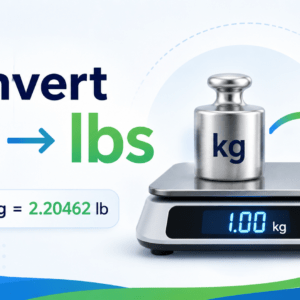
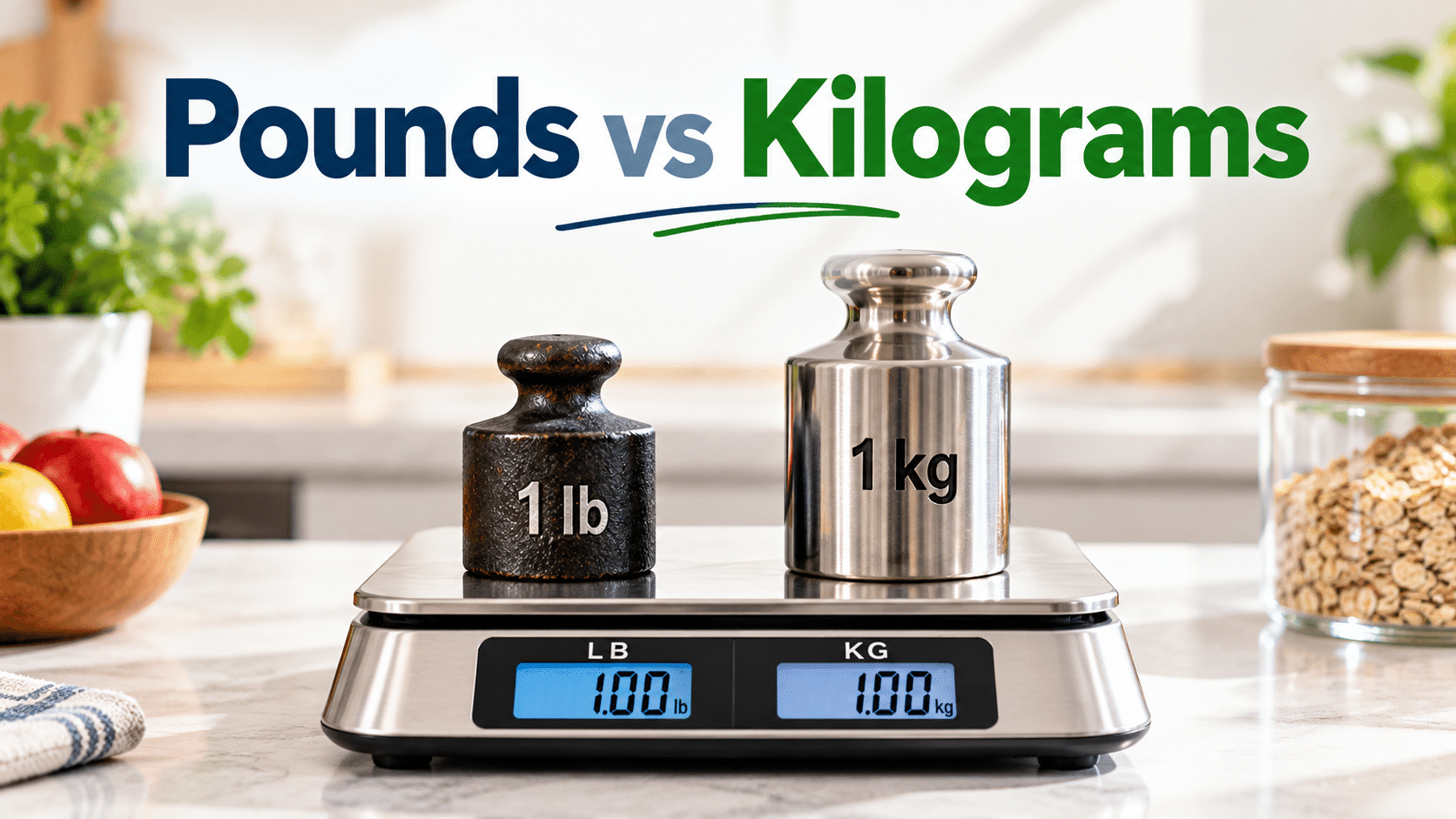
The most important difference is their size: 1 kilogram equals approximately 2.20462 pounds, while 1 pound equals exactly 0.45359237 kilograms.
Although both units can describe the mass of the same object, understanding their differences involves more than knowing a conversion formula. Their origins, international use, scientific definitions, and practical applications explain why the world continues to use both systems.
In this guide, you’ll learn how pounds and kilograms compare, which countries use them, how to interpret measurements on everyday products, and how to avoid common mistakes when switching between the two units.
Pounds vs Kilograms: Quick Comparison
The following table summarizes the most important differences between pounds and kilograms.
| Feature | Pound | Kilogram |
|---|---|---|
| Unit name | Pound | Kilogram |
| Unit symbol | lb | kg |
| Quantity measured | Mass | Mass |
| Measurement system | US customary and imperial | International System of Units (SI) |
| Equivalent mass | 1 lb = 0.45359237 kg | 1 kg ≈ 2.20462 lb |
| Relative size | Smaller unit | Larger unit |
| Related smaller unit | 1 lb = 16 oz | 1 kg = 1,000 g |
| Common everyday applications | US body weight, packaged goods, fitness equipment | International commerce, food labeling, science, body mass |
Key takeaway: A kilogram represents more than twice the mass of a pound. However, neither unit is inherently more accurate. Both describe mass, and their relationship is precisely defined.
What Is a Pound (lb)?
A pound is a unit of mass associated with the US customary and imperial measurement systems.
Its standard symbol is lb, which comes from the Latin word libra, historically associated with a unit of weight.
In modern everyday measurements, the pound generally refers to the international avoirdupois pound.
This is the pound used for common measurements such as:
- Personal body weight in the United States.
- Weights of food and consumer products.
- Dumbbells and exercise equipment.
- Parcel and shipment measurements.
- Some machinery and equipment specifications.
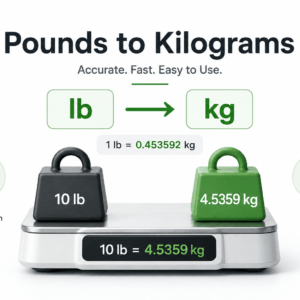
One international avoirdupois pound equals exactly 0.45359237 kilograms.
The definition was internationally standardized in 1959, establishing a consistent relationship between the pound and the metric kilogram.
The National Institute of Standards and Technology (NIST) documents the conversion of the international avoirdupois pound into kilograms.
Why is a pound abbreviated as lb instead of pd?
The abbreviation comes from the Latin word libra, rather than the English word pound.
That is why a food package may say “5 lb” even though the English word is pronounced “pounds.”
Both lb and lbs are commonly encountered in everyday writing and online searches.
However, the standard unit symbol is lb for both singular and plural quantities.
For example:
- 1 lb
- 5 lb
- 25 lb
Writing “25 lbs” is common informally, but “25 lb” follows the standard scientific convention for unit symbols.
How many ounces are in a pound?
In the ordinary avoirdupois system:
1 pound = exactly 16 ounces
This relationship is useful when reading American food packaging and recipes.
For example, a package labeled 32 oz contains two pounds of product.
The relationship between pounds and ounces is different from that between kilograms and grams, but both systems allow smaller quantities to be expressed using related mass units.
What Is a Kilogram (kg)?
The kilogram is the SI base unit of mass.
It is widely used in science, engineering, manufacturing, international trade, and everyday measurements throughout much of the world.
Its symbol is kg.
One kilogram equals exactly 1,000 grams.
Because it belongs to the metric system, converting between kilograms and grams is particularly straightforward.
For example:
- 0.25 kg = 250 g
- 0.5 kg = 500 g
- 1 kg = 1,000 g
- 2.5 kg = 2,500 g
- 10 kg = 10,000 g
This decimal relationship makes metric measurements convenient for scientific calculations, product packaging, food preparation, and international comparisons.
How is the kilogram officially defined?
The modern kilogram has a scientific definition based on a fundamental constant of nature.
Since May 20, 2019, the kilogram has been defined by fixing the numerical value of the Planck constant at exactly:
6.62607015 × 10⁻³⁴ joule-seconds (J s)
The definition also relies on the definitions of the meter and the second within the SI system.
This replaced the previous definition based on the mass of a physical platinum-iridium reference object known as the International Prototype of the Kilogram.
The change allows the unit to be realized through suitable measurement methods without depending on the mass of a single physical artifact.
The official definition is published by the International Bureau of Weights and Measures (BIPM).
Why does the kilogram remain important internationally?
One major advantage of the kilogram is its role within the International System of Units.
Scientific measurements from different countries can be compared more easily when the same standardized units are used.
For example, an international engineering specification can express the mass of a component in kilograms without requiring every reader to interpret a local customary measurement first.
The kilogram’s SI status also allows it to connect consistently with other SI units in calculations involving mass, force, energy, and related physical quantities.
Which Is Heavier: 1 Pound or 1 Kilogram?
One kilogram represents a greater mass than one pound.
Specifically:
1 kilogram ≈ 2.20462 pounds
1 pound = 0.45359237 kilograms
Therefore, a kilogram represents approximately 2.2 times as much mass as a pound.
Imagine two sealed packages containing the same type of material:
- Package A has a mass of 1 pound.
- Package B has a mass of 1 kilogram.
Package B has approximately 2.2 times the mass of Package A.
However, the actual physical size of the packages would also depend on the material, packaging, and density.
Important distinction: A kilogram is a larger mass unit, but this does not mean an object measured in kilograms must always be physically bigger than an object measured in pounds.
A dense metal object can contain more mass than a much larger object made from lightweight material.
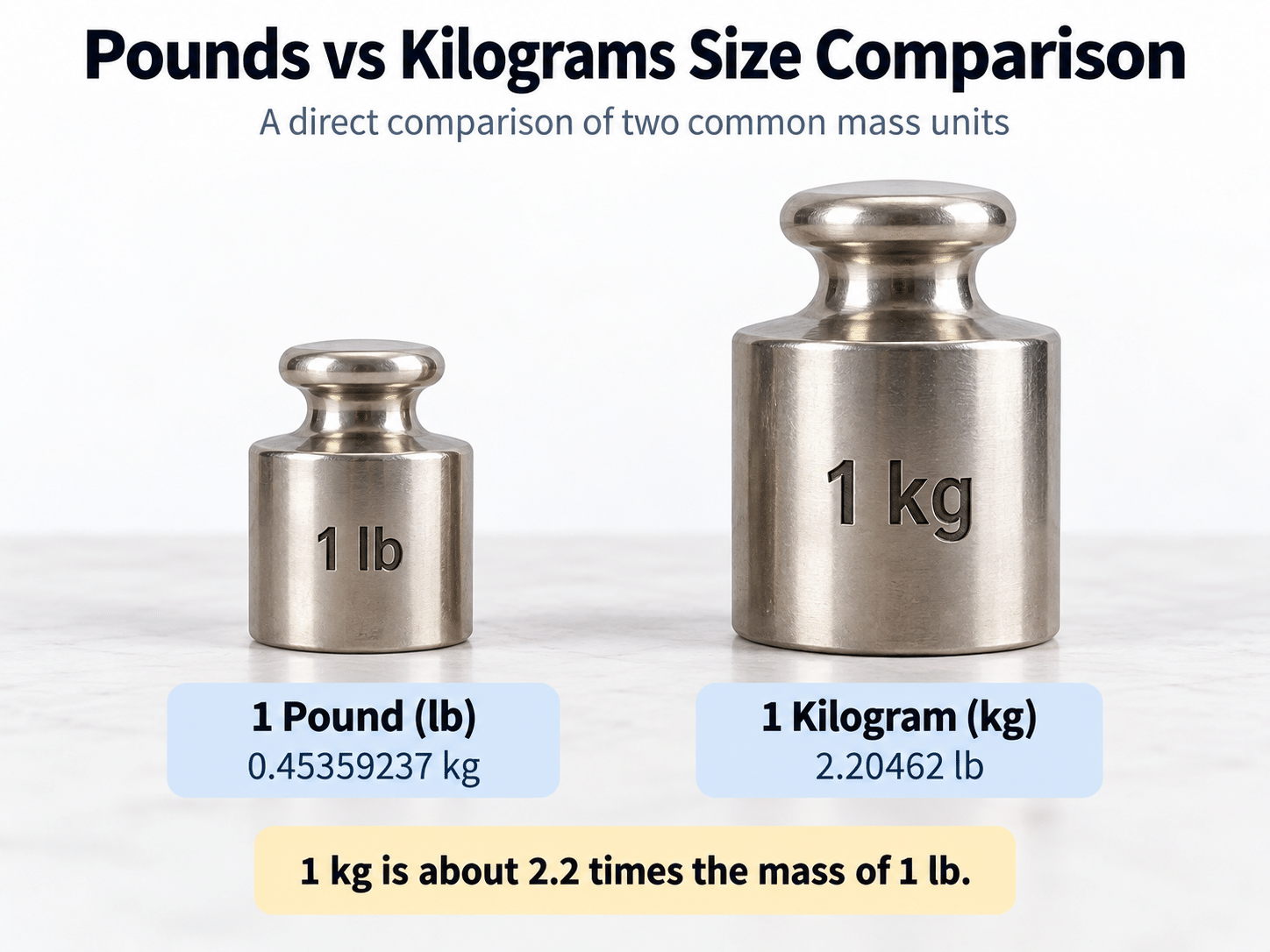
Pounds vs Kilograms: Real-World Size Comparison
It can be difficult to visualize the difference between pounds and kilograms when the numbers appear on product labels, gym equipment, or weighing scales.
The following examples compare equivalent masses using familiar objects.
Example 1: A one-kilogram bag of rice
Imagine a bag of rice labeled 1 kg.
Its mass in pounds is:
1 ÷ 0.45359237 ≈ 2.20462 lb
Therefore:
1 kg of rice ≈ 2.20 lb of rice
If you wanted to purchase approximately the same mass using pound-based packaging, you would look for a quantity totaling about 2.2 pounds.
Example 2: A five-pound package
Suppose a package is labeled 5 lb.
Its mass in kilograms is:
5 × 0.45359237 = 2.26796185 kg
Therefore:
5 lb ≈ 2.27 kg
This comparison is useful when a product’s American packaging uses pounds but an international listing gives the equivalent mass in kilograms.
Example 3: A ten-kilogram dumbbell vs. a ten-pound dumbbell
Gym equipment provides an especially useful illustration because dumbbells are commonly labeled in kilograms or pounds.
Consider two dumbbells:
- A 10 kg dumbbell.
- A 10 lb dumbbell.
The 10 kg dumbbell has a mass equivalent to approximately 22.05 lb.
The 10 lb dumbbell has a mass equivalent to approximately 4.54 kg.
Although both labels contain the number 10, they describe significantly different masses.
For anyone comparing workout programs or exercise equipment across countries, understanding the unit is just as important as reading the number.
Do Pounds and Kilograms Measure Mass or Weight?
In everyday language, pounds and kilograms are often called units of weight.
However, scientifically, the ordinary international avoirdupois pound and the kilogram are both units of mass.
Mass describes an object’s inertial property and is independent of its location.
Weight, in the technical physics sense, is a force caused by gravity.
For example, an object’s mass remains the same on Earth and on the Moon, but the gravitational force acting on it is different.
The SI unit of force is the newton (N), not the kilogram.
For more detailed definitions, see NIST’s SI Units – Mass reference.
What about pound-force (lbf)?
In engineering, a unit called pound-force may also be encountered.
Pound-force, abbreviated lbf, measures force rather than mass.
It is not interchangeable with the ordinary pound used for body mass, groceries, and luggage.
For example, a specification expressed in pound-force should not be converted directly into kilograms as if it represented an ordinary mass measurement.
The distinction matters in engineering, physics, and technical documentation.
For everyday body weight, food packages, and most consumer products, pounds and kilograms normally refer to mass measurements.
Where Are Pounds and Kilograms Used Around the World?
The two measurement systems have different histories, which helps explain their continued coexistence.
United States
Pounds remain common in many everyday American situations, including:
- Personal body-weight measurements.
- Food products and grocery shopping.
- Strength-training equipment.
- Shipping and parcel weights.
- Consumer product specifications.
However, the metric system is also used in American scientific, industrial, and technical contexts.
United Kingdom
The United Kingdom uses metric units extensively in commerce and product labeling.
However, pounds and stones remain familiar in some contexts, particularly personal body-weight measurements.
One stone equals exactly 14 pounds.
Therefore:
10 stone = 140 pounds ≈ 63.50 kg
If you encounter a British body-weight measurement expressed in stones and pounds, first convert it into total pounds before converting to kilograms.
For a direct calculation, use our Pounds to Stone Converter.
Countries using the metric system
Kilograms are used extensively throughout Europe and much of the rest of the world for:
- Body mass and health-related measurements.
- Food labeling.
- Product specifications.
- Transport and shipping documentation.
- Scientific and engineering measurements.
International communication often requires converting pounds into kilograms or vice versa when measurements originate from different countries.
When Does the Difference Between Pounds and Kilograms Matter?
Knowing the relationship between these units becomes particularly useful when comparing information from different measurement systems.
1. Fitness and strength training
Some strength-training programs specify exercise weights in pounds, while others use kilograms.
Consider a workout instruction calling for a 45 lb barbell load.
Converting to kilograms:
45 × 0.45359237 = 20.41165665 kg
Therefore, 45 lb is approximately 20.41 kg.
A 20 kg load is close, but not exactly equal to 45 lb.
When comparing training programs, avoid assuming that a number remains unchanged when switching between the two units.
2. Luggage measurements when traveling
Suppose a travel document specifies a hypothetical luggage mass limit of 23 kg, but your luggage scale displays pounds.
To understand the equivalent:
23 ÷ 0.45359237 ≈ 50.71 lb
Therefore:
23 kg ≈ 50.71 lb
The conversion helps you compare the two measurements, but always follow your airline’s actual baggage policy and any applicable rounding rules.
3. International shipping
A parcel may be weighed in pounds in one country while the destination’s shipping documentation requires kilograms.
For example, a package weighing 25 lb has a mass of:
25 × 0.45359237 = 11.33980925 kg
Rounded to two decimal places, that is 11.34 kg.
Accurate unit conversions are useful in logistics, but actual shipping charges may also depend on packaging dimensions, dimensional weight, service conditions, and carrier-specific policies.
4. Food packaging and recipes
American recipes sometimes describe ingredients in pounds, while recipes elsewhere often use kilograms and grams.
Suppose a recipe calls for 2 lb of potatoes.
2 × 0.45359237 = 0.90718474 kg
Therefore:
2 lb ≈ 907.18 grams
Converting the ingredient mass correctly helps preserve the recipe’s intended proportions.
It is important not to confuse pounds with cups or other volume measurements. Converting an ingredient’s mass into volume requires additional information about the ingredient.
5. Product comparisons
Imagine comparing two fitness products:
- Product A has a stated mass of 20 kg.
- Product B has a stated mass of 45 lb.
Converting Product A gives:
20 kg ≈ 44.09 lb
Product B is therefore approximately 0.91 lb heavier than Product A.
The products are close in mass, but they are not identical.
This comparison shows why converting both specifications into a common unit can make product evaluation easier.
How to Convert Between Pounds and Kilograms
Although this guide focuses on understanding the differences between pounds and kilograms, knowing the conversion formulas makes everyday comparisons much easier.
Convert pounds to kilograms
The exact formula is:
Kilograms = Pounds × 0.45359237
Example: Convert 150 lb into kilograms.
150 × 0.45359237 = 68.0388555 kg
Rounded to two decimal places:
150 lb = 68.04 kg
To calculate any amount instantly, use our Pounds to Kilograms Converter.
Convert kilograms to pounds
For the reverse conversion:
Pounds = Kilograms ÷ 0.45359237
Alternatively, multiply kilograms by approximately 2.20462262185.
Example: Convert 70 kg into pounds.
70 ÷ 0.45359237 ≈ 154.32358 lb
Rounded to two decimal places:
70 kg = 154.32 lb
Use our Kilograms to Pounds Converter for other values.
Pounds and Kilograms Comparison Charts
The following charts provide convenient reference values for everyday measurements.
All results use the international avoirdupois pound and are rounded to two decimal places.
Pounds to kilograms comparison
| Pounds (lb) | Kilograms (kg) |
|---|---|
| 1 lb | 0.45 kg |
| 2 lb | 0.91 kg |
| 5 lb | 2.27 kg |
| 10 lb | 4.54 kg |
| 20 lb | 9.07 kg |
| 25 lb | 11.34 kg |
| 45 lb | 20.41 kg |
| 50 lb | 22.68 kg |
| 100 lb | 45.36 kg |
| 150 lb | 68.04 kg |
| 200 lb | 90.72 kg |
Kilograms to pounds comparison
| Kilograms (kg) | Pounds (lb) |
|---|---|
| 1 kg | 2.20 lb |
| 2 kg | 4.41 lb |
| 5 kg | 11.02 lb |
| 10 kg | 22.05 lb |
| 20 kg | 44.09 lb |
| 23 kg | 50.71 lb |
| 25 kg | 55.12 lb |
| 50 kg | 110.23 lb |
| 70 kg | 154.32 lb |
| 80 kg | 176.37 lb |
| 100 kg | 220.46 lb |
These are mass equivalents, not estimates of an object’s physical dimensions. The full conversion factor is used before rounding the displayed result.
How to Estimate Pounds and Kilograms Without a Calculator
For many everyday situations, you may only need a quick estimate rather than a highly precise calculation.
Estimating kilograms from pounds
A useful mental shortcut is:
Kilograms ≈ Pounds ÷ 2.2
For example:
110 lb ÷ 2.2 ≈ 50 kg
The exact conversion gives approximately 49.90 kg.
That makes the shortcut useful for rough mental comparisons.
Estimating pounds from kilograms
The opposite shortcut is:
Pounds ≈ Kilograms × 2.2
For example:
30 kg × 2.2 = 66 lb
The more precise conversion gives approximately 66.14 lb.
For casual estimates, that difference is often acceptable.
However, when a mass value must satisfy a specific technical or contractual requirement, use the exact conversion factor and follow the applicable precision requirements.
Why Do Pounds and Kilograms Still Exist?
Pounds and kilograms developed through different historical measurement traditions.
The pound has a long history within European systems of weights and measures. The kilogram developed as part of the metric system, which was designed to provide a more systematic approach to measurement.
Over time, metric measurement became widespread internationally, particularly in scientific and industrial applications.
However, measurement systems are also connected to local customs, equipment, product labeling, and everyday habits.
That helps explain why pounds remain familiar in American households and businesses, while kilograms are widely used internationally.
Both units can express mass accurately when used correctly.
The challenge is not that one unit is inherently unreliable. Instead, difficulties arise when people compare numbers without recognizing that they belong to different measurement systems.
Common Mistakes When Comparing Pounds and Kilograms
1. Assuming 1 pound equals 1 kilogram
The two units are not equivalent.
One kilogram represents approximately 2.20462 pounds, so treating the numbers as interchangeable can produce substantial errors.
2. Using rounded values as if they were exact
One pound is often approximated as 0.45 kg.
That is convenient for quick estimates, but the exact relationship is:
1 lb = 0.45359237 kg
For example, using 0.45 instead of the exact factor for 200 lb produces 90 kg rather than approximately 90.72 kg.
The difference becomes more noticeable with larger values.
3. Confusing kilograms with grams
A kilogram contains 1,000 grams.
Therefore, a 500 g package contains 0.5 kg, not 500 kg.
Pay attention to the unit symbol, particularly when interpreting international packaging.
4. Confusing mass with force
Pounds and kilograms are used as mass units in ordinary conversions.
Force measurements, such as newtons and pound-force, involve different quantities and should not be treated as equivalent to mass without the appropriate physical context.
5. Comparing identical numbers instead of equivalent masses
A 10 lb object and a 10 kg object do not have the same mass.
Always convert one measurement before comparing them.
6. Rounding too early during calculations
If a converted mass will be used in additional calculations, keep sufficient precision until the final result.
Repeatedly rounding intermediate values may introduce avoidable differences.
7. Confusing different types of pounds
The everyday international avoirdupois pound is not the same as certain historical or specialist units, such as the troy pound.
For ordinary body mass, luggage, and consumer goods, the international avoirdupois pound is normally the intended unit.
Frequently Asked Questions About Pounds vs Kilograms
What is the main difference between pounds and kilograms?
Both are units of mass, but they belong to different measurement systems and represent different quantities. One kilogram equals approximately 2.20462 pounds, while one pound equals exactly 0.45359237 kilograms.
Is 1 kg the same as 2 pounds?
No. One kilogram is approximately 2.20462 pounds. Two pounds equal approximately 0.90718 kilograms.
Is 1 kg heavier than 1 lb?
Yes, in everyday language. More precisely, one kilogram represents more mass than one pound. One kilogram is approximately 2.20462 times one pound.
How many pounds are in 1 kilogram?
There are approximately 2.20462262 pounds in one kilogram.
How many kilograms are in 1 pound?
One international avoirdupois pound equals exactly 0.45359237 kilograms.
Why is a pound abbreviated as lb?
The standard abbreviation comes from the Latin word libra. Although “lbs” is common in informal English, the standard unit symbol is lb for singular and plural measurements.
Are kilograms more accurate than pounds?
No. Both are precisely defined mass units. Accuracy depends on the measuring equipment, the calculation, and how the result is recorded rather than simply which unit is chosen.
Why do American scales use pounds?
Pounds remain a familiar customary measurement for body mass in the United States. Many modern scales also allow the display to be switched between pounds and kilograms.
Why do some UK measurements use stone instead of kilograms?
The stone remains familiar in some British personal body-weight contexts. One stone equals exactly 14 pounds, or approximately 6.35029 kilograms.
What is 10 kg in pounds?
Ten kilograms equal approximately 22.04623 pounds, commonly rounded to 22.05 lb.
What is 100 pounds in kilograms?
One hundred pounds equal exactly 45.359237 kilograms, commonly rounded to 45.36 kg.
Is 50 kg the same as 100 pounds?
No. Fifty kilograms equal approximately 110.23 pounds, while 100 pounds equal approximately 45.36 kilograms.
Are pounds and kilograms units of weight or mass?
Technically, both the ordinary international avoirdupois pound and the kilogram are units of mass. The term weight is commonly used for mass in everyday conversation, while physics distinguishes mass from gravitational force.
Do pounds and kilograms measure the same physical quantity?
Yes. Both measure mass in ordinary measurement contexts. The difference is their unit size and measurement system.
Can you convert pounds into kilograms exactly?
Yes. The international avoirdupois pound is defined as exactly 0.45359237 kilograms. Multiply the number of pounds by this factor to obtain the equivalent mass in kilograms.
Pounds vs Kilograms: Final Comparison
The fundamental difference between pounds and kilograms is their measurement system and unit size.
The pound remains common in US customary measurements, while the kilogram is the internationally recognized SI base unit of mass.
Remember these key relationships:
- 1 lb = exactly 0.45359237 kg
- 1 kg ≈ 2.20462 lb
- 1 lb = 16 oz
- 1 kg = 1,000 g
Whether you’re comparing gym equipment, reading international packaging, interpreting body-weight measurements, or evaluating product specifications, converting both values into a common unit makes comparisons clearer.
For instant calculations, use our Pounds to Kilograms Converter or Kilograms to Pounds Converter.
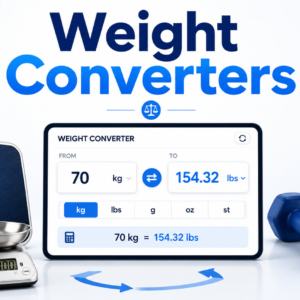
You can also explore the Weight Converters collection for related measurements involving stones, ounces, and grams.
Sources and Measurement Methodology
The numerical relationships in this guide are based on internationally established measurement definitions.
The pound-to-kilogram factor used throughout the article is:
1 international avoirdupois pound = exactly 0.45359237 kilograms.
Reverse conversions are calculated by dividing kilograms by this exact factor. Results in the comparison tables are rounded to two decimal places for readability.
Official measurement sources:
- National Institute of Standards and Technology (NIST) — Guide to the SI, Appendix B.9. Official conversion factors for mass units, including avoirdupois pounds and kilograms.
- NIST Handbook 44 (2026), Appendix C — General Tables of Units of Measurement. Official reference for avoirdupois pounds, ounces, and related mass units.
- International Bureau of Weights and Measures (BIPM) — SI Base Unit: Kilogram. International definition of the kilogram and its relationship with the Planck constant.
- NIST — SI Units: Mass. Explanation of the distinction between mass, weight, and gravitational force.
- Easy Unit Convert — Accuracy & Editorial Policy. Information about the website’s approach to conversion standards, calculations, and numerical precision.
Editorial note: Unless otherwise stated, references to pounds in this article mean international avoirdupois pounds used for ordinary mass measurements. Calculations use the full defined conversion factor rather than treating rounded approximations as exact values. Product, fitness, and travel examples are illustrative; applicable equipment specifications and provider policies should always be checked separately.