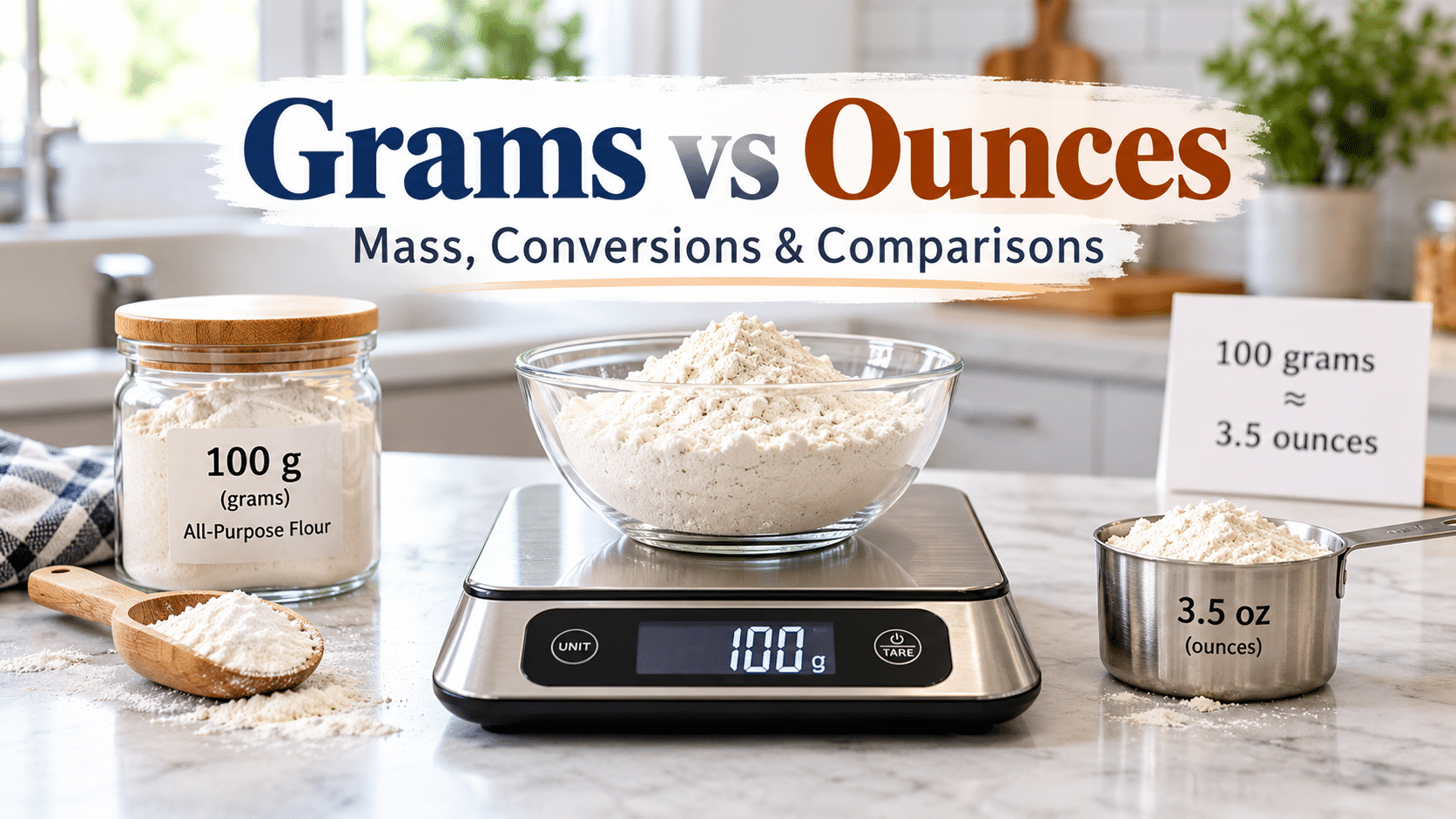
Grams vs ounces: what’s the difference? Grams (g) and ounces (oz) are both units used to measure mass, but they belong to different measurement systems. The gram is part of the metric system, while the ordinary ounce is part of the avoirdupois system used in US customary and British Imperial measurements.
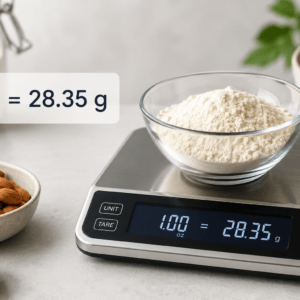
The most important conversion is that 1 ounce equals exactly 28.349523125 grams. Conversely, 1 gram equals approximately 0.035274 ounces. This means an ounce represents about 28.35 times as much mass as a gram.
Although the calculation is straightforward, choosing the correct measurement is not always so simple. Food packaging, international recipes, shipping labels, precious metals, and even measuring equipment may use different units or different meanings of the word “ounce.”
This guide explains the differences between grams and ounces, compares their everyday uses, shows how to interpret measurements correctly, and helps you avoid common conversion mistakes.
Grams vs Ounces: Quick Comparison
Both grams and ordinary ounces measure mass. Their main differences are their size, measurement system, and common applications.
| Feature | Gram | Ounce |
|---|---|---|
| Unit name | Gram | Ounce (avoirdupois) |
| Symbol | g | oz |
| Measures | Mass | Mass |
| Measurement system | Metric / SI | US customary and Imperial |
| Equivalent mass | 1 g ≈ 0.035274 oz | 1 oz = 28.349523125 g |
| Related larger unit | 1,000 g = 1 kg | 16 oz = 1 lb |
| Relative unit size | Smaller | Larger |
| Common applications | Cooking, nutrition, science, product labels | US food packaging, recipes, small packages |
Key takeaway: One ounce is approximately 28.35 grams, but an ounce is not the same as a fluid ounce or a troy ounce. Identifying the correct type of ounce is essential for accurate conversions.
What Is a Gram (g)?
A gram is a metric unit of mass. Its official symbol is the lowercase letter g.
One gram is exactly one-thousandth of a kilogram:
1 g = 0.001 kg
Because the metric system uses decimal relationships, converting between grams and kilograms is simple.
- 10 g = 0.01 kg
- 100 g = 0.1 kg
- 250 g = 0.25 kg
- 500 g = 0.5 kg
- 1,000 g = 1 kg
The kilogram is the base unit of mass in the International System of Units (SI). The gram is a decimal submultiple of the kilogram, rather than a separate SI base unit.
The international definitions of SI units are maintained by the International Bureau of Weights and Measures (BIPM).
Where are grams commonly used?
Grams are especially convenient when measuring relatively small masses.
Common applications include:
- Food ingredients and baking measurements.
- Nutrition information and serving sizes.
- Small consumer products.
- Laboratory samples and scientific measurements.
- Craft materials and small components.
- International product packaging.
For example, a food package may contain 100 g, 250 g, or 500 g of a product.
These quantities can be compared easily because they belong to a decimal measurement system.
To convert larger gram quantities into kilograms, use our Grams to Kilograms Converter.
What Is an Ounce (oz)?
An ounce is a unit of mass traditionally associated with the avoirdupois system.
Its standard symbol is oz.
The international avoirdupois ounce is the ordinary ounce used for most everyday mass measurements in the United States and in contexts where British Imperial mass units are used.
Its precise relationship to grams is:
1 oz = exactly 28.349523125 g
This relationship follows from the international avoirdupois pound:
1 pound = 16 ounces = exactly 453.59237 grams
Dividing the mass of one pound by sixteen gives:
453.59237 ÷ 16 = 28.349523125 g
Therefore, one ordinary ounce contains exactly 28.349523125 grams.
This definition is consistent with the official conversion tables published by the National Institute of Standards and Technology (NIST).
Where are ounces commonly used?
Ounces are frequently encountered in:
- American recipes and cookbooks.
- Food and grocery packaging.
- Portion-size measurements.
- Small parcels and product specifications.
- Some hobby and craft measurements.
For example, a food product might be labeled 8 oz, 12 oz, or 16 oz.
Because 16 avoirdupois ounces equal one pound, an item labeled 16 oz has the same nominal mass as a one-pound item.
However, the word ounce can also refer to different units in specialized contexts. We will examine those differences later in this guide.
Which Is Heavier: 1 Gram or 1 Ounce?
One ounce represents more mass than one gram.
The difference is substantial:
1 oz = 28.349523125 g
That means a one-ounce object has approximately 28.35 times the mass of a one-gram object.
For a simple comparison, imagine two identical containers holding the same material:
- Container A holds exactly 1 gram of material.
- Container B holds exactly 1 ounce of material.
Container B contains approximately 28.35 times as much material by mass.
But that does not mean it will always look exactly 28.35 times as large.
Physical volume depends on the density of the material. A one-ounce quantity of a dense substance can occupy less space than a lighter material with a smaller mass.
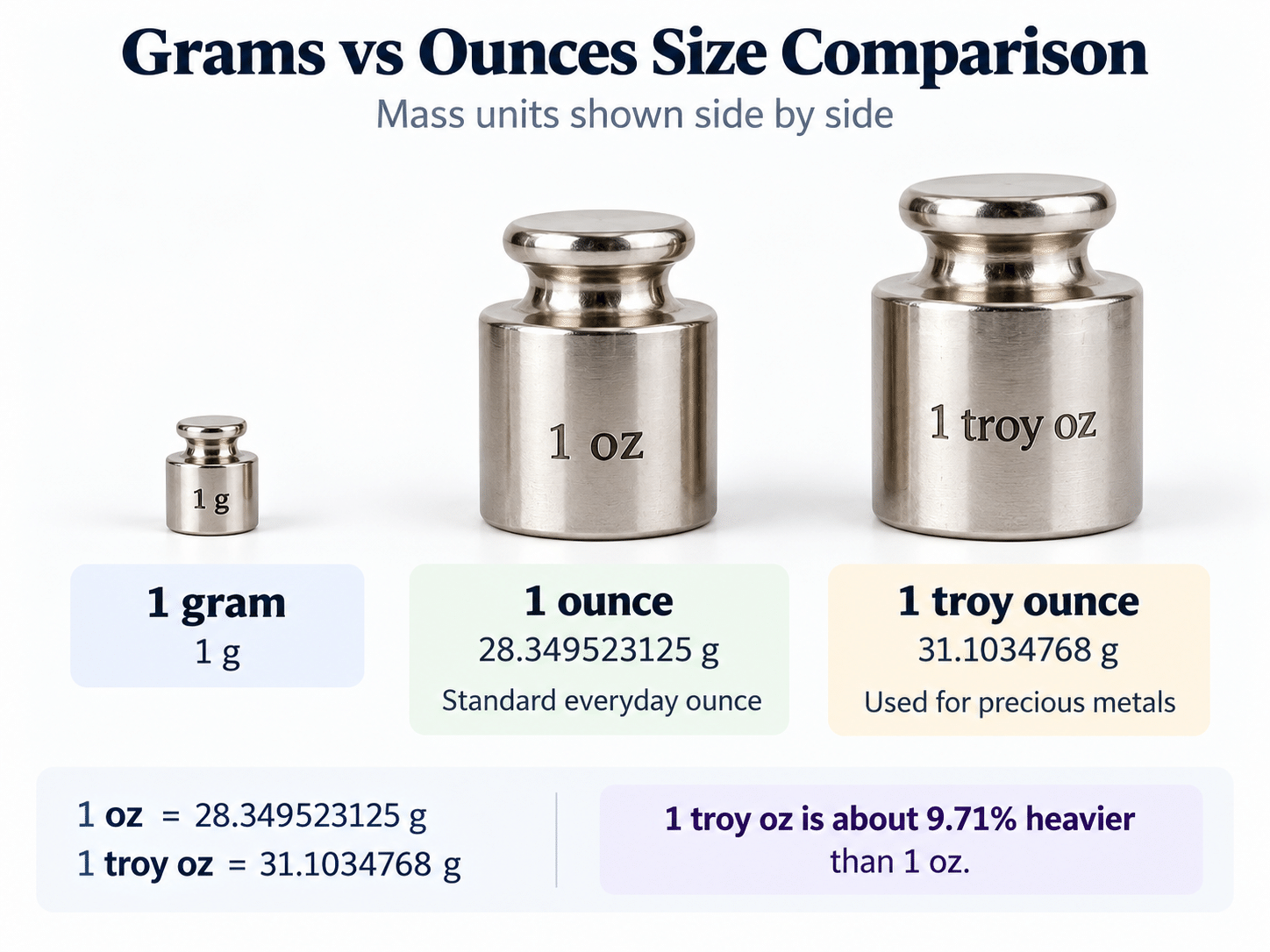
Does an ounce take up more space than a gram?
Not necessarily.
Grams and ounces describe mass, not physical volume.
If you compare equal masses of different materials, they can occupy different amounts of space.
For example, a given mass of metal usually occupies less volume than the same mass of a much less dense material.
Therefore, the most reliable way to compare grams and ounces is by using a scale or a mass conversion, rather than judging the physical size of an object.
Grams vs Ounces: Real-World Comparisons
Understanding the units becomes easier when you see how they relate to familiar quantities.
Example 1: A 100-gram food package vs. a 4-ounce package
Imagine two packages of the same product:
- Package A contains 100 g.
- Package B contains 4 oz.
To compare them, convert four ounces into grams:
4 × 28.349523125 = 113.3980925 g
Therefore:
4 oz ≈ 113.40 g
Package B contains approximately 13.40 g more product than Package A.
That represents about 13.4% more mass relative to the 100 g package.
This is a useful example of why two products with apparently similar numerical measurements may contain noticeably different amounts.
Example 2: Eight ounces of butter in a recipe
Suppose an American baking recipe calls for 8 oz of butter.
Using the exact avoirdupois conversion:
8 × 28.349523125 = 226.796185 g
Therefore:
8 oz of butter ≈ 226.80 g
For many everyday baking situations, the result may be rounded to approximately 227 g if that level of precision is appropriate.
If you have a digital kitchen scale displaying grams, you can measure the mass directly without using cups or tablespoons.
Example 3: A 250-gram product
Imagine an international product listing that specifies a mass of 250 g.
To convert to ordinary ounces:
250 ÷ 28.349523125 ≈ 8.81849 oz
Therefore:
250 g ≈ 8.82 oz
If another product is listed in ounces, converting both products into a common unit makes it easier to compare their quantities.
Example 4: A 300-gram parcel vs. a 10-ounce parcel
Suppose you are comparing two small items for shipping:
- Item A has a stated mass of 300 g.
- Item B has a stated mass of 10 oz.
Ten ounces equal:
10 × 28.349523125 = 283.49523125 g
Item B therefore has approximately 16.50 g less mass than Item A.
Actual shipping charges may also depend on packaging, dimensional weight, carrier rules, and rounding policies. Nevertheless, converting the mass units provides a useful starting point.
Metric vs US Customary Measurements: Why Are the Units Different?
Grams and ounces developed within different traditions of measurement.
The gram belongs to the metric system, which uses decimal relationships between units.
The ounce belongs to a customary mass system in which related units are connected through relationships such as:
16 ounces = 1 pound
These systems can describe the same physical mass accurately, but they express it using different numerical values.
Why are grams convenient for metric calculations?
Because the metric system uses powers of ten, changing between grams, kilograms, and milligrams involves simple decimal conversions.
For example:
250 g = 0.25 kg = 250,000 mg
These relationships are exact.
The SI system provides consistent measurement conventions for scientific work, international trade, engineering, and education.
Why do ounces remain common?
Ounces remain familiar in some customary measurement systems, especially in the United States.
American product labels, recipes, kitchen equipment, and consumer information frequently use ounces and pounds.
Using the customary system is not inherently less accurate than using metric units. Accuracy depends on the definitions, measuring instruments, calculation methods, and the quality of the original measurement.
The main difficulty arises when quantities from different systems are compared without conversion.
Avoirdupois Ounces vs Troy Ounces vs Fluid Ounces
One of the most important things to understand about ounces is that the word does not always refer to the same measurement.
Three different concepts may appear in recipes, packaging, commerce, and technical references.
| Type | Measures | Equivalent |
|---|---|---|
| Avoirdupois ounce (oz) | Mass | 28.349523125 g |
| Troy ounce (oz t) | Mass | 31.1034768 g |
| US fluid ounce (fl oz) | Volume | Approximately 29.57353 mL |
These units should not be substituted for one another.
1. Avoirdupois ounce: the standard everyday ounce
This is the ordinary ounce used in most everyday mass measurements.
1 avoirdupois oz = 28.349523125 g
It is the appropriate ounce for many food products, recipes specifying ingredient weight, parcels, and consumer goods.
The Easy Unit Convert Grams to Ounces Calculator uses this standard avoirdupois ounce.
2. Troy ounce: commonly used for precious metals
A troy ounce is another unit of mass, most closely associated with precious metals such as gold and silver.
1 troy ounce = 31.1034768 g
A troy ounce has approximately 9.71% more mass than an ordinary avoirdupois ounce.
The numerical difference between the two types of ounces is:
31.1034768 − 28.349523125 = 2.753953675 g
That may appear small, but using the wrong definition can create a significant discrepancy when measuring precious metals.
For example, a product described as containing one troy ounce of gold should not be treated as though it contains only 28.35 g.
If a precious-metal specification uses troy ounces, use a conversion specifically intended for that unit.
3. Fluid ounce: a measurement of volume
A fluid ounce is fundamentally different from the two mass units above.
A fluid ounce measures volume.
In the US customary system:
1 US fluid ounce ≈ 29.57353 mL
The Imperial fluid ounce used in historical and certain UK-related contexts represents approximately 28.41306 mL.
Neither of these volume units can be universally converted into grams without additional information.
For example, 100 mL of water and 100 mL of cooking oil have the same volume, but they generally have different masses.
The relationship between mass and volume depends on density:
Mass = Volume × Density
The units must be compatible. For example, multiplying a volume in milliliters by a density in grams per milliliter produces a mass in grams.
Important: If a recipe or product label specifies fl oz, do not use an ordinary ounce-to-grams conversion factor without considering the ingredient and its density.
How to Read Grams and Ounces on Food Labels
Food packaging often provides an excellent real-world example of grams versus ounces.
A product sold in the United States may display its net quantity in US customary and metric units.
For example, a package might state:
NET WT 8 OZ (227 g)
The two values describe approximately the same nominal mass, with the metric quantity rounded for labeling.
According to the US Food and Drug Administration’s guidance on metric quantity declarations, weight and volume measurements have different labeling conventions.
Net weight vs. serving size
One common source of confusion is the difference between the total net mass of a product and its suggested serving size.
For example, imagine a package containing 200 g of a food product.
Its nutrition information may describe an individual serving of 30 g.
Those two numbers answer different questions:
- 200 g: total stated net mass of the food in the package.
- 30 g: mass of one serving used for the nutritional information.
A conversion into ounces does not change that distinction.
The total package contains approximately 7.05 oz, while a 30 g serving contains approximately 1.06 oz.
Does 1 oz always mean 28 g on a nutrition label?
The precise avoirdupois conversion is 28.349523125 g per ounce.
However, labels and serving-size descriptions may use rounded metric equivalents according to applicable labeling conventions.
For example, an ounce-sized serving may sometimes be represented with a rounded gram quantity rather than all the decimal places of the exact conversion.
When interpreting an actual product’s Nutrition Facts information, use the stated serving-size quantity and the applicable labeling requirements rather than assuming that every displayed number is mathematically unrounded.
Grams vs Ounces in Cooking and Baking
International recipes frequently use different mass units, even when they describe the same ingredient.
For example, an American recipe may specify 4 oz of cheese, while a recipe elsewhere may give the amount in grams.
Both describe ingredient mass, so conversion between grams and ordinary ounces is direct.
By contrast, a recipe expressed in cups uses volume measurements. Converting cups into grams depends on the ingredient and how it is measured.
Why are digital kitchen scales useful?
A digital kitchen scale can display ingredient mass directly.
Many kitchen scales offer a unit-selection function that allows the display to switch between grams and ounces.
This makes it possible to use recipes from different countries without manually converting every ingredient.
However, check whether the display is set to grams, ounces, or another unit before recording the quantity.
A scale displaying 4.0 oz is not measuring the same mass as a scale displaying 4.0 g.
When should you measure ingredients in grams?
Grams can be particularly convenient for recipes requiring relatively small or precisely specified quantities.
Examples include:
- Measuring flour and other dry ingredients by mass.
- Portioning chocolate or butter.
- Weighing small quantities of ingredients.
- Scaling recipes up or down.
- Following international baking formulas.
For very small quantities, use a scale whose resolution and accuracy are appropriate for the measurement. A kitchen scale that changes only in whole-gram increments may not be suitable for accurately measuring tiny quantities.
How to weigh ingredients consistently
- Place the empty container on the scale.
- Use the tare or zero function to exclude the container’s mass.
- Select grams or ounces as required by the recipe.
- Add the ingredient until the display reaches the specified mass.
- Check the final reading before moving or removing the container.
This method avoids the need to estimate how tightly an ingredient should be packed into a measuring cup.
It also provides a consistent approach when a recipe uses both metric and customary mass units.
How to Convert Grams and Ounces Accurately
Once you have identified the ordinary avoirdupois ounce, the mathematical conversion is straightforward.
Convert grams to ounces
Use this formula:
Ounces = Grams ÷ 28.349523125
For example, convert 150 grams into ounces:
150 ÷ 28.349523125 ≈ 5.29109 oz
Rounded to two decimal places:
150 g ≈ 5.29 oz
For any other amount, use our Grams to Ounces Converter, which calculates the result using the full conversion factor.
Convert ounces to grams
For the reverse calculation:
Grams = Ounces × 28.349523125
For example, convert 6 ounces into grams:
6 × 28.349523125 = 170.09713875 g
Rounded to two decimal places:
6 oz ≈ 170.10 g
You can also use our Ounces to Grams Calculator to calculate the equivalent directly.
Grams and Ounces Comparison Charts
The following tables provide practical reference values using ordinary avoirdupois ounces.
They are intended for quick comparisons. For other amounts, the calculators linked above provide more flexible conversions.
Common gram quantities expressed in ounces
| Grams (g) | Ounces (oz) |
|---|---|
| 1 g | 0.0353 oz |
| 10 g | 0.3527 oz |
| 25 g | 0.8818 oz |
| 50 g | 1.7637 oz |
| 100 g | 3.5274 oz |
| 125 g | 4.4092 oz |
| 150 g | 5.2911 oz |
| 200 g | 7.0548 oz |
| 250 g | 8.8185 oz |
| 500 g | 17.6370 oz |
| 1,000 g | 35.2740 oz |
Common ounce quantities expressed in grams
| Ounces (oz) | Grams (g) |
|---|---|
| 0.25 oz | 7.087 g |
| 0.5 oz | 14.175 g |
| 1 oz | 28.350 g |
| 2 oz | 56.699 g |
| 3 oz | 85.049 g |
| 4 oz | 113.398 g |
| 5 oz | 141.748 g |
| 8 oz | 226.796 g |
| 10 oz | 283.495 g |
| 12 oz | 340.194 g |
| 16 oz | 453.592 g |
Values are rounded for display. Both charts use the exact relationship of 1 avoirdupois ounce = 28.349523125 grams.
Do Grams and Ounces Measure Weight or Mass?
In everyday conversation, grams and ounces are frequently called units of weight.
In scientific terminology, however, the gram and ordinary avoirdupois ounce are units of mass.
Mass and weight are related, but they are not identical physical quantities.
Mass is an intrinsic property of an object. Weight, in the physics sense, describes a gravitational force acting on the object.
For example, an object with a mass of 100 grams retains that mass whether it is on Earth or the Moon.
Its gravitational weight changes because the gravitational field is different.
The SI unit of force is the newton (N).
For ordinary grocery shopping, cooking, and product labels, the word weight is often used informally to describe an object’s mass.
The distinction becomes especially important in scientific and engineering calculations, where mass and force must not be confused.
Why Do Different Scales or Conversion Tools Show Slightly Different Results?
You may notice that the same mass is sometimes displayed with slightly different decimal values.
For example:
- 1 oz = 28 g
- 1 oz ≈ 28.35 g
- 1 oz = 28.349523125 g
These figures represent different levels of numerical precision, rather than three different ordinary-ounce definitions.
However, 28 g is only an approximation, while 28.349523125 g is the exact international avoirdupois conversion.
When is rounding acceptable?
For everyday recipes, rounding a mass to the nearest gram may often be practical if the recipe and measuring equipment do not require greater precision.
For example, 4 oz equals approximately 113.40 g. A recipe may reasonably use a rounded value when appropriate.
For analytical, commercial, or other measurements where accuracy is particularly important, retain the necessary precision and follow the relevant measurement standards.
Does a precise conversion make the original measurement exact?
No.
A conversion factor can be mathematically exact even when the original measured quantity has uncertainty.
For example, if a scale measures only to the nearest whole gram, converting its reading into ounces does not suddenly make the original measurement accurate to six decimal places.
The reliability of the final result depends on both the conversion method and the quality of the input measurement.
Seven Common Grams vs Ounces Mistakes
1. Assuming one ounce equals one gram
The units are not equivalent. One ordinary ounce contains approximately 28.35 grams.
2. Confusing ounces with fluid ounces
Ordinary ounces measure mass, while fluid ounces measure volume. Converting between volume and mass requires the density of the substance.
3. Using ordinary ounces for precious metals
Precious-metal quantities may be expressed in troy ounces, which contain approximately 31.10348 grams each.
4. Converting in the wrong direction
To convert grams into ounces, divide by 28.349523125.
To convert ounces into grams, multiply by 28.349523125.
5. Treating rounded conversion values as exact
Using 28 g instead of 28.349523125 g introduces an approximation. Whether that matters depends on the intended use.
6. Comparing product quantities without checking the units
A 100 g package and a 4 oz package do not contain identical masses. Convert the measurements into the same unit before comparing them.
7. Confusing mass with volume when adapting recipes
A cup of flour represents a volume measurement, while 100 g of flour represents a mass measurement.
A universal cups-to-grams conversion cannot be applied to every ingredient without accounting for the ingredient’s properties.
Frequently Asked Questions About Grams vs Ounces
What is the main difference between grams and ounces?
Both measure mass, but grams are metric units, while ordinary ounces are part of the avoirdupois measurement system. One ounce equals exactly 28.349523125 grams.
Which is bigger, a gram or an ounce?
An ounce is the larger unit of mass. One ordinary ounce represents approximately 28.35 grams.
How many grams are in 1 ounce?
One ordinary avoirdupois ounce equals exactly 28.349523125 grams. For everyday use, it is commonly rounded to 28.35 g.
How many ounces are in 1 gram?
One gram equals approximately 0.03527396 avoirdupois ounces.
Is 1 ounce the same as 30 grams?
No. One ordinary ounce is approximately 28.35 grams. Thirty grams equal approximately 1.0582 ounces.
Is 28 grams equal to 1 ounce?
Not exactly. One ounce equals 28.349523125 grams, so 28 grams are approximately 0.9877 ounces. The two values are close but not identical.
How many ounces are in 100 grams?
100 grams equal approximately 3.5274 ordinary ounces, commonly rounded to 3.53 oz.
How many grams are in 4 ounces?
Four avoirdupois ounces equal 113.3980925 grams, approximately 113.40 g.
How many grams are in 8 ounces?
Eight ordinary ounces equal 226.796185 grams, approximately 226.80 g.
Are grams more accurate than ounces?
No. Both are precisely defined units of mass. Measurement accuracy depends on the measuring instrument, the original data, and the calculation method.
Are US and UK ounces the same?
For the ordinary international avoirdupois ounce used to measure mass, the conversion is the same: 28.349523125 grams. However, US and Imperial fluid ounces are different volume units.
Is a troy ounce the same as a regular ounce?
No. A troy ounce equals 31.1034768 grams, while an ordinary avoirdupois ounce equals 28.349523125 grams. Troy ounces are commonly associated with precious metals.
Can I convert fluid ounces directly into grams?
Not with one universal conversion factor. Fluid ounces measure volume, while grams measure mass. You need the substance’s density to convert accurately between the two.
Do grams and ounces measure the same quantity?
Yes, when ounce refers to an ordinary avoirdupois ounce, both are units of mass. They differ in their numerical size and measurement systems.
How many ounces are in one kilogram?
One kilogram contains approximately 35.274 ordinary avoirdupois ounces.
What is the best way to compare grams and ounces on food labels?
Convert both quantities into the same mass unit, preferably using the exact avoirdupois conversion factor. Also distinguish the product’s total net mass from any serving-size information.
Grams vs Ounces: Final Comparison
Grams and ounces can both describe an object’s mass accurately, but they use different numerical scales.
The key relationships to remember are:
- 1 ordinary ounce = exactly 28.349523125 grams
- 1 gram ≈ 0.035274 ordinary ounces
- 16 ordinary ounces = 1 pound
- 1,000 grams = 1 kilogram
The most important practical distinction is between ordinary ounces, troy ounces, and fluid ounces. They are not interchangeable measurements.
When comparing food labels, recipes, small packages, or product specifications, make sure you identify the correct unit and convert both quantities into a common measurement system.
For instant calculations, use our Grams to Ounces Converter or Ounces to Grams Converter.
You can also explore the Weight Converters collection for related conversions involving kilograms, pounds, grams, ounces, and stones.
Sources and Measurement Methodology
This guide uses the international avoirdupois ounce as the standard ounce for everyday mass measurements.
The exact factor used throughout the article is:
1 avoirdupois ounce = 28.349523125 grams.
Conversions from ounces to grams are calculated by multiplying by this factor. Reverse conversions divide by the same factor. Unless otherwise specified, calculated results are rounded for readability.
The distinction between avoirdupois ounces, troy ounces, and fluid ounces follows established measurement references.
Official sources:
- National Institute of Standards and Technology (NIST) – Guide to the SI, Appendix B.9: Mass Conversion Factors. Official relationships for avoirdupois ounces, troy ounces, pounds, grams, and kilograms.
- NIST – Approximate Conversions from US Customary Measures to Metric. Practical conversion references distinguishing mass and volume measurements.
- International Bureau of Weights and Measures (BIPM) – SI Base Unit: Kilogram. International definition of the SI base unit of mass.
- US Food and Drug Administration (FDA) – Metric Declarations of Quantity of Contents on Product Labels. Reference for the distinction between net weight and fluid measure on product labels.
- Easy Unit Convert – Accuracy & Editorial Policy. Information about the website’s calculation standards and editorial methodology.
Editorial note: This article discusses ordinary international avoirdupois ounces unless another ounce type is explicitly identified. The troy ounce and fluid ounce are treated separately because they represent different measurement conventions or physical quantities. The illustrative product and recipe examples are intended to demonstrate unit comparisons, not to replace the measurement requirements of specific commercial, technical, or regulatory applications.