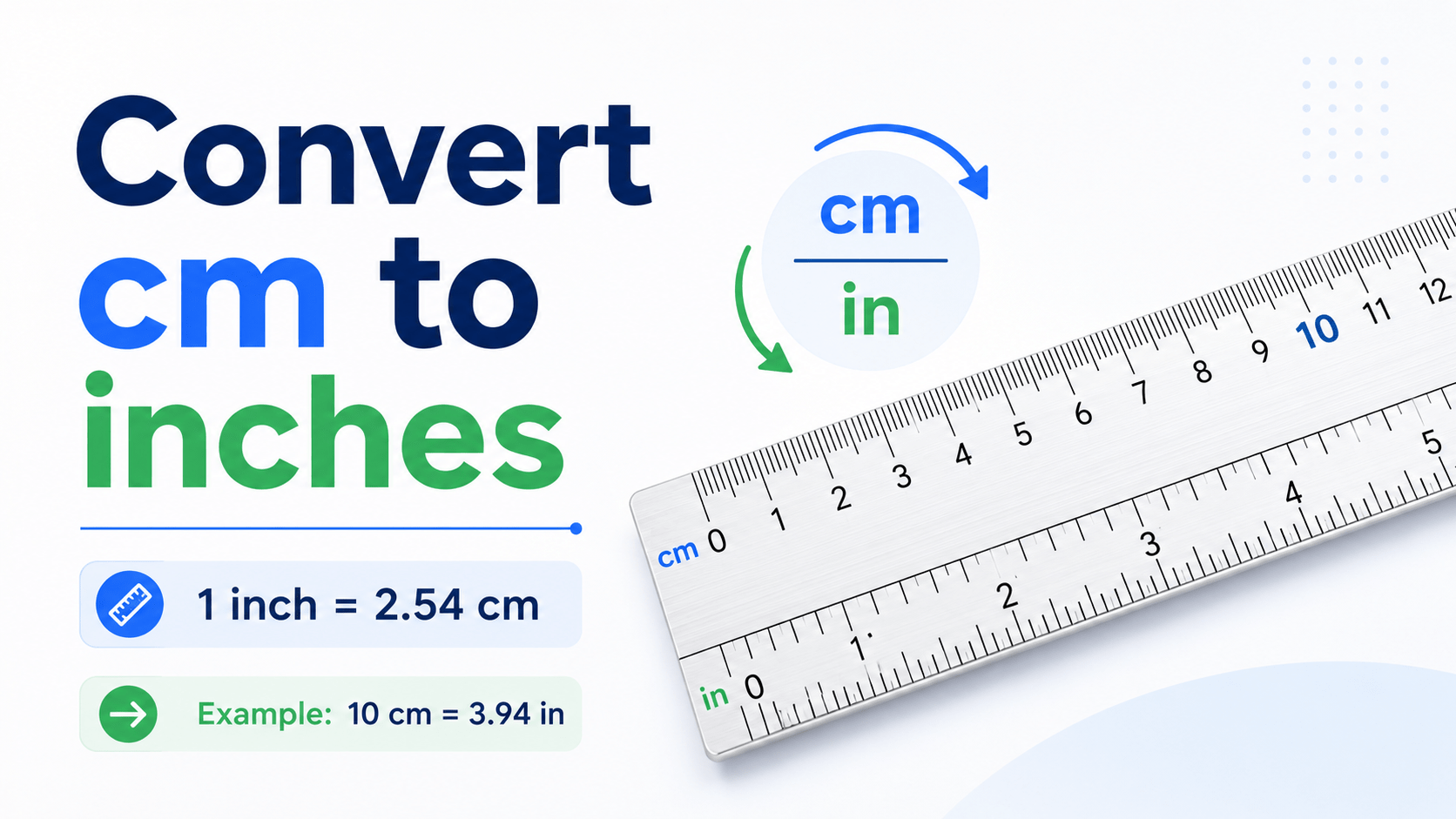
If you need to convert cm to inches, the exact rule is simple: divide the number of centimeters by 2.54. One inch is defined as exactly 2.54 centimeters, so 1 centimeter equals approximately 0.3937007874 inches. Use the calculator below for an instant result, or continue for the formula, worked examples, practical uses, accuracy guidance and a quick conversion chart.
Convert cm to Inches Instantly
Need a fast answer? Enter any length in centimeters into the calculator below and it will return the equivalent length in inches. The calculator uses the exact relationship of 1 inch = 2.54 centimeters and rounds only the displayed result.
Quick formula: inches = centimeters ÷ 2.54
How to Convert cm to Inches
To convert cm to inches manually, divide the centimeter value by 2.54:
inches = centimeters ÷ 2.54
For example, to convert 25 cm:
25 ÷ 2.54 = 9.842519685 inches
Rounded to two decimal places:
25 cm ≈ 9.84 inches
You may also multiply centimeters by approximately 0.3937007874. Dividing by 2.54 is usually the clearest method because it comes directly from the exact definition of the inch.
Why is 2.54 used?
The relationship is not an estimate:
1 inch = exactly 2.54 centimeters
This means the conversion factor itself does not introduce uncertainty. Any difference in a displayed result comes from rounding or from the precision of the original measurement.
The U.S. National Institute of Standards and Technology (NIST) lists one inch as exactly 2.54 centimeters.
Worked cm to Inches Examples
Example 1: 15 cm to inches
15 ÷ 2.54 = 5.905511811
Therefore:
15 cm ≈ 5.91 inches
This is a useful type of conversion for product dimensions, picture frames, clothing measurements and small household items.
Example 2: 30.48 cm to inches
30.48 ÷ 2.54 = 12
Therefore:
30.48 cm = 12 inches
This is also exactly one international foot because one foot contains 12 inches.
Example 3: 50 cm to inches
50 ÷ 2.54 = 19.68503937
Therefore:
50 cm ≈ 19.69 inches
For everyday measurements, two decimal places are usually easy to read. For technical work, keep enough digits for the precision required by the task.
What Is a Centimeter?
A centimeter, symbol cm, is one hundredth of a meter:
1 cm = 0.01 m
Centimeters are convenient for measuring objects that are too small to describe comfortably in meters but larger than measurements usually expressed in millimeters.
They are widely used for body measurements, furniture dimensions, packaging, schoolwork, maps, crafts and many everyday measurements in countries that use the metric system.
What Is an Inch?
An inch, symbol in, is a unit of length used in U.S. customary measurements and in the modern Imperial system.
The modern inch is defined as exactly:
25.4 millimeters
which is the same as:
2.54 centimeters
Inches are especially common in the United States for everyday dimensions, construction, tools and product specifications. They are also used internationally for some product categories, such as television and monitor screen diagonals.
When Do You Need to Convert Centimeters to Inches?
Centimeters and inches often appear together because products, plans and measurements cross between metric and U.S. customary or Imperial conventions.
Online shopping and product dimensions
International stores may list furniture, bags, picture frames, storage boxes or accessories in centimeters while you are more familiar with inches.
Converting the measurements before ordering helps you compare the product with the space or object you already have.
Clothing and body measurements
Size charts may show chest, waist, sleeve or inseam measurements in centimeters, while a tape measure or familiar sizing guide uses inches.
A correct conversion can make it easier to compare measurements across brands and countries.
DIY, woodworking and home improvement
Plans and components may use metric measurements while tools, fasteners or reference materials use inches.
Converting accurately helps reduce fitting errors, especially when several measurements must match.
Screens and electronics
Screen diagonal sizes are commonly described in inches, even in countries where most other dimensions are metric.
Product specifications may also give width and height in centimeters, so converting between the two can make comparisons easier.
Education, science, design and technical work
Students, designers, engineers and technicians may encounter measurements from sources that use different unit systems.
Converting units correctly is important when comparing data, drawings or specifications.
For precision work, always follow the tolerance and rounding requirements of the project rather than relying on a rounded display value alone.
Why Accurate cm to Inches Conversion Matters
A rough estimate can be useful for mental math, but rounding too early may create a noticeable error.
For example, if you use the rough shortcut:
1 cm ≈ 0.39 inches
then:
25 × 0.39 = 9.75 inches
Using the exact definition instead:
25 ÷ 2.54 = 9.842519685 inches
The difference is about 0.09 inch.
That may not matter for a quick estimate, but it can matter when checking whether an object fits a space, matching a component or working from a technical drawing.
For reliable results, use 2.54 cm per inch exactly and round only the final answer.
Conversion Accuracy and Rounding
The conversion factor is exact, but the original measurement may not be.
For example, if an object is measured as 25 cm only to the nearest centimeter, displaying:
9.842520 inches
can imply more measurement precision than you actually have.
In many everyday situations, rounding to two decimal places is appropriate:
25 cm ≈ 9.84 in
For manufacturing, engineering or other precision-sensitive work, retain the number of decimal places required by the specification and use appropriately calibrated measuring equipment.
The calculator on this page keeps additional precision during the calculation and rounds only the displayed result.
Ez a rész szerintem különösen értékes az új oldalon, mert nem csak újramondjuk az átváltási képletet, hanem elmagyarázzuk a conversion accuracy és measurement precision közötti különbséget.
Common Mistakes When Converting cm to Inches
Multiplying by 2.54 instead of dividing.
To go from centimeters to inches, divide by 2.54. Multiplying by 2.54 converts inches to centimeters.
Using 0.39 as an exact factor.
The value 0.39 is only a rough approximation. For a more accurate answer, divide by 2.54 or use 0.3937007874 as an approximate multiplier.
Confusing centimeters with millimeters.
Ten millimeters equal one centimeter, so make sure the input unit is really cm before converting.
Rounding during intermediate steps.
Keep the full calculator result and round at the end. This is particularly useful when several dimensions are being converted.
Centimeters to Inches and Back Again
The two formulas are direct reverses of each other:
cm to inches:
inches = cm ÷ 2.54
inches to cm:
centimeters = inches × 2.54
If your starting measurement is in inches, use our Convert Inches to cm tool for the reverse calculation.
Itt a Convert Inches to cm szöveget linkeld a meglévő fordított konverteredre.
Conversion Standard and How We Check Accuracy
Easy Unit Convert uses standardized unit relationships rather than estimating the conversion factor.
The U.S. National Institute of Standards and Technology (NIST) lists:
1 inch = 2.54 centimeters exactly
Our calculator applies that exact relationship and only rounds the result for display.
For more information about how conversion factors and page content are checked, see our Accuracy & Editorial Policy.
Az Accuracy & Editorial Policy szöveget itt mindenképpen linkeld a most elkészített policy oldaladra. Ez már ténylegesen hozzákapcsolja az egyedi converter-oldalt a trust/editorial rendszerünkhöz.
Related Length Converters
You may also find these tools useful:
- Convert Inches to cm
- MM to Inches Converter
- Inches to MM Converter
- Convert feet to inches
- Convert Inches to Feet
- Length Converters
cm to Inches Conversion Table
Use this table when you want to convert cm to inches quickly without entering each value into the calculator. Values are rounded to four decimal places.
| Centimeters (cm) | Inches (in) |
|---|---|
| 1 | 0.3937 |
| 10 | 3.9370 |
| 20 | 7.8740 |
| 30 | 11.8110 |
| 40 | 15.7480 |
| 50 | 19.6850 |
| 60 | 23.6220 |
| 70 | 27.5591 |
| 80 | 31.4961 |
| 90 | 35.4331 |
| 100 | 39.3701 |
For any value not shown in the table, use the calculator at the top of the page.
Frequently Asked Questions
1 cm is approximately 0.3937007874 inches, usually rounded to 0.3937 inches.
To convert cm to inches, divide the number of centimeters by 2.54:
inches = cm ÷ 2.54
Yes. The modern inch is defined as exactly 2.54 centimeters, or 25.4 millimeters
No. 0.3937 inches is a rounded value.
Because 1 inch equals exactly 2.54 cm, its reciprocal does not terminate at four decimal places:
1 cm ≈ 0.3937007874 inches
10 cm is approximately 3.9370 inches.
100 cm is approximately 39.3701 inches.
Divide centimeters by 2.54.
Multiplying by 2.54 performs the reverse conversion, from inches to centimeters.
For everyday measurements, two decimal places are often sufficient.
For technical or precision-sensitive work, use the number of decimal places required by the relevant specification and keep in mind the precision of the original measurement.