Convert Feet to Inches Instantly
Need to convert feet to inches quickly? Enter any value in feet into the calculator below and get the equivalent measurement in inches instantly.
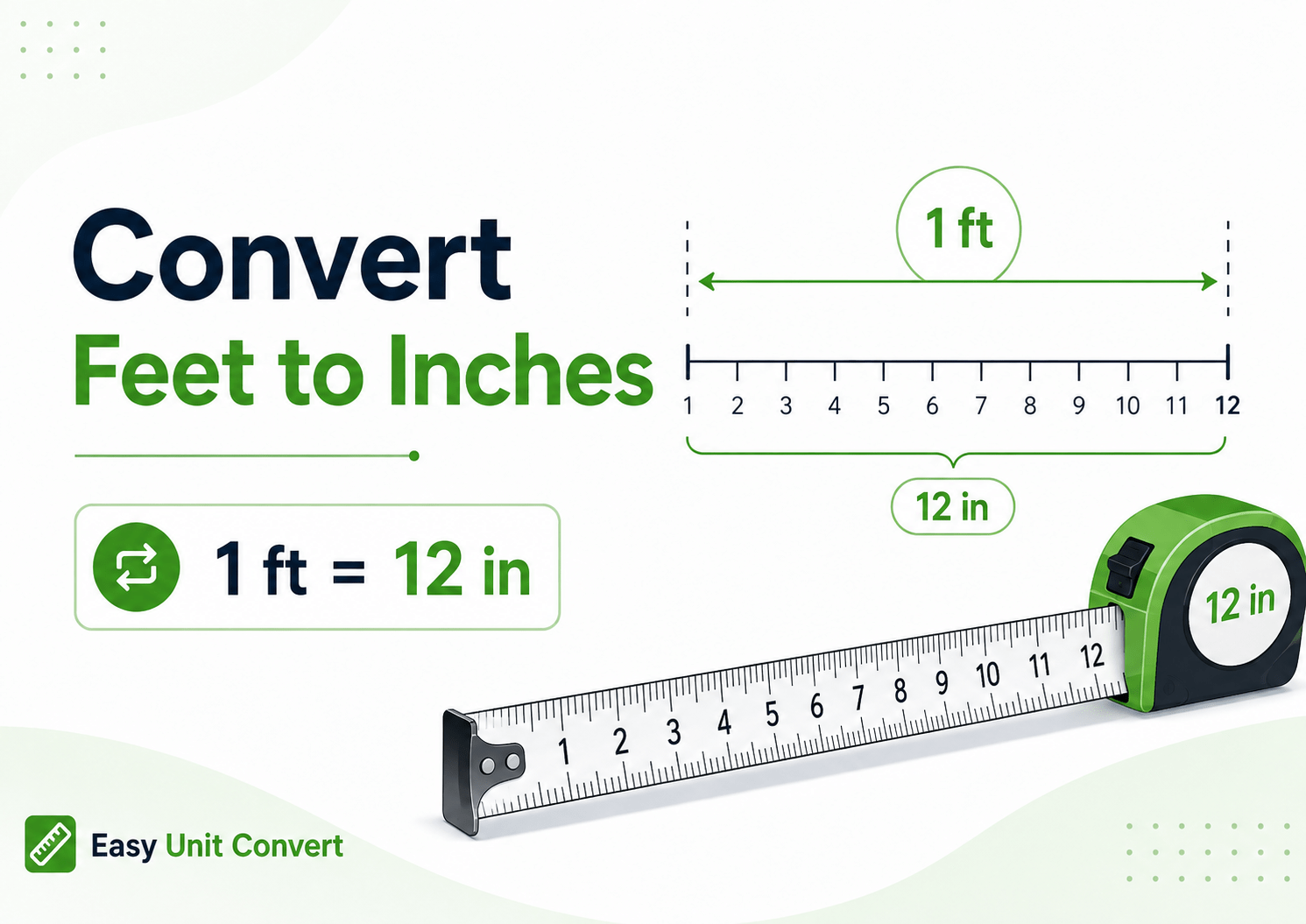
The conversion is exact: 1 foot equals exactly 12 inches. This means there is no approximate conversion factor or rounding required. Simply multiply the number of feet by 12.
Use the calculator for whole numbers or decimal values, whether you are measuring a room, checking furniture dimensions, working on a construction project, studying measurement units, or converting a height or length.
How to Convert Feet to Inches
To convert feet to inches, multiply the number of feet by 12.
The formula is:
Inches = Feet × 12
This works because:
1 foot = 12 inches exactly
For example, if a measurement is 5 feet:
5 × 12 = 60 inches
Therefore:
5 ft = 60 in
Unlike many conversions between different measurement systems, this calculation does not require an approximate conversion factor. The relationship between feet and inches is exact.
Example: Convert 8 Feet to Inches
Multiply 8 by 12:
8 × 12 = 96
So:
8 feet = 96 inches
Example: Convert 3.5 Feet to Inches
Decimal feet are converted in exactly the same way:
3.5 × 12 = 42
Therefore:
3.5 feet = 42 inches
Example: Convert 7.25 Feet to Inches
7.25 × 12 = 87
Therefore:
7.25 feet = 87 inches
This is particularly useful when plans, specifications or measurements use decimal feet rather than a feet-and-inches format.
What Are Feet and Inches?
A foot, abbreviated ft, is a unit of length used primarily in the U.S. customary system and in some applications associated with Imperial measurements.
An inch, abbreviated in, is a smaller unit of length.
The relationship is fixed:
1 ft = 12 in
The modern international foot is also defined as exactly 0.3048 meters, while one inch is exactly 2.54 centimeters.
These exact definitions make conversions between feet and inches straightforward and reliable.
Why Is Converting Feet to Inches Important?
Although feet and inches belong to the same measurement system, they are often used for different types of measurements.
Feet are convenient for larger dimensions such as:
- room length and width;
- ceiling height;
- building dimensions;
- human height;
- longer pieces of timber;
- floor plans.
Inches are often more convenient when a smaller or more precise measurement is needed.
For example, a room may be described as 12 feet wide, while a shelf may be specified as 36 inches wide. Converting both measurements to the same unit makes comparisons and calculations easier.
Using a consistent unit can also reduce mistakes when calculating dimensions, ordering materials or checking whether an object will fit into a particular space.
Where Is the Feet-to-Inches Conversion Most Commonly Used?
The need to convert feet to inches appears in many everyday and professional situations.
Construction and Home Improvement
Feet and inches are widely encountered in construction, renovation and DIY projects in the United States.
You may need the conversion when measuring:
- walls;
- doors;
- windows;
- timber;
- shelving;
- flooring;
- countertops;
- ceiling heights.
For example, a wall that is 9 feet high is:
9 × 12 = 108 inches high
Having all measurements in inches can make it easier to compare dimensions or calculate smaller sections.
Furniture and Interior Design
Furniture specifications often use inches even when room dimensions are given in feet.
Suppose a space is 7 feet wide and you want to determine whether a 78-inch piece of furniture will fit.
Convert the space first:
7 × 12 = 84 inches
The available width is therefore 84 inches, allowing you to compare the measurements directly.
Architecture and Floor Plans
Architectural drawings and floor plans may contain measurements expressed in feet, inches or a combination of both.
Converting measurements into a single unit can simplify calculations involving layouts, spacing and dimensions.
Human Height
Height is commonly expressed as a combination of feet and inches in the United States.
For example:
6 feet = 72 inches
A person who is 5 feet 10 inches tall can also be expressed entirely in inches:
(5 × 12) + 10 = 70 inches
Education
Feet-to-inches conversions are also common in mathematics and measurement lessons.
Because the conversion factor is a whole number, it is a useful way to learn how units within a measurement system relate to one another.
Crafts and DIY Projects
Woodworking, sewing, framing and other practical projects can involve measurements supplied in different units. Converting everything to inches may make it easier to mark materials precisely and avoid measurement errors.
How to Convert Feet and Inches to Total Inches
Sometimes a measurement contains both units, such as:
5 ft 8 in
First convert the feet:
5 × 12 = 60 inches
Then add the remaining 8 inches:
60 + 8 = 68 inches
Therefore:
5 ft 8 in = 68 in
The general formula is:
Total inches = (Feet × 12) + Additional inches
Another example:
6 ft 4 in
(6 × 12) + 4 = 76 inches
So:
6 ft 4 in = 76 in
Understanding Decimal Feet
A decimal value in feet is not the same thing as writing feet and inches.
For example:
5.5 feet = 66 inches
because:
5.5 × 12 = 66
This corresponds to:
5 ft 6 in
However, 5.8 feet does not mean 5 feet 8 inches.
Instead:
5.8 × 12 = 69.6 inches
That equals:
5 feet 9.6 inches
This distinction is important when working with decimal measurements in engineering, construction software or technical documents.
Measurement Standard and Accuracy
The feet-to-inches relationship is an exact conversion, not an approximation.
The U.S. National Institute of Standards and Technology (NIST) defines the international foot as:
1 foot = 12 inches exactly
and:
1 foot = 0.3048 meter exactly
Because the conversion factor is exact, a feet-to-inches calculation does not introduce rounding error by itself. Any rounding only becomes necessary if the original measurement already contains more decimal places than you want to display.
This calculator uses the exact factor of 12 inches per foot.
What About the U.S. Survey Foot?
Historically, the United States also used a slightly different unit called the U.S. survey foot for some surveying and mapping applications.
NIST and other U.S. federal agencies discontinued its use for most purposes after December 31, 2022 in favor of the international foot.
For an ordinary feet-to-inches conversion, this historical distinction does not change the practical relationship used here: a foot is divided into 12 inches.
Common Feet-to-Inches Conversion Mistakes
The calculation itself is simple, but several mistakes are common.
Dividing Instead of Multiplying
When converting from feet to the smaller unit of inches, multiply by 12.
Correct:
4 ft × 12 = 48 in
To go in the opposite direction—from inches to feet—you divide by 12.
Confusing Decimal Feet With Feet and Inches
As explained above, 6.5 feet means 6 feet 6 inches, not 6 feet 5 inches.
Always convert the decimal portion by multiplying it by 12.
Mixing Units in the Same Calculation
If one measurement is in feet and another is in inches, convert them to the same unit before adding, subtracting or comparing them.
Rounding Too Early
If your original measurement contains decimals, keep the full value during your calculation and round only the final result when necessary.
Quick Feet to Inches Examples
Here are several common conversions:
- 1 foot = 12 inches
- 2 feet = 24 inches
- 3 feet = 36 inches
- 4 feet = 48 inches
- 5 feet = 60 inches
- 6 feet = 72 inches
- 8 feet = 96 inches
- 10 feet = 120 inches
- 12 feet = 144 inches
For any other value, use the calculator above or multiply the number of feet by 12.
Convert Feet to Inches Conversion Table
The following quick-reference table shows common values from 1 to 100 feet.
| Feet (ft) | Inches (in) |
|---|---|
| 1 | 12 |
| 10 | 120 |
| 20 | 240 |
| 30 | 360 |
| 40 | 480 |
| 50 | 600 |
| 60 | 720 |
| 70 | 840 |
| 80 | 960 |
| 90 | 1,080 |
| 100 | 1,200 |
Because the relationship is exact, every value in the table is calculated using:
inches = feet × 12
Related Length Converters
If you work with length measurements regularly, these related tools may also be useful:
- Convert Inches to Feet
- Convert Feet to Meters
- Convert Meters to Feet
- Convert Inches to Centimeters
- Convert Centimeters to Inches
- MM to Inches Converter
Accuracy Note
Easy Unit Convert uses established unit definitions and exact conversion factors wherever available. For this calculator, the conversion factor is 1 foot = 12 inches exactly.
For more information about how conversion factors, formulas and content are checked, see our Accuracy & Editorial Policy.
Frequently Asked Questions
There are exactly 12 inches in 1 foot.
Multiply the number of feet by 12:
inches = feet × 12
For example:
7 ft × 12 = 84 in
There are 60 inches in 5 feet:
5 × 12 = 60
There are 72 inches in 6 feet:
6 × 12 = 72
Yes. Multiply the decimal value by 12 just as you would with a whole number.
For example:
2.75 × 12 = 33 inches
Therefore:
2.75 feet = 33 inches
Multiply the feet by 12 and add the remaining inches.
For example:
5 ft 7 in = (5 × 12) + 7 = 67 inches
For the standard international foot used today, yes. One foot is exactly 12 inches.
The standard relationship between these units is the same: 1 foot equals 12 inches. However, the countries differ in how frequently they use feet and inches in official and everyday measurements.
Usually not. Because 1 foot equals exactly 12 inches, the conversion factor itself does not require rounding.
If your starting value contains many decimal places, you may choose to round the final result for practical use.