Use our grams to kilos calculator to convert grams (g) to kilograms (kg) instantly. Enter any value in grams below and the calculator will return the equivalent mass in kilograms.
Quick answer:
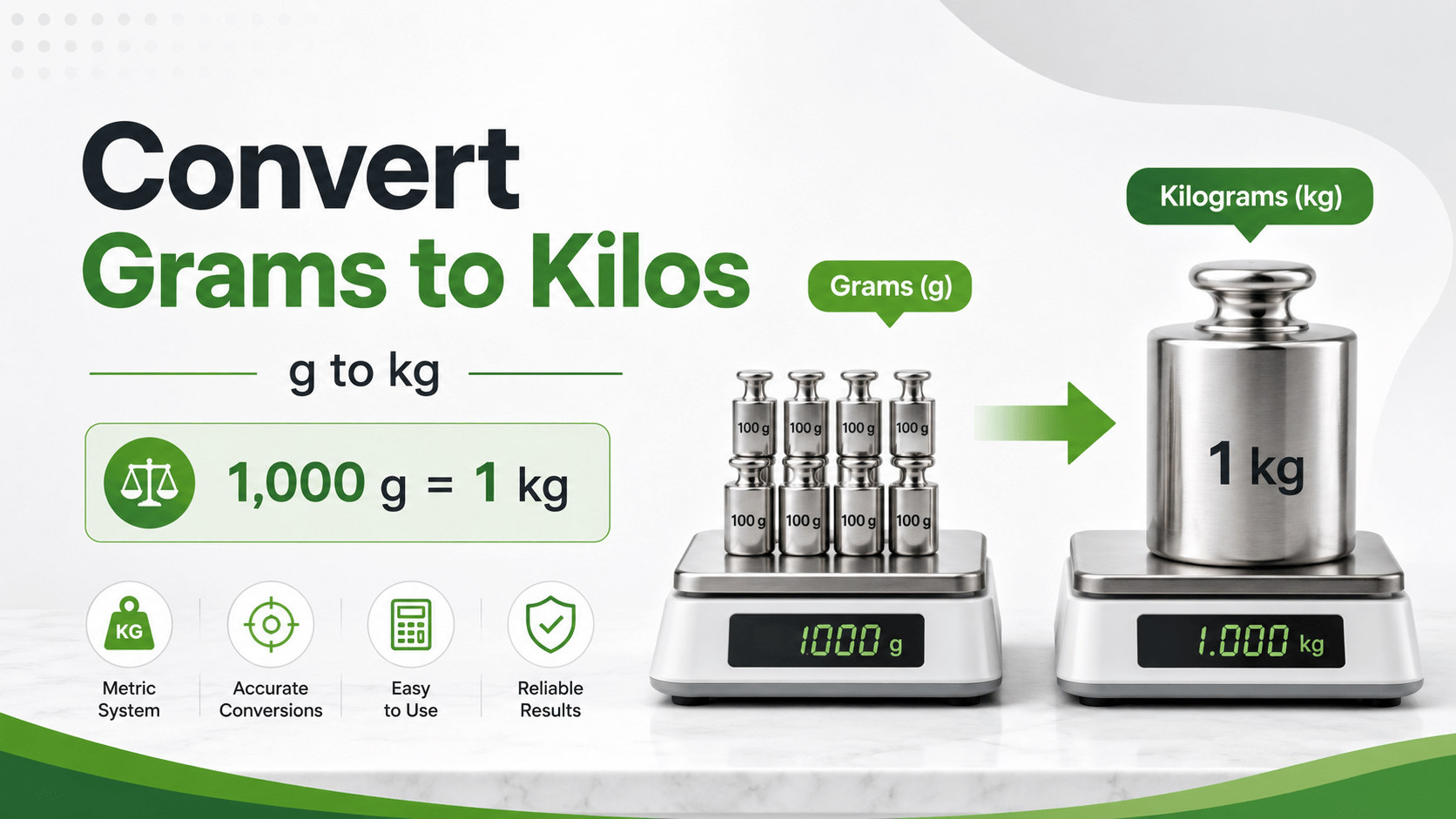
1,000 grams = 1 kilogram
To convert grams to kilograms, divide the number of grams by 1,000.
Formula:
kilograms = grams ÷ 1,000
For example:
2,500 g ÷ 1,000 = 2.5 kg
So, 2,500 grams = 2.5 kilograms.
How to Convert Grams to Kilos
Converting grams to kilograms is straightforward because both units belong to the same metric system.
There are exactly 1,000 grams in one kilogram, so simply divide the gram value by 1,000.
Grams to kilograms formula
kg = g ÷ 1,000
You can also think of this as multiplying the number of grams by 0.001:
kg = g × 0.001
Both methods give exactly the same result.
Example 1: Convert 500 grams to kilos
Start with:
500 g
Divide by 1,000:
500 ÷ 1,000 = 0.5
Therefore:
500 g = 0.5 kg
Example 2: Convert 1,500 grams to kilos
1,500 ÷ 1,000 = 1.5
Therefore:
1,500 g = 1.5 kg
Example 3: Convert 2,750 grams to kilos
2,750 ÷ 1,000 = 2.75
Therefore:
2,750 g = 2.75 kg
Popular Grams to Kilos Conversions
Here are some common gram values converted to kilograms.
| Grams | Kilograms |
|---|---|
| 1 g | 0.001 kg |
| 10 g | 0.01 kg |
| 50 g | 0.05 kg |
| 100 g | 0.1 kg |
| 250 g | 0.25 kg |
| 500 g | 0.5 kg |
| 750 g | 0.75 kg |
| 1,000 g | 1 kg |
| 1,500 g | 1.5 kg |
| 2,000 g | 2 kg |
| 2,500 g | 2.5 kg |
| 5,000 g | 5 kg |
| 10,000 g | 10 kg |
For any value not included in the table, enter the number of grams in the calculator above.
100 Grams to Kilos
100 grams = 0.1 kilograms.
Calculation:
100 ÷ 1,000 = 0.1 kg
This means that ten portions of 100 grams together have a total mass of one kilogram.
250 Grams to Kilos
250 grams = 0.25 kilograms.
Calculation:
250 ÷ 1,000 = 0.25 kg
Therefore, 250 g is one quarter of a kilogram.
500 Grams to Kilos
500 grams = 0.5 kilograms.
Calculation:
500 ÷ 1,000 = 0.5 kg
So, 500 grams is exactly half a kilogram.
750 Grams to Kilos
750 grams = 0.75 kilograms.
Calculation:
750 ÷ 1,000 = 0.75 kg
1,000 Grams to Kilos
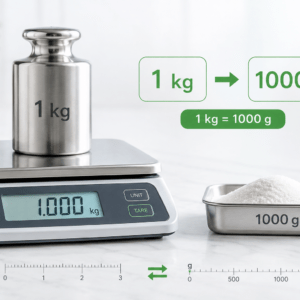
1,000 grams = exactly 1 kilogram.
This is the basic relationship between the two units:
1 kg = 1,000 g
Therefore:
1,000 ÷ 1,000 = 1 kg
2,000 Grams to Kilos
2,000 grams = 2 kilograms.
Calculation:
2,000 ÷ 1,000 = 2 kg
5,000 Grams to Kilos
5,000 grams = 5 kilograms.
Calculation:
5,000 ÷ 1,000 = 5 kg
Because the conversion is based on powers of ten, converting larger gram values is particularly simple.
What Are Grams and Kilograms?
Grams and kilograms are both metric units used to express mass.
Gram
The gram, abbreviated g, is commonly used for relatively small masses.
Typical examples include:
- food ingredients,
- product quantities,
- small packages,
- laboratory samples,
- nutritional serving sizes.
One gram is equal to:
0.001 kilogram
or:
1 g = 0.001 kg
Kilogram
The kilogram, abbreviated kg, is the SI base unit of mass.
One kilogram is exactly:
1,000 grams
The kilogram is widely used for body mass, food, luggage, parcels, sporting equipment and countless other everyday measurements.
The relationship between grams and kilograms is based on the SI decimal prefix system. The official SI documentation is maintained by the Bureau International des Poids et Mesures (BIPM).
Grams vs Kilograms: What's the Difference?
The main difference is their size.
1 kilogram is 1,000 times as large as 1 gram.
For example:
- a small food ingredient might weigh 5 g,
- a chocolate bar might weigh 100 g,
- a bag of flour might weigh 1 kg,
- a piece of luggage might weigh 20 kg.
Grams are therefore convenient for smaller masses, while kilograms are easier to use for larger quantities.
Both units are part of the metric measurement system, so converting between them requires only moving the decimal point.
A Quick Way to Convert Grams to Kilograms
Because you divide by 1,000, you can move the decimal point three places to the left.
For example:
3,500 g
becomes:
3.500 → 3.5 kg
Another example:
275 g
becomes:
0.275 kg
And:
25 g
becomes:
0.025 kg
This is useful for mental conversions, although the calculator above is convenient when working with unusual or decimal values.
Why Is 1 Kilogram Equal to 1,000 Grams?
The metric system uses decimal prefixes based on powers of ten.
The prefix kilo- represents a factor of 1,000.
This is why:
1 kilogram = 1,000 grams
The same decimal structure makes metric conversions relatively easy compared with conversions between unrelated measurement systems.
The BIPM's SI Brochure explains that, for historical reasons, the kilogram is unusual because it is the only coherent SI unit whose name already contains a prefix. Decimal multiples and submultiples of mass are therefore formed from the word gram, such as milligram and kilogram.
When Is a Grams to Kilograms Conversion Useful?
You may need to convert grams to kilos whenever a smaller mass is given in grams but a larger-scale measurement or specification uses kilograms.
Cooking and food
Food packaging and recipes frequently use both grams and kilograms.
For example:
750 g = 0.75 kg
Knowing the relationship makes it easy to compare package sizes or combine several quantities.
Shopping and product weights
Smaller products may be labelled in grams while bulk quantities are shown in kilograms.
For example, four 250 g packages have a combined mass of:
4 × 250 g = 1,000 g = 1 kg
Shipping and parcels
A scale may give a parcel's mass in grams while shipping information uses kilograms.
For example:
2,350 g = 2.35 kg
Always use the carrier's own weighing and rounding rules when a shipping charge depends on weight.
Science and education
Grams and kilograms are commonly used when learning or working with metric measurements.
Because the conversion factor is exactly 1,000, converting between the two units is a useful example of how SI prefixes work.
How Accurate Is the Grams to Kilos Conversion?
The mathematical conversion between grams and kilograms is exact:
1 kg = 1,000 g
Therefore, the conversion itself introduces no approximation.
For example:
1,234.5 g = exactly 1.2345 kg
Any uncertainty in a real-world measurement comes from the measuring device or the original measurement, not from the grams-to-kilograms conversion.
Our calculator divides the value entered in grams by 1,000 and displays the result in kilograms.
Grams to Kilograms Conversion Chart
Use this larger reference chart for common values.
| Grams (g) | Kilograms (kg) |
|---|---|
| 10 | 0.01 |
| 20 | 0.02 |
| 50 | 0.05 |
| 100 | 0.10 |
| 200 | 0.20 |
| 250 | 0.25 |
| 300 | 0.30 |
| 400 | 0.40 |
| 500 | 0.50 |
| 600 | 0.60 |
| 750 | 0.75 |
| 800 | 0.80 |
| 900 | 0.90 |
| 1,000 | 1.00 |
| 1,250 | 1.25 |
| 1,500 | 1.50 |
| 2,000 | 2.00 |
| 2,500 | 2.50 |
| 3,000 | 3.00 |
| 5,000 | 5.00 |
| 10,000 | 10.00 |
Convert Kilograms Back to Grams
To reverse the conversion, multiply kilograms by 1,000:
grams = kilograms × 1,000
For example:
2.5 kg × 1,000 = 2,500 g
For the reverse calculation, use our Convert kg to Grams calculator
About Our Conversion Data
EasyUnitConvert uses established SI unit relationships for metric conversions. For grams and kilograms, the conversion is based on the exact relationship:
1 kilogram = 1,000 grams
The International System of Units is maintained internationally by the Bureau International des Poids et Mesures (BIPM). Its current SI Brochure is the authoritative reference for the SI system and was most recently revised in 2026.
Frequently Asked Questions
Divide the number of grams by 1,000.
kilograms = grams ÷ 1,000
For example:
850 g ÷ 1,000 = 0.85 kg
Therefore, 850 grams = 0.85 kilograms.
There are exactly 1,000 grams in one kilogram.
1 kg = 1,000 g
Yes.
500 g = 0.5 kg
Therefore, 500 grams is exactly half a kilogram.
Yes.
250 g = 0.25 kg
Because:
1,000 ÷ 4 = 250
100 grams = 0.1 kilograms.
2,500 grams = 2.5 kilograms.
Calculation:
2,500 ÷ 1,000 = 2.5
To convert grams to kilograms, divide by 1,000.
To convert in the opposite direction — kilograms to grams — multiply by 1,000.
In everyday language, kilo is commonly used as a shortened form of kilogram. The official unit name is kilogram, with the symbol kg.
Yes. The relationship is exact:
1 kilogram = 1,000 grams
You only need to round a result if you choose to display fewer decimal places.