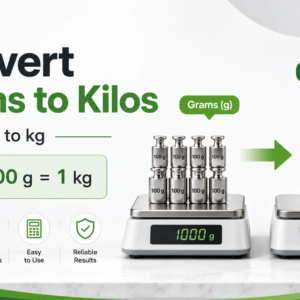
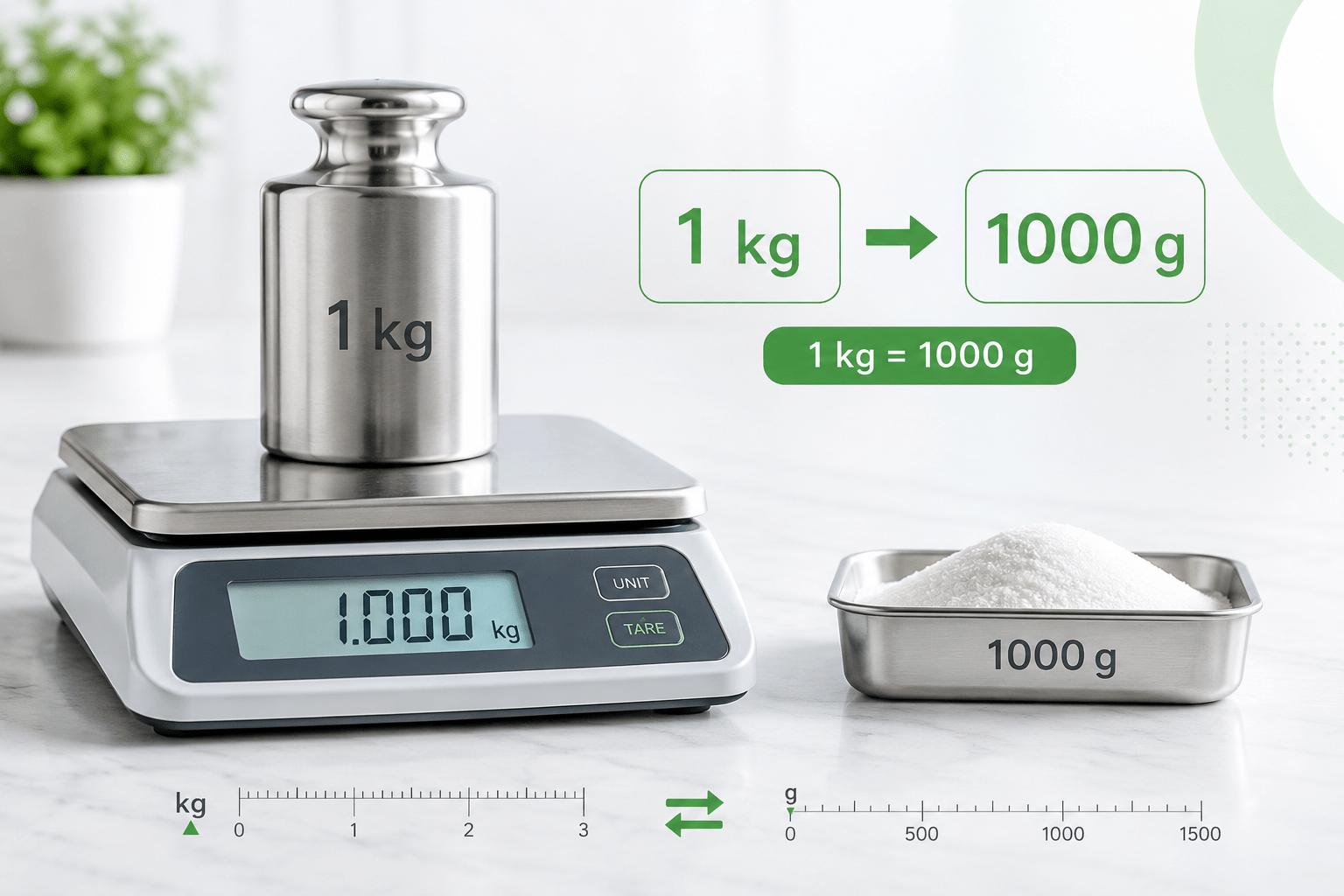
Need to convert kg to grams? The calculation is simple and exact: 1 kilogram equals 1,000 grams. Multiply the number of kilograms by 1,000 to get the equivalent mass in grams.
Use the calculator below for an instant result, or continue reading for the formula, worked examples, practical uses, common mistakes, and a kilograms-to-grams conversion chart.
Convert kg to Grams Instantly
Enter any value in kilograms below and select Convert. The calculator uses the exact SI relationship of 1 kg = 1,000 g, so no approximation or conversion-factor rounding is required.
For example, 2.5 kg equals exactly 2,500 g.
How to Convert kg to Grams
To convert kg to grams, multiply the mass in kilograms by 1,000.
The formula is:
grams = kilograms × 1,000
or, using unit symbols:
g = kg × 1,000
This conversion is especially straightforward because kilograms and grams belong to the same metric measurement system. The relationship is exact, so there is no need to use an approximate conversion factor.
1 kg = 1,000 g exactly
For example, to convert 4.5 kg to grams:
4.5 × 1,000 = 4,500 g
Therefore:
4.5 kg = 4,500 g
A quick mental shortcut is to move the decimal point three places to the right. For example, 0.75 kg becomes 750 g and 2.25 kg becomes 2,250 g
Quick kg to Grams Examples
Here are several common conversions:
| Kilograms | Grams |
|---|---|
| 0.1 kg | 100 g |
| 0.25 kg | 250 g |
| 0.5 kg | 500 g |
| 0.75 kg | 750 g |
| 1 kg | 1,000 g |
| 1.5 kg | 1,500 g |
| 2 kg | 2,000 g |
| 2.5 kg | 2,500 g |
| 5 kg | 5,000 g |
| 10 kg | 10,000 g |
These smaller decimal values are particularly useful in cooking, food packaging and other situations where an amount may be supplied in kilograms but used or measured in grams.
Why Does 1 Kilogram Equal 1,000 Grams?
The kilogram and gram are units used to measure mass in the International System of Units (SI).
The kilogram, symbol kg, is the SI base unit of mass. The prefix kilo- represents a factor of 1,000. That is why one kilogram corresponds to one thousand grams.
This also means that the relationship does not change between countries or applications:
1 kg always equals 1,000 g.
Unlike conversions between metric and imperial units, such as kilograms to pounds, converting kilograms to grams does not require an approximate decimal conversion factor.
Mass vs. weight: a useful distinction
Kilograms and grams are often casually described as units of “weight,” especially in recipes, shops and everyday conversation.
Technically, however, kg and g are units of mass. Weight is a force resulting from gravity acting on a mass.
For everyday unit conversion, people commonly use expressions such as “weight in kilograms,” but understanding the distinction is useful in scientific and technical contexts.
When Do You Need to Convert Kilograms to Grams?
The ability to convert kg to grams is useful whenever a larger quantity is stated in kilograms but a smaller or more precise amount needs to be expressed in grams.
Because grams provide a finer scale, they are often more convenient for smaller quantities.
Cooking and baking
Recipes frequently mix kilograms and grams.
You might buy a 1 kg bag of flour, for example, while a recipe requires only 250 g. Converting between the units helps you measure the correct portion without guessing.
Examples include:
0.5 kg flour = 500 g
1.2 kg dough = 1,200 g
2 kg sugar = 2,000 g
This is especially useful when scaling recipes for larger or smaller quantities.
Food packaging and retail
Large packages are often sold in kilograms, while serving sizes and nutrition information are commonly expressed in grams.
A 2 kg package can therefore be thought of as:
2 kg = 2,000 g
If each portion is 100 g, the package contains 20 portions by mass.
Science and laboratory work
Kilograms and grams are both widely used when recording mass, but smaller samples are often easier to express in grams.
For example:
0.35 kg = 350 g
Expressing the value in grams can make calculations and laboratory records easier to read when working with relatively small masses.
The appropriate unit depends on the scale and precision required by the measurement.
Shipping and logistics
Packages may be listed in kilograms while postal or courier thresholds are stated in grams.
For example, a parcel weighing:
1.75 kg = 1,750 g
can immediately be compared with a shipping limit expressed in grams.
This can also help when comparing measurements from different scales, labels or shipping systems.
Manufacturing and production
Industrial materials may be purchased in kilograms while individual components or production batches are measured in grams.
For example, if 5 kg of material is divided into 50 g portions:
5 kg = 5,000 g
and:
5,000 ÷ 50 = 100 portions
Converting to the smaller unit makes this type of calculation easier.
Education
Kilograms-to-grams conversion is one of the basic relationships used when learning the metric system.
Because the units differ by a factor of 1,000, it also provides a simple example of how metric prefixes work.
Why Convert to Grams Instead of Keeping Kilograms?
Using grams can make smaller amounts easier to read and compare.
For example:
0.035 kg
and
35 g
represent exactly the same mass, but 35 g is usually easier to understand when discussing a small amount of food or material.
Likewise:
0.008 kg = 8 g
Using the most appropriate unit reduces unnecessary decimals and makes measurements clearer.
There is no universal rule saying that a particular mass must be written in grams instead of kilograms. The best unit usually depends on the context and the level of detail needed.
Common Mistakes When Converting kg to Grams
Although the calculation is simple, several mistakes are easy to make.
The most common is dividing by 1,000 instead of multiplying. Remember that a gram is the smaller unit, so the numerical value becomes larger when kilograms are converted to grams.
For example:
3 kg = 3,000 g
not 0.003 g.
Another mistake is moving the decimal point the wrong number of places. Kilograms and grams differ by a factor of exactly 1,000, so the decimal moves three places to the right when converting kg to g.
For example:
0.025 kg → 25 g
A third useful check is to keep the unit symbols visible throughout the calculation. The correct symbols are:
kilogram = kg
gram = g
SI unit symbols are case-sensitive, so kg and g are the preferred forms.
Is the kg to g Conversion Exact?
Yes.
When you convert kg to grams, the conversion factor is exact:
1 kg = 1,000 g
This means the conversion itself introduces no rounding error.
If the original measurement is approximate — for example, a kitchen scale showing 1.2 kg — the converted value has the same underlying measurement precision. The calculator should not be interpreted as making the original measurement more precise simply because it displays the answer in a smaller unit.
For example:
1.2 kg = 1,200 g
The mathematical conversion is exact, although the measured value of 1.2 kg may itself have been rounded by the measuring device.
Accuracy and Measurement Standards
Easy Unit Convert uses established SI unit relationships for metric conversions.
For kilograms and grams, the conversion is based on the International System of Units. The kilogram is the SI base unit of mass, while decimal multiples and submultiples of mass are expressed using the gram and standard SI prefixes.
Our calculators are designed to make these relationships easy to use while keeping formulas and unit notation transparent.
For more information about how conversion factors and content are checked, see our Accuracy & Editorial Policy.
Related Weight Converters
If you are working with other units of mass, you may also find these tools useful:
Grams to Kilograms – reverse this conversion.
Kilograms to Pounds – convert metric mass to pounds.
Ounces to Grams – convert ounces to metric grams.
Grams to Ounces – convert grams to ounces.
Weight Converters – browse all mass and weight conversion tools.
Kilograms to Grams Conversion Chart
Use this reference chart for common values from 1 to 100 kilograms. Every result uses the exact relationship 1 kg = 1,000 g.
| Kilograms (kg) | Grams (g) |
|---|---|
| 1 kg | 1,000 g |
| 10 kg | 10,000 g |
| 20 kg | 20,000 g |
| 30 kg | 30,000 g |
| 40 kg | 40,000 g |
| 50 kg | 50,000 g |
| 60 kg | 60,000 g |
| 70 kg | 70,000 g |
| 80 kg | 80,000 g |
| 90 kg | 90,000 g |
| 100 kg | 100,000 g |
Frequently Asked Questions
To convert kg to grams, multiply the number of kilograms by 1,000. For example, 3 kg × 1,000 = 3,000 g.
There are exactly 1,000 grams in 1 kilogram.
1 kg = 1,000 g
Multiply 0.5 by 1,000:
0.5 kg = 500 g
2 kg = 2,000 g.
The calculation is 2 × 1,000 = 2,000.
2.5 kg = 2,500 g.
Multiply 2.5 by 1,000.
Divide the number of grams by 1,000.
For example:
2,500 g ÷ 1,000 = 2.5 kg
You can also use our Grams to Kilograms Converter.
Technically, kilograms and grams are units of mass. In everyday language they are also commonly used when people talk about the “weight” of food, packages and other objects.
Yes. The relationship is exact within the SI system:
1 kg = exactly 1,000 g.
No approximate conversion factor is required.