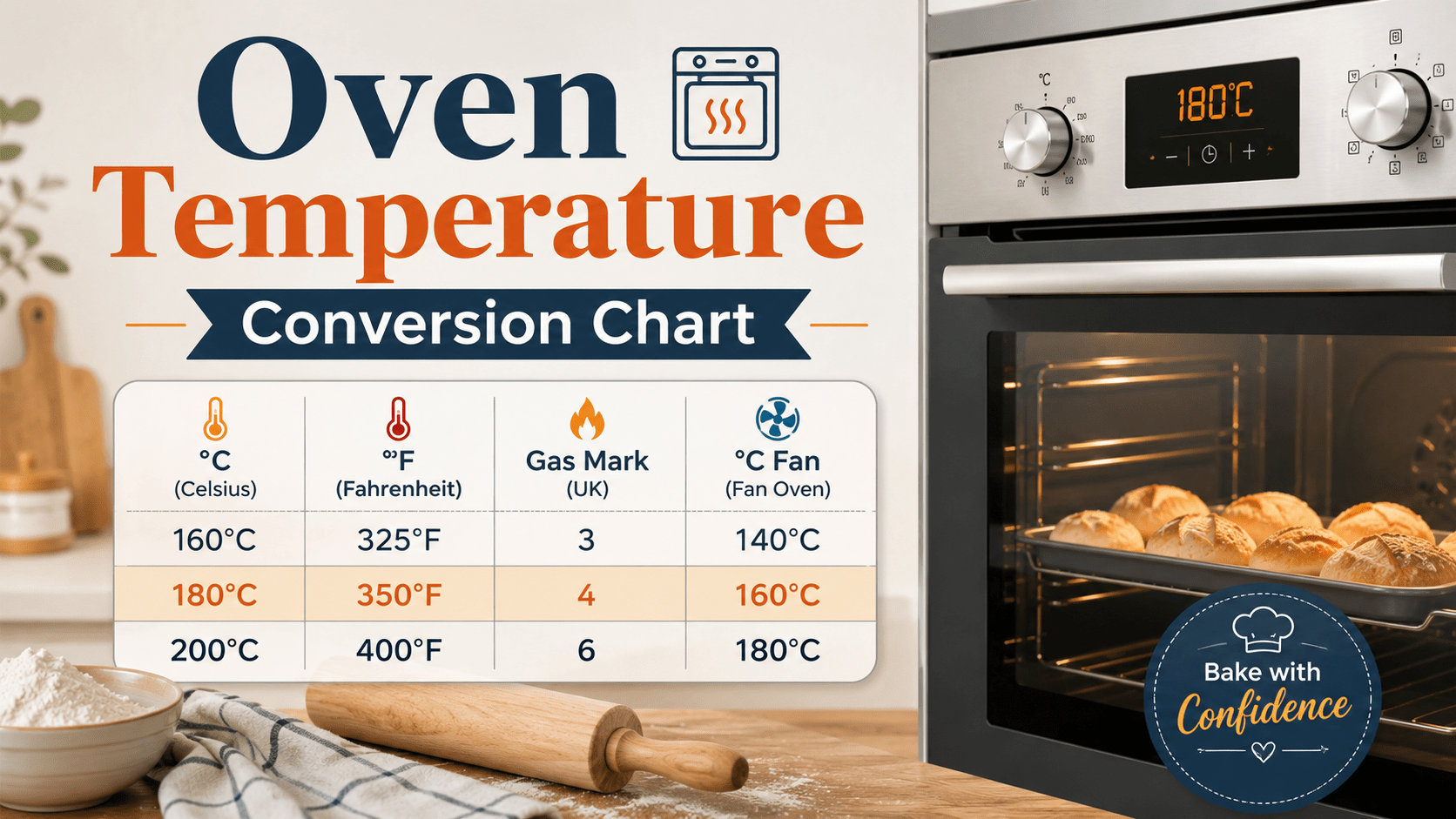
Use this oven temperature conversion chart to compare Celsius, Fahrenheit, fan oven temperatures, and gas marks quickly. For example, 180°C in a conventional oven is generally equivalent to 350°F, gas mark 4, or 160°C in a fan-assisted oven.
Although these values are reliable for everyday cooking, they are practical equivalents rather than exact mathematical matches. In fact, 180°C converts precisely to 356°F. However, most ovens use standard temperature intervals, so recipes commonly round this value to 350°F.
Complete Oven Temperature Conversion Chart
| Gas mark | Fahrenheit | Conventional oven | Fan oven | Heat description |
|---|---|---|---|---|
| 1/4 | 225°F | 110°C | 90°C | Very cool |
| 1/2 | 250°F | 120°C | 100°C | Very cool |
| 1 | 275°F | 140°C | 120°C | Cool |
| 2 | 300°F | 150°C | 130°C | Cool |
| 3 | 325°F | 160°C | 140°C | Moderate |
| 4 | 350°F | 180°C | 160°C | Moderate |
| 5 | 375°F | 190°C | 170°C | Moderately hot |
| 6 | 400°F | 200°C | 180°C | Moderately hot |
| 7 | 425°F | 220°C | 200°C | Hot |
| 8 | 450°F | 230°C | 210°C | Hot |
| 9 | 475°F | 240°C | 220°C | Very hot |
| 10 | 500°F | 260°C | 240°C | Extremely hot |
The table shows rounded settings commonly used in recipes and on domestic ovens. However, individual appliances may heat differently. Therefore, you should also follow the recipe instructions and check the guidance provided by your oven manufacturer.
How to Use the Oven Temperature Conversion Chart
Identify the Temperature Used in the Recipe
First, check which temperature system appears in the recipe. Recipes written in the United States usually show Fahrenheit, while recipes from Europe, Australia, and many other regions often use Celsius.
In addition, British and Irish recipes may include gas marks. Some recipes also provide a separate temperature for fan-assisted ovens.
Next, identify whether your oven is conventional or fan-assisted. This step is important because fan ovens generally require a lower temperature.
Find the Equivalent Oven Setting
After identifying the original value, find it in the appropriate column of the chart. Then, read across the same row to locate the equivalent setting for your oven.
For example, a recipe that requires 400°F can normally be cooked at 200°C in a conventional oven. Alternatively, you can use 180°C in a fan oven or gas mark 6.
However, check whether the recipe already includes a fan oven temperature. When it does, do not reduce the setting again because the adjustment has already been made.
Celsius to Fahrenheit Oven Conversion
A chart is usually the fastest solution while cooking. However, a formula can help when a recipe contains a temperature that does not appear in the table.
Celsius to Fahrenheit Formula
Use the following formula:
°F = (°C × 9/5) + 32
For example:
180 × 9/5 + 32 = 356°F
The exact result is 356°F. Nevertheless, most recipes round this value to 350°F because it is a standard setting on many ovens.
Therefore, mathematical conversion and practical recipe conversion may produce slightly different numbers. Even so, both values refer to approximately the same cooking temperature.
Fahrenheit to Celsius Oven Conversion
Fahrenheit to Celsius Formula
Use this formula:
°C = (°F − 32) × 5/9
For example:
400 − 32 = 368
368 × 5/9 = 204.4°C
Consequently, 400°F converts mathematically to approximately 204°C. However, recipes usually round the result to 200°C because domestic ovens rarely use a setting of exactly 204°C.
For that reason, the oven temperature conversion chart displays practical cooking values instead of long decimal numbers.
Conventional Oven vs Fan Oven
A conventional oven heats the air without continuously circulating it. By contrast, a fan oven moves heated air around the oven cavity.
As a result, food often cooks more efficiently in a fan-assisted appliance. Therefore, a lower temperature is usually recommended.
The 20°C Fan Oven Rule
As a general rule, reduce a conventional Celsius temperature by approximately 20°C when using a fan oven.
For example:
- 180°C conventional becomes approximately 160°C fan
- 200°C conventional becomes approximately 180°C fan
- 220°C conventional becomes approximately 200°C fan
Although this guideline is useful, it is still an approximation. In addition, some manufacturers recommend a slightly different adjustment.
When Not to Reduce the Temperature
Do not reduce the temperature when the recipe already provides a fan setting. For example, the instructions may state “180°C conventional or 160°C fan.”
In that situation, simply choose the value that matches your appliance. Otherwise, you may accidentally lower the temperature twice.
Likewise, avoid reducing both the temperature and the cooking time unless the recipe specifically recommends both adjustments.
What Do Gas Marks Mean?
Gas mark is an oven scale used mainly in the United Kingdom, Ireland, and some Commonwealth countries. Instead of choosing a temperature in degrees, the cook selects a numbered setting.
For example, gas mark 4 is a common moderate setting. It corresponds to approximately 350°F, 180°C conventional, or 160°C fan.
Meanwhile, gas mark 6 is approximately equal to 400°F, 200°C conventional, or 180°C fan.
Because gas mark values are rounded, there is no simple formula that works as conveniently as a chart. Therefore, an oven temperature conversion chart is the easiest way to compare gas marks with Celsius and Fahrenheit.
Exact and Practical Oven Conversions
Mathematical conversion and cooking conversion are closely related. However, they are not always identical.
Exact formulas can produce temperatures such as 356°F or 204.4°C. On the other hand, most ovens use intervals of 5°C, 10°C, or 25°F.
For that reason, recipe writers usually select the nearest familiar setting. Thus, 180°C is commonly paired with 350°F, even though the exact conversion is 356°F.
Similarly, 400°F is normally shown as 200°C, although the precise result is approximately 204°C. Consequently, small differences in conversion tables are normal and do not necessarily indicate an error.
Why Oven Temperature Matters
Oven temperature affects browning, rising, moisture loss, texture, and cooking time. Therefore, even a relatively small difference can influence the final result.
When the Oven Is Too Hot
An oven that is too hot may brown the outside of food before the centre is fully cooked. For example, a cake may develop a dark crust while remaining wet inside.
In addition, excessive heat can cause cakes to rise too quickly and then collapse. Pastry may also brown before its inner layers become crisp.
When the Oven Is Too Cool
A low temperature can extend cooking time considerably. As a result, cakes may become pale, dense, or dry.
Moreover, bread and pastries may not rise correctly if they do not receive enough initial heat. Therefore, accurate preheating is especially important for baked foods that depend on an immediate burst of heat.
How to Preheat an Oven Correctly
First, set the required temperature before preparing the final stages of the recipe. Then, allow the oven to heat fully before placing the food inside.
Although many ovens have a preheat indicator, the entire cavity may not yet have reached an even temperature. Therefore, waiting a few extra minutes can improve consistency.
Preheating is particularly important for cakes, bread, biscuits, pastry, and pizza. However, slow-cooked dishes and some casseroles are usually less sensitive to the starting temperature.
Choose the Correct Oven Rack
Rack position can affect how quickly the top or bottom of food cooks. Therefore, follow the position recommended in the recipe whenever possible.
The middle rack usually provides balanced heat for cakes, biscuits, and casseroles. By contrast, a higher rack can increase surface browning.
Meanwhile, a lower rack may provide more heat to the base of bread, pastry, or pizza. However, placing food too close to the heating element can cause burning.
Avoid Opening the Oven Door
Each time the door is opened, heat escapes from the oven. Consequently, the cooking temperature may fall and the total baking time may increase.
This effect is especially important during the early stages of baking. For example, opening the door too soon can cause cakes, soufflés, or bread to collapse.
Therefore, use the oven light and window whenever possible. Finally, open the door only when you need to check the food or test whether it is ready.
Check the Accuracy of Your Oven
If food regularly burns or takes much longer than expected, the displayed setting may not match the actual temperature. Therefore, an oven thermometer can be helpful.
First, place the thermometer near the centre of the oven. Next, preheat the appliance and compare the thermometer reading with the selected temperature.
However, remember that ovens naturally heat in cycles. As a result, the temperature may rise above and fall below the selected value before reaching an average.
Allow Air to Circulate
Do not overcrowd the oven because heated air needs space to move around the food. This is particularly important in a fan oven.
In addition, large trays placed close together may block heat from reaching other shelves. Therefore, leave space between dishes and stagger trays when possible.
Although fan ovens distribute heat efficiently, poor airflow can still cause uneven cooking. Consequently, correct tray placement is just as important as choosing the right temperature.
Adjust the Cooking Time Carefully
Use the converted temperature as a reliable starting point. However, check the food shortly before the recommended cooking time ends.
Pan size, pan material, food quantity, and rack position can all affect the result. Moreover, individual ovens may run slightly hotter or cooler than their selected setting.
Therefore, make only small adjustments at first. Finally, record successful settings so you can repeat the same result with your own appliance.
Keep this oven temperature conversion chart available whenever you cook from an international recipe.
180°C is commonly treated as 350°F for cooking and baking. The exact mathematical conversion is 356°F, but 350°F is the nearest widely used oven setting. In a fan oven, use approximately 160°C.
350°F is approximately 180°C in a conventional oven. The exact conversion is about 177°C; however, recipes normally round it to 180°C. It also corresponds to gas mark 4 or about 160°C fan.
200°C conventional is generally equivalent to 180°C in a fan oven. The usual adjustment is to reduce the conventional setting by around 20°C.
400°F is approximately gas mark 6. It also corresponds to about 200°C in a conventional oven or 180°C in a fan-assisted oven.
Not always. Celsius and Fahrenheit can be converted exactly with formulas, but cooking charts round the results to settings available on real ovens. Fan-oven and gas-mark values are also practical approximations.
A fan oven often cooks more efficiently because moving air distributes heat around the food. Therefore, recipes generally use a lower temperature, a shorter time, or occasionally both. Always follow the recipe when it provides specific fan instructions.
A moderate oven usually means approximately 350°F to 375°F, or about 180°C to 190°C in a conventional oven. In many recipes, 350°F, 180°C, or gas mark 4 is the standard moderate setting.
The conversion may be correct while the oven itself runs hot, cold, or unevenly. Pan material, rack position, oven size, preheating, and fan strength can also affect the result. Consequently, use the converted setting as a guide and adjust it according to your appliance.