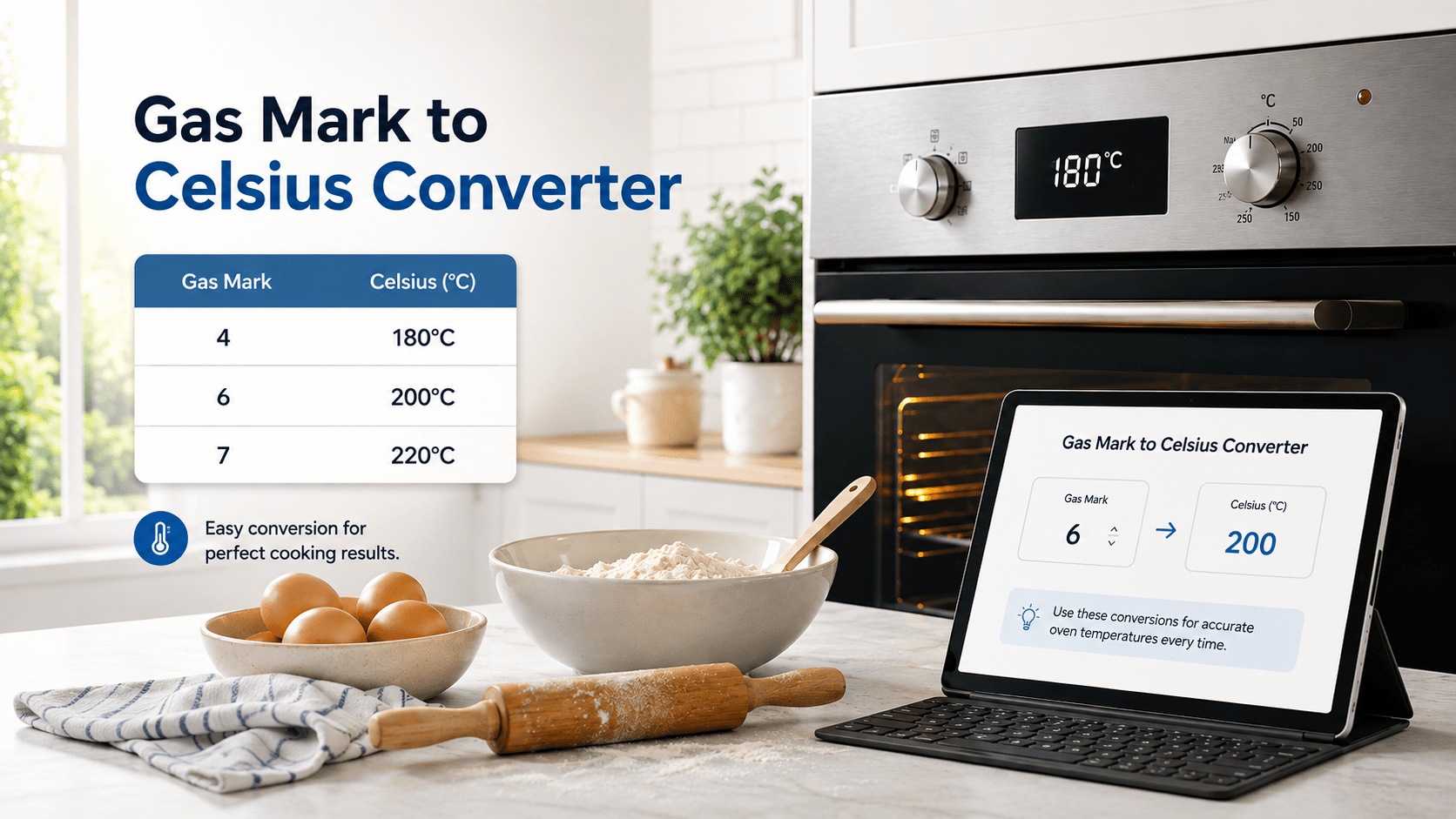
Use this Gas Mark to Celsius Converter to change a British oven setting into degrees Celsius in seconds. Enter the gas mark shown in your recipe, and the calculator will display the equivalent temperature for a conventional oven. It can also show a practical fan-oven setting, so you can use older recipes with a modern appliance more confidently.
For a quick reference, Gas Mark 4 is about 180°C, Gas Mark 6 is about 200°C, and Gas Mark 7 is about 220°C in a conventional oven. However, fan ovens usually require a lower setting. Therefore, you will often reduce the conventional temperature by approximately 20°C.
How to Use the Gas Mark to Celsius Converter
First, enter or select the gas mark from your recipe. Next, choose whether you need a conventional Celsius temperature or a fan-oven setting. Finally, use the displayed result to set your oven.
The calculator uses standard gas-mark reference temperatures. In addition, it presents a practical rounded Celsius setting because most domestic ovens cannot be set to values such as 176.7°C. For example, the exact Fahrenheit-based equivalent of Gas Mark 4 is about 176.7°C, while recipes normally round it to 180°C.
Gas Mark to Celsius Conversion Chart
The table below compares standard Fahrenheit reference points with practical oven settings. The Exact Celsius column explains why some charts show slightly different figures. Meanwhile, the rounded conventional and fan settings are easier to use when cooking.
| Gas Mark | Fahrenheit | Exact Celsius | Conventional Oven | Fan Oven* | Heat Description |
|---|---|---|---|---|---|
| ¼ | 225°F | 107.2°C | 110°C | 90°C | Very cool |
| ½ | 250°F | 121.1°C | 120°C | 100°C | Very cool |
| 1 | 275°F | 135.0°C | 140°C | 120°C | Cool |
| 2 | 300°F | 148.9°C | 150°C | 130°C | Cool |
| 3 | 325°F | 162.8°C | 160°C | 140°C | Moderate |
| 4 | 350°F | 176.7°C | 180°C | 160°C | Moderate |
| 5 | 375°F | 190.6°C | 190°C | 170°C | Moderately hot |
| 6 | 400°F | 204.4°C | 200°C | 180°C | Moderately hot |
| 7 | 425°F | 218.3°C | 220°C | 200°C | Hot |
| 8 | 450°F | 232.2°C | 230°C | 210°C | Hot |
| 9 | 475°F | 246.1°C | 240°C | 220°C | Very hot |
*Fan-oven settings are practical guidelines. Always check the recipe and your oven manufacturer’s instructions before changing the temperature.
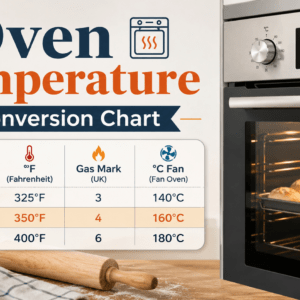
For a broader comparison of Celsius, Fahrenheit, fan-assisted settings and gas marks, see our Oven Temperature Conversion Chart.
Why Do Gas Mark Charts Sometimes Disagree?
Gas marks are linked to traditional Fahrenheit oven settings, while Celsius figures are usually rounded for everyday cooking. Consequently, one chart may list Gas Mark 3 as 160°C, while another may show 165°C or 170°C. Lower marks can vary as well, especially Gas Mark ½.
These differences do not necessarily mean that one table is unusable. Instead, they reflect different rounding conventions and appliance guidance. This Gas Mark to Celsius Converter uses standard Fahrenheit reference points and then shows a practical Celsius setting. Nevertheless, your oven manual should take priority if it provides its own conversion table.
How to Convert Gas Mark to Celsius Manually
For whole gas marks from 1 upward, you can estimate Celsius with this formula:
°C ≈ (Gas Mark × 14) + 121
For example, convert Gas Mark 4:
(4 × 14) + 121 = 177°C
A domestic oven would normally be set to the nearest practical temperature. Therefore, Gas Mark 4 is commonly treated as 180°C.
The formula works because each full step above Gas Mark 1 represents an increase of approximately 25°F, which is about 13.9°C. However, the scale below Gas Mark 1 does not follow the same simple sequence. For Gas Mark ¼ and ½, use the converter or the lookup chart instead.
For exact equations between the main temperature scales, visit our Temperature Conversion Formula guide.
Gas Mark to Celsius for a Fan Oven
A gas mark normally refers to a conventional gas oven. Fan-assisted ovens circulate hot air, so they often cook more efficiently at a lower set temperature. As a general starting point, subtract about 20°C after converting the gas mark to conventional Celsius.
For example:
Gas Mark 6 = approximately 200°C conventional = approximately 180°C fan
However, do not reduce the temperature twice. If a recipe already lists a fan setting, use that figure directly. Moreover, some appliances have powerful fan modes or manufacturer-specific recommendations. Therefore, check the oven manual when precision is especially important.
Common Gas Mark Conversions
What Is Gas Mark 4 in Celsius?
Gas Mark 4 equals approximately 180°C in a conventional oven or 160°C in a fan oven. This moderate setting appears frequently in British recipes.
What Is Gas Mark 5 in Celsius?
Gas Mark 5 is normally rounded to 190°C conventional or 170°C fan. Because it is slightly hotter than Gas Mark 4, food may brown more quickly.
What Is Gas Mark 6 in Celsius?
Gas Mark 6 converts to approximately 200°C conventional or 180°C fan. It is a moderately hot oven setting.
What Is Gas Mark 7 in Celsius?
Gas Mark 7 is about 220°C conventional or 200°C fan. Since this is a hot setting, preheating and accurate timing become particularly important.
What Is a Gas Mark?
A gas mark is a numbered oven-temperature scale traditionally used on gas ovens in the United Kingdom, Ireland, and several Commonwealth countries. Modern recipes often include Celsius or Fahrenheit as well. Nevertheless, older cookbooks and family recipes may provide only a gas mark.
Unlike Celsius and Fahrenheit, the gas-mark system is mainly a set of standard cooking reference points. Therefore, a lookup chart is usually more useful than treating it as a completely free-form temperature scale. The Gas Mark to Celsius Converter handles this automatically and returns a practical oven setting.
Practical Tips for More Accurate Baking
Preheat the oven fully before adding food, unless the recipe clearly says otherwise. In addition, avoid opening the door repeatedly because a sudden loss of heat can affect delicate cakes, pastries, and soufflés.
Ovens can also run hotter or colder than the selected setting. If food regularly burns early or remains undercooked, an oven thermometer can help you check the actual temperature. Furthermore, testing more than one shelf position may reveal hot or cool areas inside the oven. Independent oven tests have found that some appliances can differ substantially from their selected temperature.
Finally, remember that temperature is only one part of a recipe. Tin size, ingredient temperature, shelf position, and cooking time can also change the result. The converter gives you the correct starting setting, while observation helps you adapt it to your own appliance.
For Gas Mark 1 and above, use °C ≈ (Gas Mark × 14) + 121, and then round to a practical oven setting. Alternatively, use the Gas Mark to Celsius Converter for an immediate result.
Yes. Gas Mark 4 is commonly rounded to 180°C in a conventional oven. The underlying Fahrenheit reference is 350°F, which converts to approximately 176.7°C.
Gas Mark 6 is approximately 200°C conventional, 180°C fan, or 400°F.
Usually, yes. A common guideline is to reduce a conventional Celsius temperature by about 20°C. However, follow the recipe or appliance manual when it gives a specific fan setting.
The exact equivalent is approximately 162.8°C. Therefore, different sources may round it to 160°C, 165°C, or occasionally 170°C. For everyday cooking, use the setting recommended by your recipe and oven manufacturer.
No. The simple whole-number formula is not suitable below Gas Mark 1. Use the lookup table or converter for fractional gas marks.