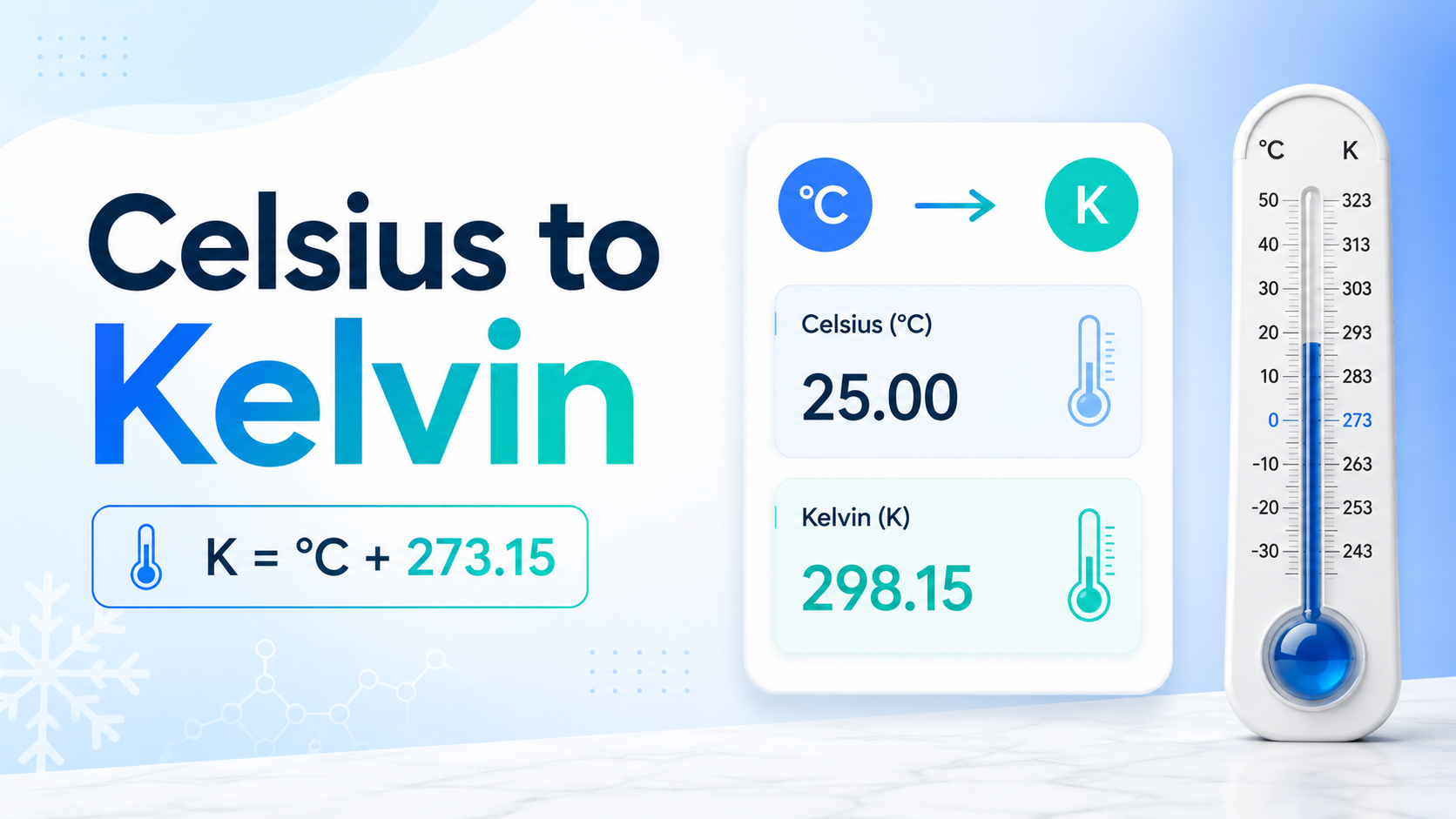
Use this Celsius to Kelvin converter to change any valid temperature from degrees Celsius (°C) into kelvins (K). Enter the Celsius value below and select Convert °C to K to receive an instant result.
The calculator uses the exact formula K = °C + 273.15. It accepts positive, zero, decimal, and negative Celsius values down to absolute zero at −273.15 °C. Remember that kelvin values are written without a degree symbol. For example, 25 °C equals 298.15 K.
How to Convert Celsius to Kelvin
The Celsius to Kelvin conversion is simple because the two temperature scales use intervals of the same size. The only difference is their starting point.
Use this exact formula:
Kelvin = Celsius + 273.15
Or in symbols:
K = °C + 273.15
To complete the calculation manually, take the temperature in degrees Celsius and add 273.15. You do not need to multiply or divide the value.
For example:
25 °C + 273.15 = 298.15 K
Therefore, 25 degrees Celsius is equal to 298.15 kelvins.
Worked conversion examples
Here are several common examples:
- 0 °C = 273.15 K
- 20 °C = 293.15 K
- 25 °C = 298.15 K
- −40 °C = 233.15 K
- 100 °C = 373.15 K
The conversion works in exactly the same way for decimal temperatures. For example, 36.6 °C is equal to 309.75 K.
Why Is the Celsius to Kelvin Conversion Important?
Celsius is practical for everyday temperatures, weather reports, cooking, and household measurements. Kelvin, however, is the SI unit of thermodynamic temperature and is widely used in scientific and technical work.
The Kelvin scale begins at absolute zero. Absolute zero is the lowest point of the thermodynamic temperature scale:
−273.15 °C = 0 K
Because the Kelvin scale starts at absolute zero, it is useful in calculations involving heat, energy, gases, radiation, and other physical processes. Many scientific equations require an absolute temperature rather than a relative Celsius value.
Using Celsius directly in these equations can produce an incorrect result. Therefore, converting Celsius to Kelvin is often a necessary step rather than an optional formatting change.
Where Is Kelvin Used Most Often?
Physics and thermodynamics
Kelvin is commonly used when studying heat transfer, thermal energy, entropy, and the behavior of matter. Many thermodynamic equations require temperatures to be entered in kelvins.
Chemistry
Chemists use Kelvin in calculations involving gases, reaction rates, equilibrium, and molecular motion. For example, temperature values in the ideal gas law are normally expressed in kelvins.
Engineering
Engineers may need Kelvin when working with engines, industrial processes, materials, electronics, refrigeration, and thermal systems. Converting the original Celsius measurement helps keep technical calculations consistent.
Astronomy and space science
Scientists describe the temperatures of stars, planets, gases, and objects in space using kelvins. The scale is especially useful because many of these temperatures are far outside normal weather ranges.
Atmospheric and environmental science
Public weather forecasts usually display degrees Celsius or Fahrenheit. However, researchers, satellite systems, and atmospheric models often process temperatures in kelvins.
Lighting
Kelvin is also used to describe the color appearance of light. A lower color temperature appears warmer, while a higher value appears cooler or more blue. However, lighting color temperature is a separate application and should not be confused with converting the physical temperature of a room or object.
When Do You Need to Convert Celsius to Kelvin?
You may need this conversion when:
- completing physics or chemistry homework;
- preparing a laboratory report;
- entering data into a scientific equation;
- comparing international datasets;
- working with sensors or technical specifications;
- analysing atmospheric or astronomical data;
- checking an engineering calculation;
- converting a temperature before using the ideal gas law.
The online calculator is useful when accuracy matters or when you need to process a negative or decimal Celsius value quickly.
What Is the Difference Between Celsius and Kelvin?
Celsius and Kelvin have the same interval size. A temperature increase of 1 °C is the same size as an increase of 1 K.
However, their zero points are different:
- 0 °C equals 273.15 K.
- −273.15 °C equals 0 K.
- 100 °C equals 373.15 K.
This means that you only need to add 273.15 when converting from Celsius. There is no scaling factor.
Another important difference is notation. Celsius values include the degree symbol, such as 20 °C. Kelvin values do not use a degree symbol. The correct form is 293.15 K, not “293.15 °K.”
Accuracy, Rounding and Common Mistakes
For an accurate Celsius to Kelvin result, always add 273.15. Adding only 273 may be acceptable for a rough classroom estimate, but it is not the exact conversion.
Avoid these common errors:
- Do not multiply the Celsius value by 273.15.
- Do not use the Fahrenheit conversion formula.
- Do not write a degree symbol before K.
- Do not enter a Celsius temperature below −273.15 °C.
- Do not round the starting value too early in a multi-step calculation.
The calculator displays results to two decimal places. When working with scientific measurements, the final number of significant figures may depend on the precision of the original Celsius measurement.
Calculation Methodology
This calculator adds exactly 273.15 to the entered Celsius value:
Result in K = entered value in °C + 273.15
It accepts whole numbers, decimals, zero, and negative Celsius temperatures. Values below −273.15 °C are rejected because they would fall below absolute zero on the standard thermodynamic scale.
Celsius to Kelvin Conversion Chart
The following chart begins at 1 °C and then continues in ten-degree steps up to 100 °C.
| Celsius (°C) | Kelvin (K) |
|---|---|
| 1 °C | 274.15 K |
| 10 °C | 283.15 K |
| 20 °C | 293.15 K |
| 30 °C | 303.15 K |
| 40 °C | 313.15 K |
| 50 °C | 323.15 K |
| 60 °C | 333.15 K |
| 70 °C | 343.15 K |
| 80 °C | 353.15 K |
| 90 °C | 363.15 K |
| 100 °C | 373.15 K |
Accuracy and review: This calculator uses the exact Celsius–Kelvin relationship K = °C + 273.15. The formula, examples, and conversion chart were manually checked for mathematical accuracy. Last reviewed: July 2026.
The formula is K = °C + 273.15. Add 273.15 to the Celsius temperature to obtain the temperature in kelvins.
0 °C is exactly 273.15 K.
100 °C is equal to 373.15 K.
On the standard thermodynamic temperature scale, Kelvin begins at 0 K. A Celsius value below −273.15 °C would correspond to a value below absolute zero and is not accepted by this calculator.
Yes. The size of one Celsius degree is equal to the size of one kelvin. However, the two scales have different zero points.
No. Write 300 K, not “300 °K.” Celsius does use the degree symbol, as in 26.85 °C.
Subtract 273.15 from the Kelvin value:
°C = K − 273.15
For example, 300 K minus 273.15 equals 26.85 °C.
No. The correct spelling is Celsius to Kelvin. “Celcius to Kelvin” is a common search misspelling, but both phrases refer to the same temperature conversion.