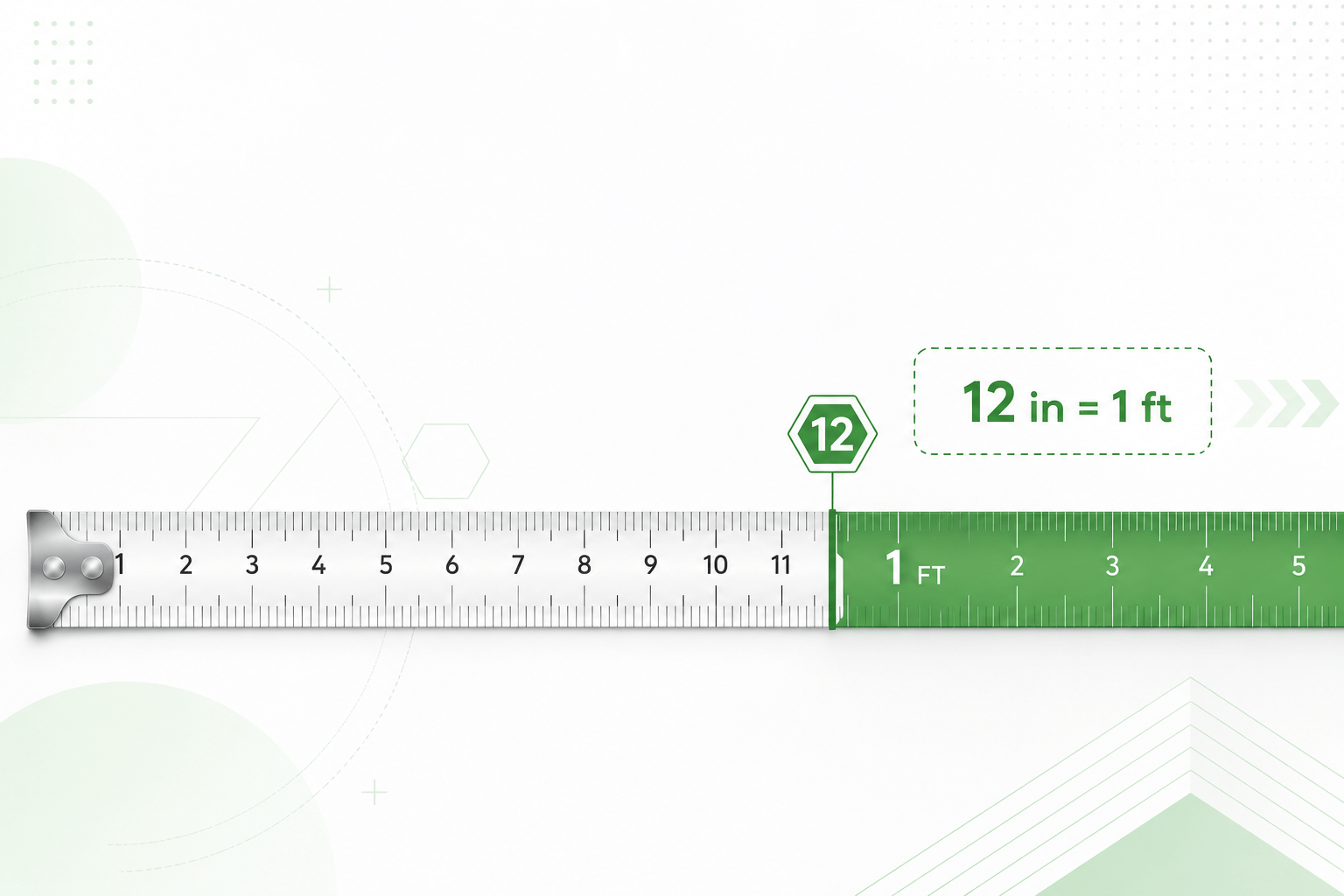
Need to convert inches to feet quickly? Divide the number of inches by 12. Because one foot contains exactly 12 inches, the conversion is straightforward:
feet = inches ÷ 12
For example, 36 inches = 3 feet, while 66 inches = 5.5 feet. Use the calculator below for an instant result, or continue reading for the formula, practical examples, decimal-foot guidance, common uses and a conversion chart.
Convert Inches to Feet Instantly
Enter any measurement in inches into the calculator below and select Convert Inches to Feet. The calculator uses the exact relationship of 12 inches = 1 foot, so no estimated conversion factor is required.
It is useful for room and furniture measurements, construction and DIY projects, product dimensions, materials, height measurements and any situation where a length supplied in inches needs to be expressed in feet.
The calculator gives the answer in decimal feet and also shows the equivalent as feet and remaining inches where useful.
How to Convert Inches to Feet
To convert inches to feet, divide the number of inches by 12:
Feet = Inches ÷ 12
This works because:
12 inches = 1 foot exactly
For example, suppose a board is 72 inches long:
72 ÷ 12 = 6
Therefore:
72 inches = 6 feet
If the number is not divisible by 12, the result will contain a decimal.
For example:
50 ÷ 12 = 4.166667
So:
50 inches ≈ 4.1667 feet
The conversion factor itself is exact. Any small difference you see in a displayed decimal result comes only from rounding the answer for readability.
Inches to Feet Conversion Formula
There are two convenient ways to express the relationship.
To convert from inches to feet:
ft = in ÷ 12
or:
ft = in × 0.0833333333…
Dividing by 12 is usually the clearer method because the relationship between the two units is exact.
To convert in the opposite direction, multiply feet by 12:
in = ft × 12
For example:
8 ft × 12 = 96 in
If you regularly work in both directions, you can also use our Convert Feet to Inches calculator.
Why Does 12 Inches Equal 1 Foot?
The inch and foot are established units of length used in U.S. customary measurement and also encountered in other contexts where traditional English units remain common.
The relationship is not an approximation:
1 foot = 12 inches exactly
For additional reference, the current NIST tables also define:
1 foot = 0.3048 meter exactly
and:
1 inch = 2.54 centimeters exactly
These exact definitions make inches-to-feet conversion reliable and reproducible: the calculator does not need an estimated conversion factor.
Practical Examples of Converting Inches to Feet
Here are several examples that show how the calculation works.
Example 1: 24 inches to feet
24 ÷ 12 = 2
So:
24 inches = 2 feet
Example 2: 48 inches to feet
48 ÷ 12 = 4
Therefore:
48 inches = 4 feet
Example 3: 60 inches to feet
60 ÷ 12 = 5
Therefore:
60 inches = 5 feet
Example 4: 66 inches to feet
66 ÷ 12 = 5.5
Therefore:
66 inches = 5.5 feet
This is also commonly written as:
5 ft 6 in
Example 5: 100 inches to feet
100 ÷ 12 = 8.333333…
Therefore:
100 inches ≈ 8.3333 feet
or, in feet-and-inches notation:
8 ft 4 in
Decimal Feet vs. Feet and Inches
One of the most common sources of confusion when you convert inches to feet is the difference between decimal feet and conventional feet-and-inches notation.
For example:
66 inches = 5.5 feet = 5 ft 6 in
However:
5.5 ft does not mean 5 ft 5 in.
The decimal .5 represents half of a foot. Since a foot contains 12 inches:
0.5 × 12 = 6 inches
Therefore:
5.5 ft = 5 ft 6 in
Another example:
4.25 ft
The decimal part is 0.25, so:
0.25 × 12 = 3 inches
Therefore:
4.25 ft = 4 ft 3 in
This distinction matters when measurements are being transferred between calculators, spreadsheets, building plans and tape-measure readings.
Where Are Inches-to-Feet Conversions Most Commonly Used?
Being able to convert inches to feet is particularly useful when smaller dimensions are supplied in inches but the larger measurement is easier to understand or compare in feet.
Construction and DIY
Building materials, boards, pipes, cables and individual components may be specified in inches, while rooms, walls and larger project dimensions are often discussed in feet.
For example, a piece of material measuring 96 inches is easier to recognize as 8 feet long.
Furniture and Interior Design
Furniture specifications frequently use inches for width, height and depth. Converting a large dimension to feet can make it easier to compare the item with available room space.
A cabinet measuring 72 inches high, for example, is 6 feet tall.
Home Measurements
Measurements for walls, doors, shelving, curtains and storage areas often mix feet and inches. Converting everything to the same unit reduces confusion before calculating quantities or comparing dimensions.
Product Specifications
Many U.S.-market products are described in inches even when their dimensions become relatively large. Converting those measurements to feet can make their real-world size easier to visualize.
Education
Inches-to-feet calculations are also a basic example of working with units that do not use a base-10 relationship. They help illustrate the difference between traditional measurement systems and decimal-based metric conversions.
Why Accurate Length Conversion Matters
A simple conversion can still matter when the result is used for ordering materials, fitting furniture, cutting components or comparing plans.
For example, confusing 5.5 feet with 5 feet 5 inches creates an error of one inch. That may be insignificant for a rough estimate but important when cutting timber, positioning furniture or working with a dimension that requires a close fit.
For practical work:
- keep extra decimal places during calculations;
- round only the final result to the precision you actually need;
- check whether the destination requires decimal feet or feet-and-inches notation;
- use the original measurement whenever maximum accuracy is important.
Our calculator uses the exact 12 inches per foot relationship and rounds only the displayed decimal result.
When Should You Use Decimal Feet?
Decimal feet are especially convenient when the result will be used in further mathematical calculations.
For example:
42 inches ÷ 12 = 3.5 feet
Using 3.5 is convenient in a spreadsheet or formula.
Feet-and-inches notation may be more convenient when physically measuring something with a tape measure:
3.5 ft = 3 ft 6 in
Neither format is more accurate. They are simply two ways of representing the same length.
Inches, Feet and Measurement Standards
The symbols normally used are:
inch: in
foot: ft
The plural of foot is feet, but the unit symbol remains ft.
Therefore:
1 foot = 1 ft
and:
6 feet = 6 ft
NIST’s current measurement tables list 1 foot as exactly 12 inches and exactly 0.3048 meter, while one inch is exactly 2.54 centimeters. These fixed relationships are the basis of the calculations used on this page.
You can learn more about how conversion factors are checked and how results are presented on our Accuracy & Editorial Policy page.
Convert Inches to Feet: Quick Conversion Table
Use this table when you need a common value without entering it into the calculator.
| Inches (in) | Feet (ft) | Feet and inches |
|---|---|---|
| 1 | 0.083333 | 0 ft 1 in |
| 10 | 0.833333 | 0 ft 10 in |
| 20 | 1.666667 | 1 ft 8 in |
| 30 | 2.500000 | 2 ft 6 in |
| 40 | 3.333333 | 3 ft 4 in |
| 50 | 4.166667 | 4 ft 2 in |
| 60 | 5.000000 | 5 ft 0 in |
| 70 | 5.833333 | 5 ft 10 in |
| 80 | 6.666667 | 6 ft 8 in |
| 90 | 7.500000 | 7 ft 6 in |
| 100 | 8.333333 | 8 ft 4 in |
Decimal values in the table are rounded to six decimal places where necessary.
Related Length Converters
For related calculations, you can also use:
Convert Feet to Inches
Convert Inches to Centimeters
Inches to MM Converter
Convert Feet to Meters
Convert Meters to Feet
Frequently Asked Questions
Divide the number of inches by 12. For example, 84 inches ÷ 12 = 7 feet.
One inch equals exactly 1/12 of a foot, or approximately 0.083333 feet.
There are exactly 12 inches in 1 foot.
Yes. Since 24 ÷ 12 = 2, 24 inches equals exactly 2 feet.
36 inches = 3 feet, because 36 ÷ 12 = 3.
48 inches = 4 feet.
60 inches = 5 feet.
No. Half a foot equals 6 inches, so 5.5 feet = 5 feet 6 inches. This is an important distinction when working with decimal feet.
The conversion factor is exact because 12 inches equals exactly 1 foot. When the result is a repeating decimal, the calculator rounds only the displayed value for readability.
For ordinary modern length conversion, the relationship used here is exact: 12 inches = 1 foot. NIST also defines the international foot as exactly 0.3048 meter.