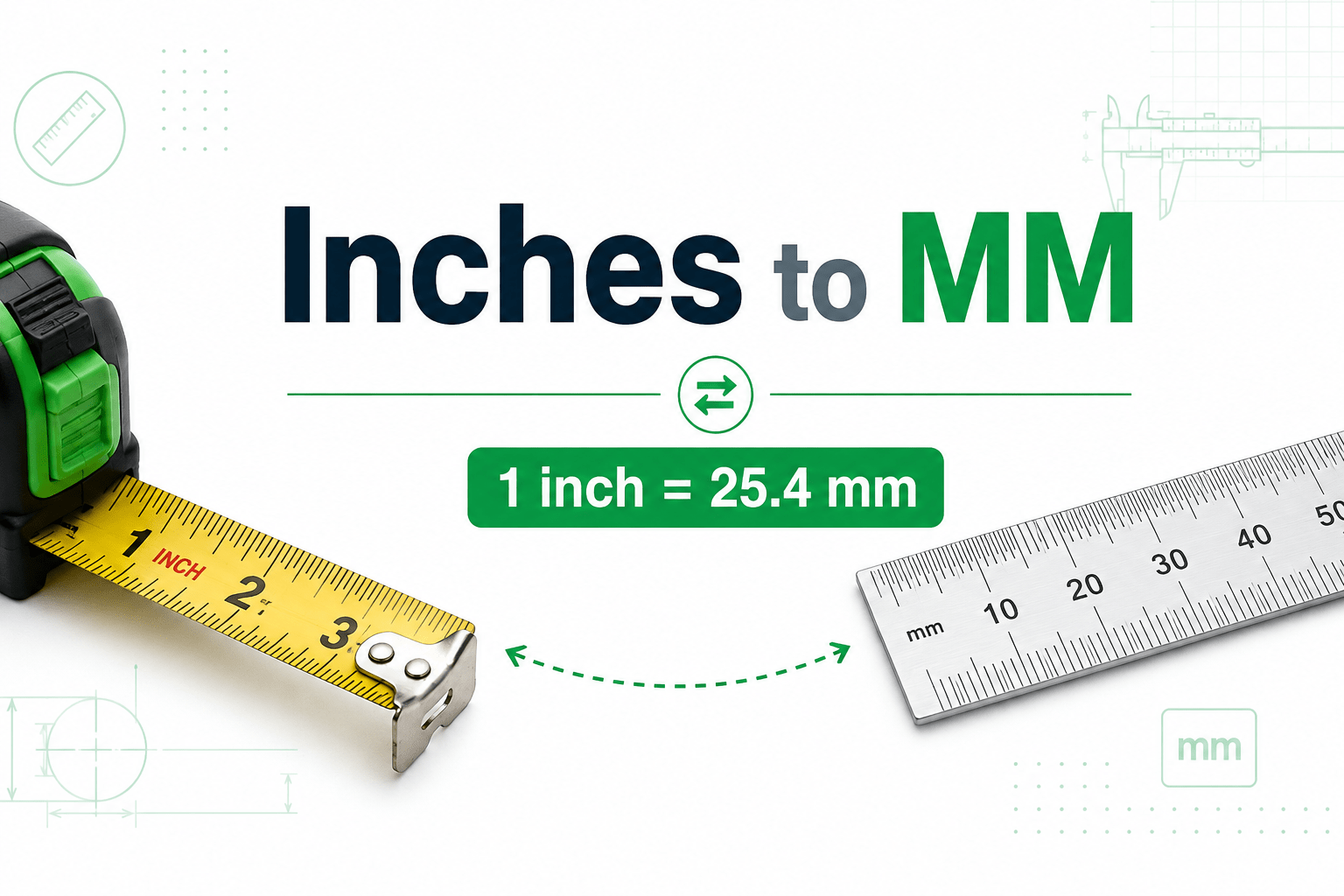
Need to convert inches to mm quickly? The conversion is simple: multiply the number of inches by 25.4.
1 inch = 25.4 millimeters exactly.
For example, 2 inches equal 50.8 mm, 5 inches equal 127 mm, and 10 inches equal 254 mm.
Use the calculator below for an instant result, or keep reading for the exact formula, worked examples, fractional-inch conversions, a conversion chart, and practical guidance on when this measurement is useful.
Convert Inches to MM Instantly
Need a fast and accurate answer? Enter your measurement in inches in the calculator below and select Convert inches to mm. The calculator uses the internationally standardized conversion factor of 25.4 millimeters per inch.
You can enter whole numbers such as 5, decimal values such as 2.75, or common fractions such as 1/2 and 1 1/2.
Quick example:
2.5 inches × 25.4 = 63.5 mm
How to Convert Inches to MM
The inches to mm conversion uses one fixed conversion factor:
Millimeters = Inches × 25.4
So if you know the measurement in inches, simply multiply it by 25.4.
Inches to MM Formula
The formula can be written as:
mm = in × 25.4
Where:
mm = millimeters
in = inches
Because one inch is defined as exactly 25.4 millimeters, the conversion factor itself does not need to be approximated.
Example: Convert 4 Inches to MM
Start with 4 inches:
4 × 25.4 = 101.6
Therefore:
4 inches = 101.6 mm
Example: Convert 7.5 Inches to MM
For decimal measurements, the same formula applies:
7.5 × 25.4 = 190.5
Therefore:
7.5 inches = 190.5 mm
Example: Convert 1/2 Inch to MM
Half an inch is 0.5 inches:
0.5 × 25.4 = 12.7
Therefore:
1/2 inch = 12.7 mm
Why Does 1 Inch Equal Exactly 25.4 MM?
The relationship between inches and millimeters is not an estimate. The modern international inch is defined so that:
1 inch = 25.4 millimeters exactly.
This standardized relationship has been used since the international yard and pound agreement that took effect in 1959. The U.S. National Institute of Standards and Technology (NIST) confirms the 25.4 mm value as an exact conversion.
That is important because an inches to mm calculator does not need to rely on an approximate conversion factor. Any rounding you see in a result comes from the precision of the original measurement or the number of decimal places displayed, not from the 25.4 conversion factor itself.
Inches and Millimeters Explained
Inches and millimeters are both units used to measure length, but they belong to different measurement systems.
What Is an Inch?
An inch is a unit of length commonly represented by the symbol in or by the double-prime symbol ″.
There are:
12 inches in 1 foot
and:
36 inches in 1 yard
Inches are especially common in U.S. product dimensions, construction measurements, tools, hardware, displays, woodworking, and many everyday measurements.
What Is a Millimeter?
A millimeter is a metric unit of length represented by the symbol mm.
There are:
10 millimeters in 1 centimeter
and:
1,000 millimeters in 1 meter
Millimeters are particularly useful for small or precise measurements because they allow dimensions to be expressed without relying heavily on decimal fractions of a larger unit.
The symbol remains mm, whether the value is 1 millimeter or 100 millimeters.
When Do You Need to Convert Inches to MM?
The need to convert inches to mm often appears when measurements move between U.S. customary or imperial-style specifications and metric specifications.
Engineering and Manufacturing
Technical drawings, machine components, tools, and manufactured parts may be specified in either inches or millimeters.
For example, a component listed as 0.5 inches wide is 12.7 mm wide. Converting accurately becomes especially important when parts must fit together within small tolerances.
Screws, Bolts, and Hardware
Hardware dimensions frequently appear in different measurement systems. You may encounter an inch-based measurement while another drawing, tool, or component uses millimeters.
Converting the measurement helps you compare dimensions before choosing compatible parts.
Woodworking and DIY Projects
Many woodworking plans use fractional inches such as 1/4, 1/2, or 3/4 inch, while metric rulers, saw settings, materials, or replacement parts may use millimeters.
For example:
3/4 inch = 19.05 mm
A quick conversion can help prevent cutting or fitting errors.
Product Dimensions and International Shopping
Furniture, electronics, tools, replacement parts, and accessories may be listed in inches on one website and millimeters on another.
An inches to mm conversion lets you compare those specifications directly instead of estimating whether two products are the same size.
CAD, 3D Printing, and Design
Design files and technical models may use different unit systems depending on the software, designer, or manufacturing process.
Converting measurements correctly before entering dimensions can help maintain the intended scale of a model or component.
Screens, Prints, and Other Dimensions
Measurements for displays, photographs, frames, paper sizes, and similar products may also appear in inches.
For example, a 6-inch physical dimension corresponds to:
6 × 25.4 = 152.4 mm
Common Fractional Inches to MM
Fractional inches are especially common in woodworking, hardware, machining, and DIY work. These frequently used values are useful to know:
| Inches | Millimeters |
|---|---|
| 1/16 in | 1.5875 mm |
| 1/8 in | 3.175 mm |
| 3/16 in | 4.7625 mm |
| 1/4 in | 6.35 mm |
| 5/16 in | 7.9375 mm |
| 3/8 in | 9.525 mm |
| 7/16 in | 11.1125 mm |
| 1/2 in | 12.7 mm |
| 5/8 in | 15.875 mm |
| 3/4 in | 19.05 mm |
| 7/8 in | 22.225 mm |
| 1 in | 25.4 mm |
For other fractions or mixed measurements such as 1 1/2 inches, use the calculator above.
How Accurate Should an Inches to MM Conversion Be?
Because 1 inch equals exactly 25.4 mm, the mathematical conversion can be highly precise.
However, the useful number of decimal places depends on the original measurement.
If a board is measured only to the nearest inch, showing a converted result to six decimal places does not make the original measurement more precise. On the other hand, engineering or machining measurements may require several decimal places.
A useful rule is to keep enough digits for your application and round only after completing the conversion.
For example:
2.375 inches × 25.4 = 60.325 mm
In this case, 60.325 mm is an exact result for the stated inch value.
Common Mistakes When Converting Inches to Millimeters
One of the easiest mistakes is confusing the centimeter conversion with the millimeter conversion.
Remember:
1 inch = 2.54 cm
but:
1 inch = 25.4 mm
Because 1 centimeter contains 10 millimeters, the millimeter value is ten times the centimeter value.
Another common mistake is rounding too early. If accuracy matters, multiply the complete inch value by 25.4 first and round only the final answer.
Also remember that the correct unit symbol is mm, not “mms.”
Inches to MM Conversion Table
The following inches to mm chart provides quick reference values from 1 to 100 inches.
| Inches | Millimeters |
| 1 in | 25.4 mm |
| 10 in | 254 mm |
| 20 in | 508 mm |
| 30 in | 762 mm |
| 40 in | 1,016 mm |
| 50 in | 1,270 mm |
| 60 in | 1,524 mm |
| 70 in | 1,778 mm |
| 80 in | 2,032 mm |
| 90 in | 2,286 mm |
| 100 in | 2,540 mm |
For any value not shown in the table, enter the measurement into the calculator at the top of the page.
Related Length Conversions
If you regularly work with metric and imperial measurements, you may also find these conversions useful:
Inches to centimeters for larger metric dimensions.
Centimeters to inches for the reverse calculation.
Inches to feet and feet to inches for U.S. length measurements.
Millimeters to inches for converting in the opposite direction.
The Length Converters section for other common metric and imperial unit conversions.
Accuracy Standard
This converter uses the internationally standardized relationship:
1 inch = 25.4 millimeters exactly.
The conversion factor is consistent with the definition published by the U.S. National Institute of Standards and Technology (NIST). For technical work, keep the precision of the original measurement in mind when deciding how many decimal places to use in the final result.
Frequently Asked Questions About Inches to MM
There are exactly 25.4 millimeters in 1 inch.
Multiply the number of inches by 25.4:
mm = inches × 25.4
Half an inch equals:
0.5 × 25.4 = 12.7 mm
So 1/2 inch = 12.7 mm.
One quarter of an inch is 0.25 inches:
0.25 × 25.4 = 6.35 mm
So 1/4 inch = 6.35 mm.
One eighth of an inch equals:
1/8 inch = 3.175 mm
2 × 25.4 = 50.8 mm
Therefore, 2 inches = 50.8 mm.
10 × 25.4 = 254 mm
Therefore, 10 inches = 254 mm.
Yes. The international inch is defined as exactly 25.4 millimeters. It is not merely a rounded approximation.
Multiply the inch value by 25.4.
For example:
3 inches × 25.4 = 76.2 mm
For quick mental estimates, you can think of one inch as approximately 25 mm, but use 25.4 whenever an accurate result is required.
For the reverse conversion, divide the number of millimeters by 25.4:
inches = millimeters ÷ 25.4
For example:
254 mm ÷ 25.4 = 10 inches