Convert Kelvin to Celsius Instantly
Need a quick and accurate temperature conversion? Enter a Kelvin value in the calculator below and select Convert K to °C. The result is calculated using the exact formula °C = K − 273.15.
The calculator accepts whole numbers and decimals, including 0 K. Temperatures below 0 K are not accepted because absolute zero is the lowest physically meaningful temperature on the Kelvin scale.
Kelvin to Celsius Converter
A Kelvin to Celsius conversion is used to express an absolute temperature in the more familiar Celsius scale. To convert Kelvin to Celsius, subtract 273.15 from the Kelvin value:
Degrees Celsius = Kelvin − 273.15
For example, 300 K equals 26.85°C. Use the calculator above for an instant result, or follow the formula and examples below to complete the calculation manually.
Kelvin to Celsius formula
The exact conversion formula is:
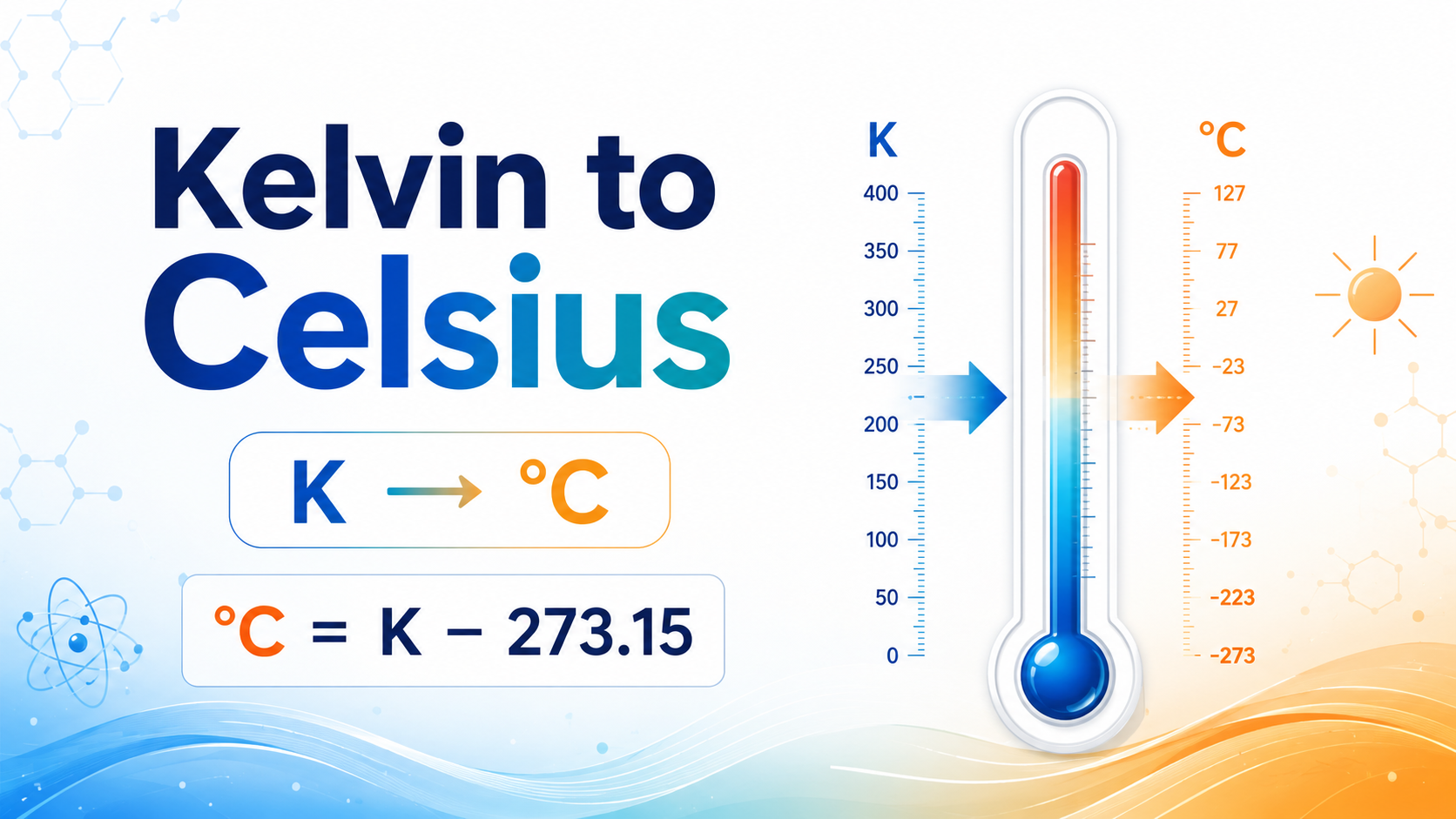
°C = K − 273.15
In this formula:
- K represents the temperature in kelvins.
- °C represents the temperature in degrees Celsius.
- 273.15 is the exact difference between the zero points of the two scales.
The Kelvin and Celsius scales use intervals of the same size. A temperature change of 1 K is equal in magnitude to a temperature change of 1°C. The only difference is where each scale begins.
Zero kelvin is absolute zero, while zero degrees Celsius is the freezing point of water under commonly defined standard conditions. Therefore:
0 K = −273.15°C
273.15 K = 0°C
How to convert Kelvin to Celsius
Follow these three steps:
- Write down the temperature in Kelvin.
- Subtract 273.15 from that value.
- Add the Celsius symbol, °C, to the result.
Example: convert 300 K to Celsius
Start with the formula:
°C = K − 273.15
Insert 300 K:
°C = 300 − 273.15
Calculate the result:
300 K = 26.85°C
Example: convert 310.15 K to Celsius
310.15 − 273.15 = 37
Therefore:
310.15 K = 37°C
This example is useful because 37°C is commonly associated with normal human body temperature, although actual body temperature varies by person, measurement method and time of day.
Example: convert 250 K to Celsius
250 − 273.15 = −23.15
Therefore:
250 K = −23.15°C
A Kelvin value can produce a negative Celsius result without being physically invalid. Only a Kelvin temperature below 0 K would fall below absolute zero.
Why is the conversion important?
The Kelvin to Celsius calculation connects an absolute scientific temperature scale with a scale that is more familiar in everyday life.
Kelvin is especially useful in science because it begins at absolute zero. This makes it suitable for equations involving thermal energy, thermodynamics, radiation and the behaviour of gases. Celsius is easier for most people to interpret because it is widely used for weather, room temperature, cooking, refrigeration and everyday temperature measurements.
Converting between the two allows scientific measurements to be communicated in a practical and understandable form without changing the underlying temperature.
Where is Kelvin most commonly used?
Kelvin is the SI base unit of thermodynamic temperature and is commonly used in:
- Physics and thermodynamics
- Chemistry and laboratory research
- Astronomy and space science
- Engineering and materials science
- Cryogenics and low-temperature research
- Climate and atmospheric modelling
- Electronics and sensor calibration
- Heating, ventilation and refrigeration calculations
Scientific instruments, datasets and equations may provide temperatures in Kelvin even when the final result needs to be presented in degrees Celsius.
For example, a laboratory sensor might record 295.15 K. Converting the value gives 22°C, which is easier to recognise as a typical indoor temperature.
When do you need a Kelvin to Celsius conversion?
You may need this conversion when:
- Reading a scientific paper or laboratory report
- Comparing technical data with everyday temperatures
- Completing physics or chemistry calculations
- Interpreting temperature sensor output
- Working with engineering specifications
- Converting astronomy or climate data
- Preparing educational materials
- Checking values in international scientific datasets
Students often encounter the conversion in equations involving pressure, volume, heat and energy. Engineers and researchers may use Kelvin during calculations and then convert the final value into Celsius for reports, displays or operating instructions.
Kelvin compared with Celsius
Kelvin is an absolute temperature scale. Its lowest possible value is 0 K, known as absolute zero. At this theoretical limit, a system has the minimum possible thermal energy under the principles of thermodynamics.
Celsius is a relative scale historically connected with the freezing and boiling behaviour of water. It is widely used for practical temperature communication.
An important notation difference is that Kelvin does not use a degree symbol:
- Correct: 300 K
- Incorrect: 300°K
- Correct Celsius notation: 26.85°C
The unit name is written as “kelvin” in lowercase, while its symbol is an uppercase K.
Accuracy and rounding
The constant 273.15 is exact for this conversion. Do not shorten it to 273 when accuracy matters.
For everyday use, rounding the result to one or two decimal places is usually sufficient:
298 K = 24.85°C
Rounded to one decimal place:
298 K ≈ 24.9°C
Scientific and engineering work may require more decimal places. The converted result should normally retain a level of precision appropriate to the original measurement.
Common conversion mistakes
One common mistake is adding 273.15 instead of subtracting it. Adding is used for the reverse conversion from Celsius to Kelvin.
Another mistake is using 273 rather than 273.15. This creates an error of 0.15°C, which may be significant in precise measurements.
Do not add a degree sign to the Kelvin symbol. Write 100 K, not 100°K.
It is also important not to confuse thermodynamic temperature with lighting color temperature. Lamps may be described as 2700 K or 6500 K, but converting those values into Celsius is normally not useful. In lighting, Kelvin describes the visual appearance of the light, not necessarily the physical temperature of the lamp.
Kelvin to Celsius conversion table
The following chart provides common values from 1 K to 100 K. Because these temperatures are below 273.15 K, all corresponding Celsius values are negative.
| Kelvin | Celsius |
|---|---|
| 1 K | −272.15°C |
| 10 K | −263.15°C |
| 20 K | −253.15°C |
| 30 K | −243.15°C |
| 40 K | −233.15°C |
| 50 K | −223.15°C |
| 60 K | −213.15°C |
| 70 K | −203.15°C |
| 80 K | −193.15°C |
| 90 K | −183.15°C |
| 100 K | −173.15°C |
Subtract 273.15 from the Kelvin value:
°C = K − 273.15
For example, 290 K equals 16.85°C.
Zero kelvin is equal to −273.15°C. This temperature is known as absolute zero.
273.15 K is exactly 0°C.
Yes. The size of one kelvin is equal to the size of one degree Celsius. The scales have different zero points, but their temperature intervals are equal.
A thermodynamic temperature cannot be below 0 K. Negative Kelvin values should therefore not be entered into a standard temperature converter.
Kelvin is an absolute SI unit and is written without the degree symbol. The correct notation is 300 K, while Celsius is written as 26.85°C.
300 K equals 26.85°C, which most people would describe as warm room temperature.
Add 273.15 to the Celsius value:
K = °C + 273.15
For example, 20°C equals 293.15 K.