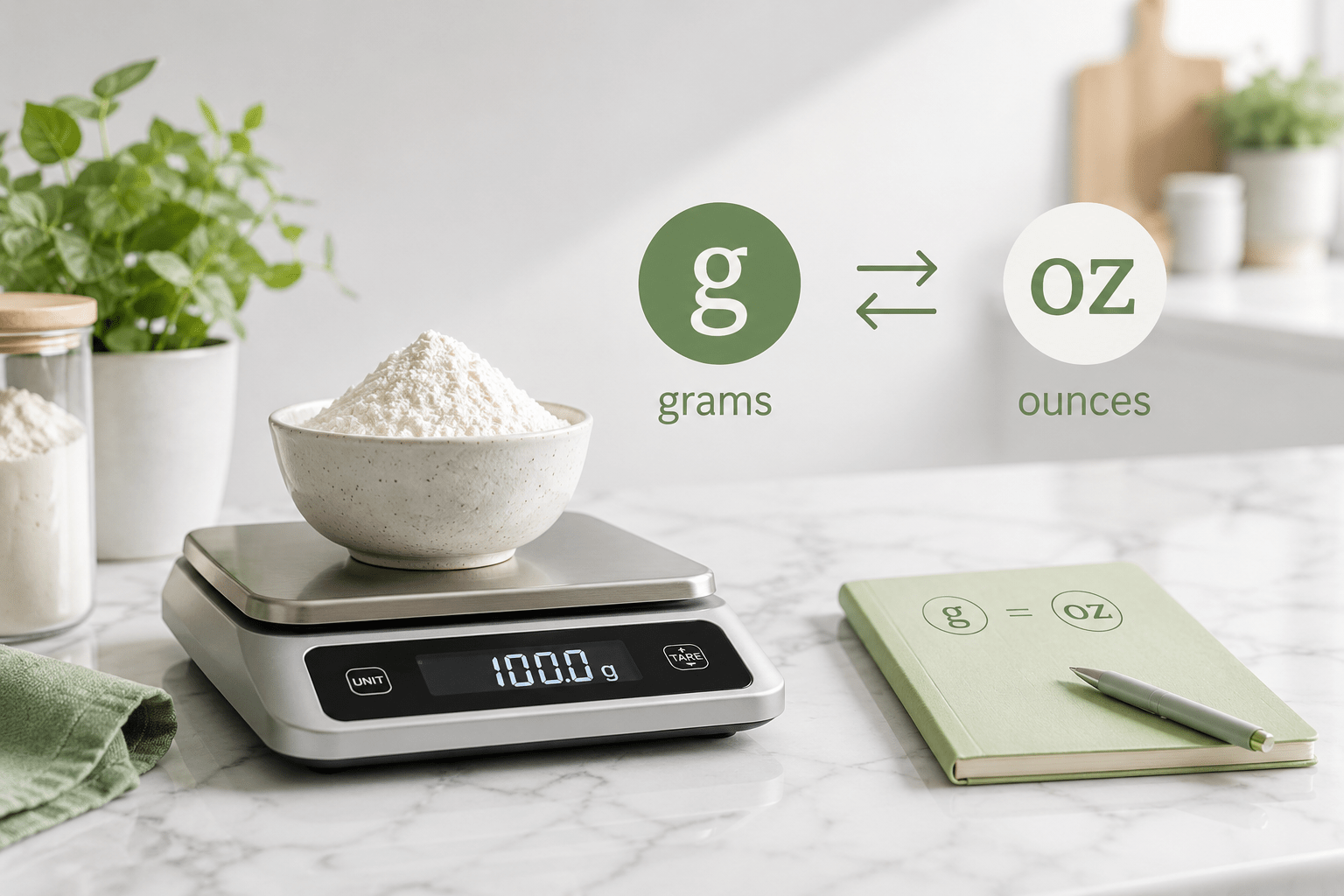
If you need to convert grams to ounces, use the standard avoirdupois conversion: 1 gram = 0.03527396195 ounces. You can divide the number of grams by 28.349523125, or multiply by 0.03527396195. For example, 100 g = 3.5274 oz.
The calculator below gives you the answer instantly and uses the ordinary avoirdupois ounce used for food, product weights, packages and everyday measurements. It does not use fluid ounces or troy ounces, which are different units.
Convert Grams to Ounces Instantly
Need the answer right away? Enter the amount in grams below and the calculator will convert it to ounces instantly.
The calculator uses the standard relationship 1 avoirdupois ounce = 28.349523125 grams, so you can use it for recipes, food portions, product weights, packages and other everyday mass conversions.
Quick example: 100 g = approximately 3.5274 oz.
Important: This converter calculates ordinary weight ounces (avoirdupois oz). If you are measuring liquids or precious metals, read the explanation below because fluid ounces and troy ounces are different units.
How to Convert Grams to Ounces
To convert grams to ounces accurately, use this formula:
ounces = grams ÷ 28.349523125
You can also use:
ounces = grams × 0.03527396195
The second number is the rounded reciprocal of the standard relationship:
1 avoirdupois ounce = 28.349523125 grams
For maximum consistency, our calculator divides the entered gram value by 28.349523125 before displaying the result.
Worked Examples
25 grams to ounces
25 ÷ 28.349523125 = 0.881849 oz
50 grams to ounces
50 ÷ 28.349523125 = 1.763698 oz
250 grams to ounces
250 ÷ 28.349523125 = 8.81849 oz
These examples also show why using more than the shortened value of 0.035 can be useful when you need a more precise conversion.
What Is a Gram?
The gram (g) is an SI unit of mass equal to one-thousandth of a kilogram:
1 g = 0.001 kg
The kilogram is the SI base unit of mass. Because a gram is convenient for relatively small quantities, grams are widely used for food ingredients, nutrition labels, laboratory measurements, education, product specifications and package weights.
In everyday language, people often talk about the “weight” of an object in grams, although technically grams are units of mass.
What Is an Ounce?
On this page, ounce (oz) means the avoirdupois ounce.
This is the ordinary ounce used for most everyday mass and weight measurements involving pounds and ounces, including food, packages and consumer products.
The conversion relationship is:
1 oz = 28.349523125 g
There are also:
16 avoirdupois ounces = 1 avoirdupois pound
This distinction is important because the word “ounce” can also refer to a troy ounce or a fluid ounce. Those units are not interchangeable with the avoirdupois ounce used by this calculator.
When Do You Need to Convert Grams to Ounces?
Being able to convert grams to ounces is particularly useful when a metric measurement needs to be understood or used in a system that expresses smaller masses in ounces.
Cooking and Baking
International recipes frequently list ingredients in grams, while some cookbooks, kitchen scales and recipes use ounces.
Converting between the two makes it possible to follow the same recipe regardless of which measurement system your equipment uses.
For example:
125 g = 4.4092 oz
Mass-based measurements can be especially useful in baking because weighing ingredients can provide more consistent results than measuring them by volume.
Food Portions and Nutrition Information
Food packaging and portion sizes may be listed in grams in one country and ounces in another.
Converting the amount can make it easier to compare:
- serving sizes;
- package quantities;
- ingredient amounts;
- food portions;
- product sizes.
Shipping, E-Commerce and Product Weights
Small products and parcels are often specified in grams on international websites but in ounces on US product listings.
A conversion can therefore help when comparing:
- shipping weights;
- product specifications;
- package sizes;
- online store listings.
For regulated shipping, commercial labeling or trade, always follow the measurement and precision requirements that apply to the particular carrier, service or jurisdiction.
Crafts, Hobbies and Small Objects
Craft materials, model components and other lightweight products can also be sold using either metric or customary measurements.
Converting between grams and ounces makes quantities easier to compare when suppliers use different systems.
For precious metals, however, always check whether the stated ounce is a troy ounce rather than an ordinary avoirdupois ounce.
Education, Science and Data Comparison
Scientific work normally uses SI measurements, but students and professionals may encounter older data, US customary measurements or industry information expressed in ounces.
Converting the units helps values from different measurement systems to be compared consistently.
For formal scientific or technical work, retain enough significant figures for the required level of precision.
Grams and Ounces Use Different Measurement Systems
Grams belong to the International System of Units (SI), while ounces belong to the avoirdupois measurement system used with pounds.
This is why converting between them does not involve a simple factor of 10, 100 or 1,000.
The ordinary avoirdupois ounce has the same mass relationship in US customary and British Imperial measurements:
1 oz = 28.349523125 g
That is different from fluid ounces, where the US fluid ounce and Imperial fluid ounce represent different volumes.
Avoirdupois Ounces, Troy Ounces and Fluid Ounces
Before you convert grams to ounces, make sure you are using the correct type of ounce.
Avoirdupois ounce (oz): 28.349523125 g
This is the ordinary mass ounce used for foods, packages and most consumer goods.
Troy ounce (oz t): 31.1034768 g
The troy ounce is mainly associated with precious metals such as gold and silver.
Fluid ounce (fl oz): a unit of volume
A fluid ounce does not measure mass. Therefore, grams cannot be accurately converted directly into fluid ounces unless you also know the density of the substance.
US and Imperial fluid ounces also represent different volumes.
Confusing these three types of ounce is one of the easiest ways to produce an incorrect conversion.
Accuracy, Precision and Rounding
The calculator on this page uses the relationship:
1 avoirdupois ounce = 28.349523125 grams
Calculator results are displayed to up to six decimal places, while the quick-reference table below is rounded to four decimal places for easier reading.
The number of decimal places you need depends on what you are doing.
For example:
100 g = 3.527396 oz
Rounded to four decimal places:
100 g ≈ 3.5274 oz
Rounded to two decimal places:
100 g ≈ 3.53 oz
For everyday cooking, a heavily rounded value may be perfectly practical. For technical calculations, comparisons or other situations where precision matters, keep additional digits and avoid rounding until the final step.
Quick Grams-to-Ounces Estimates
These common values are useful when you need a fast mental estimate:
- 28.35 g ≈ 1 oz
- 30 g ≈ 1.06 oz
- 50 g ≈ 1.76 oz
- 100 g ≈ 3.53 oz
- 250 g ≈ 8.82 oz
- 500 g ≈ 17.64 oz
For values that are not listed, use the calculator above rather than repeatedly rounding an estimated conversion factor.
Common Grams-to-Ounces Conversion Mistakes
Although the calculation is simple, several common mistakes can produce the wrong answer.
Confusing ounces with fluid ounces.
An ordinary ounce measures mass, while a fluid ounce measures volume.
Using a troy ounce for an everyday measurement.
A troy ounce is heavier than an avoirdupois ounce and is mainly used for precious metals.
Using only 0.035 as the conversion factor.
This may be acceptable for a rough estimate, but it is less precise and the difference increases with larger quantities.
Rounding too early.
Keep additional digits during the calculation and round only the final result.
Converting in the wrong direction.
To go from grams to ounces, divide by 28.349523125. To go from ounces to grams, multiply by 28.349523125.
About the Accuracy of This Conversion
Easy Unit Convert bases this calculation on the standard avoirdupois ounce relationship published in recognized measurement references.
The calculator, formula, examples and conversion table on this page use the same underlying relationship so that the results remain consistent throughout the page.
For more information about how we check conversion factors, formulas, rounding and conversion tables, see our Accuracy & Editorial Policy.
Reference Standards
The mass relationship used on this page is checked against the National Institute of Standards and Technology (NIST), which lists:
1 avoirdupois ounce = 28.349523125 grams
SI unit definitions and terminology are also checked against the Bureau International des Poids et Mesures (BIPM), the organization responsible for maintaining the International System of Units.
A NIST jelenlegi Handbook 133 táblázata ezt az ounce–gram kapcsolatot közli, a BIPM pedig a kilogramot definiálja SI-alapegységként.
NIST Handbook 133 measurement tables
BIPM – SI unit of mass, kilogram
Grams to Ounces Conversion Table
The following table provides quick-reference values from 1 to 100 grams. Values are rounded to four decimal places.
| Grams (g) | Ounces (oz) |
|---|---|
| 1 | 0.0353 |
| 10 | 0.3527 |
| 20 | 0.7055 |
| 30 | 1.0582 |
| 40 | 1.4110 |
| 50 | 1.7637 |
| 60 | 2.1164 |
| 70 | 2.4692 |
| 80 | 2.8219 |
| 90 | 3.1747 |
| 100 | 3.5274 |
Frequently Asked Questions
One gram is approximately 0.03527396195 avoirdupois ounces. For quick everyday use, this is often rounded to 0.0353 oz.
How many grams are in 1 ounce?
Approximately. 100 grams = 3.527396 ounces, which becomes about 3.53 oz when rounded to two decimal places.
50 grams = 1.763698 ounces, or approximately 1.76 oz.
Divide the number of grams by 28.349523125. For a faster method, enter the gram value in the calculator at the top of this page and it will perform the calculation automatically.
No. An ounce (oz) in this converter is a unit of mass. A fluid ounce (fl oz) is a unit of volume. Converting grams into fluid ounces requires additional information, particularly the density of the substance.
No. This calculator uses the standard avoirdupois ounce. A troy ounce equals approximately 31.1034768 grams and is mainly used for precious metals.
Most small differences are caused by rounding. A source using only 0.035 oz per gram will produce a less precise result than a calculation that retains more digits. Larger differences may occur when avoirdupois ounces, troy ounces and fluid ounces are confused.