Need a quick answer? 1 avoirdupois ounce (oz) equals exactly 28.349523125 grams (g). Enter any weight in ounces below and the calculator will convert it to grams using the full conversion factor.
This calculator is for ounces of weight, not fluid ounces. For everyday food, package and general weight measurements, “oz” normally refers to the avoirdupois ounce.
If you need to convert ounces to gram measurements, the calculation is straightforward: 1 ounce equals exactly 28.349523125 grams when using the standard avoirdupois ounce. Enter your value in the calculator above for an instant result, or use the formula, examples and conversion chart below to calculate ounces to grams manually.
Quick answer:
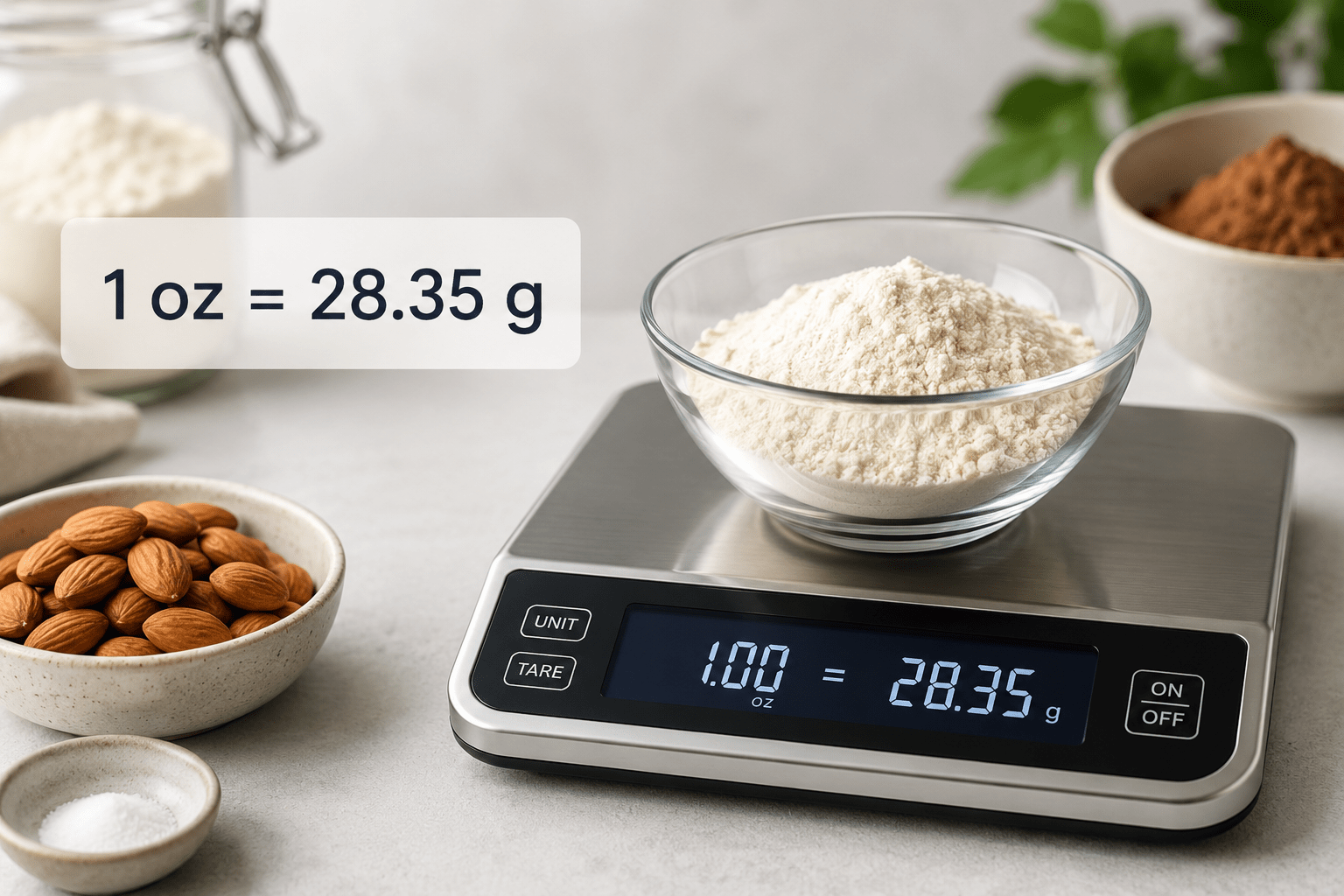
1 oz = 28.349523125 g
For most everyday purposes:
1 oz ≈ 28.35 g
The calculator on this page uses the full conversion factor rather than the rounded 28.35 value.
How to Convert Ounces to Grams Measurements
To convert ounces to grams, multiply the number of ounces by 28.349523125.
Ounces to grams formula
grams = ounces × 28.349523125
Or, using unit symbols:
g = oz × 28.349523125
For example, to convert 5 ounces to grams:
5 × 28.349523125 = 141.747615625 g
Therefore:
5 oz ≈ 141.75 g
when rounded to two decimal places.
For quick everyday calculations, multiplying by 28.35 is usually sufficient. For calculations where greater precision matters, use the full conversion factor or the calculator above.
Common Ounces to Grams Conversions
Here are some useful values that frequently occur in cooking, food packaging and everyday weight measurements:
| Ounces | Grams |
|---|---|
| 0.5 oz | 14.175 g |
| 1 oz | 28.350 g |
| 2 oz | 56.699 g |
| 4 oz | 113.398 g |
| 8 oz | 226.796 g |
| 12 oz | 340.194 g |
| 16 oz | 453.592 g |
An especially useful relationship to remember is:
16 oz = 1 lb = 453.59237 g
This is because there are exactly 16 avoirdupois ounces in one avoirdupois pound.
What Is an Ounce?
An ounce, abbreviated oz, is a unit of mass used primarily in the United States and in some contexts in countries that still use Imperial or customary measurements.
The ounce used for ordinary weights is normally the avoirdupois ounce.
One avoirdupois ounce is:
1 oz = 28.349523125 g
and:
16 oz = 1 lb
This distinction matters because “ounce” can refer to more than one measurement system.
Avoirdupois ounce vs troy ounce
The standard ounce used for groceries, food portions, packages and most everyday objects is the avoirdupois ounce.
A troy ounce, however, is different:
1 troy ounce ≈ 31.1034768 g
Troy ounces are primarily used for precious metals such as gold and silver.
Therefore, if you are converting the weight of gold, silver or another precious metal, you should not use a standard ounces-to-grams calculator unless the measurement is specifically stated in avoirdupois ounces.
What Is a Gram?
A gram, abbreviated g, is a metric unit of mass.
The kilogram is the SI base unit of mass, and:
1 gram = 0.001 kilogram
or:
1 kilogram = 1,000 grams
Grams are particularly convenient for relatively small masses. They are widely used for food ingredients, nutrition information, product weights, laboratory measurements and many everyday objects.
Because metric measurements are widely used internationally, converting ounces to grams is particularly useful when moving between U.S. customary and metric measurements.
Why Is It Useful to Convert Ounces to Grams Values?
The need to convert ounces to gram values occurs frequently because ounces and grams belong to different measurement systems.
Cooking and baking
One of the most common situations is following a recipe from another country.
A U.S. recipe may specify:
4 oz of an ingredient
while a digital kitchen scale or an international recipe may use grams.
The conversion is:
4 × 28.349523125 = 113.3980925 g
So 4 oz is approximately 113.4 grams.
Weight-based measurements can be particularly useful in baking because weighing ingredients can provide more consistent results than estimating quantities by volume.
Food packaging and portion sizes
Product labels and food packages may display weights in ounces, grams or both.
Knowing the conversion makes it easier to compare products or understand package sizes when shopping internationally.
For example:
8 oz ≈ 226.8 g
and:
16 oz ≈ 453.6 g
Shipping and small packages
Ounces are often used for lightweight items and packages in the United States, while international shipping documentation may use grams or kilograms.
Being able to convert between the two systems makes it easier to compare weight limits or prepare measurements for different services.
Education and technical work
Students and professionals may also encounter measurements expressed in different systems.
Using the exact conversion factor allows measurements to be translated consistently between ounces and metric units.
Ounces Are Not the Same as Fluid Ounces
This is one of the most important distinctions on this page.
Ounces (oz) measure mass.
Fluid ounces (fl oz) measure volume.
Therefore:
1 oz → grams
is a direct mass conversion.
But:
1 fl oz → grams
cannot be converted with one universal factor because the answer depends on the density of the substance.
For example, a fluid ounce of water and a fluid ounce of oil occupy a similar volume but do not necessarily have the same mass.
If your measurement says fl oz, use a fluid-volume converter rather than this weight converter.
How Accurate Should an Ounces to Grams Conversion Be?
The appropriate number of decimal places depends on what you are measuring.
The exact conversion factor used on this page is:
1 oz = 28.349523125 g
However, displaying every decimal place is not always useful.
For everyday purposes:
1 oz ≈ 28.35 g
For kitchen measurements, rounding to the nearest gram or tenth of a gram may often be sufficient depending on the ingredient and scale.
For calculations requiring greater precision, keep more decimal places and avoid repeatedly rounding intermediate values.
Our calculator performs the conversion using the full factor and only formats the displayed result afterward.
Worked Examples
Example 1: Convert 2 oz to grams
Use the formula:
grams = ounces × 28.349523125
Therefore:
2 × 28.349523125 = 56.69904625
So:
2 oz ≈ 56.70 g
Example 2: Convert 8 oz to grams
8 × 28.349523125 = 226.796185
Therefore:
8 oz ≈ 226.80 g
Example 3: Convert 16 oz to grams
16 × 28.349523125 = 453.59237
Therefore:
16 oz = 453.59237 g
This is also one pound.
Example 4: Convert 25 oz to grams
25 × 28.349523125 = 708.738078125
Therefore:
25 oz ≈ 708.74 g
Example 5: Convert 100 oz to grams
100 × 28.349523125 = 2,834.9523125
Therefore:
100 oz ≈ 2,834.95 g
or approximately:
2.835 kg
Can I Convert Ounces to Grams Without a Calculator?
Yes.
For a quick mental estimate, multiply ounces by approximately 28.35.
For example, for 10 ounces:
10 × 28.35 = 283.5 g
The more precise result is:
10 oz = 283.49523125 g
The difference is tiny for ordinary everyday measurements.
For larger quantities or when precision matters, use the calculator rather than repeatedly estimating.
Understanding Rounding
A conversion can be mathematically correct while being displayed at different levels of precision.
For example:
1 oz = 28.349523125 g
may be displayed as:
- 28.35 g to two decimal places
- 28.350 g to three decimal places
- 28 g to the nearest whole gram
None of these automatically means the underlying conversion factor has changed. They simply represent different levels of rounding.
On Easy Unit Convert, we use the full conversion factor for the calculation whenever practical and round displayed examples to a useful number of decimal places.
Accuracy and Conversion Standard
This page uses the avoirdupois ounce, which is the standard ounce used for most ordinary weight measurements.
The conversion factor used here is:
1 avoirdupois ounce = 28.349523125 grams
This value is consistent with conversion tables published by the U.S. National Institute of Standards and Technology (NIST).
For information about how Easy Unit Convert checks formulas, conversion factors and rounding, see our Accuracy & Editorial Policy.
Ounces to Grams Conversion Table
The table below uses the full conversion factor of 28.349523125 grams per avoirdupois ounce. Results are rounded to three decimal places for easy reference.
| Ounces (oz) | Grams (g) |
|---|---|
| 1 oz | 28.350 g |
| 10 oz | 283.495 g |
| 20 oz | 566.990 g |
| 30 oz | 850.486 g |
| 40 oz | 1,133.981 g |
| 50 oz | 1,417.476 g |
| 60 oz | 1,700.971 g |
| 70 oz | 1,984.467 g |
| 80 oz | 2,267.962 g |
| 90 oz | 2,551.457 g |
| 100 oz | 2,834.952 g |
Related Weight Converters
If you need to move between related weight units, you may also find these useful:
Frequently Asked Questions
One standard avoirdupois ounce contains exactly 28.349523125 grams. For everyday use, this is usually rounded to 28.35 grams
The more accurate value is 28.349523125 grams. Saying 28 grams is a rough approximation, while 28.35 g is a much better everyday rounded value.
Multiply the number of ounces by 28.349523125.
For example:
6 oz × 28.349523125 = 170.09713875 g
So 6 oz is approximately 170.10 grams.
2 oz = 56.69904625 g, or approximately 56.70 grams
4 oz = 113.3980925 g, or approximately 113.40 grams
8 oz = 226.796185 g, or approximately 226.80 grams.
16 oz = 453.59237 g. Sixteen ounces also equal one avoirdupois pound.
No. An ounce (oz) measures mass, while a fluid ounce (fl oz) measures volume. Converting fluid ounces to grams requires information about the density of the substance.
No. A standard avoirdupois ounce is 28.349523125 g, while a troy ounce is approximately 31.1034768 g. Troy ounces are mainly used for precious metals.
For most everyday cooking and general measurements, 28.35 is sufficiently accurate. For higher-precision calculations, use 28.349523125 or the calculator on this page.
Sources and measurement references
The conversion factor used on this page is based on recognized measurement standards.
- NIST Handbook 44, Appendix C – General Tables of Units of Measurement: lists 1 avoirdupois ounce as exactly 0.028349523125 kilograms, or 28.349523125 grams.
- BIPM – The International System of Units (SI): identifies the kilogram as the SI base unit of mass.
For more information about how conversion factors are checked and rounded on Easy Unit Convert, see our Accuracy & Editorial Policy.