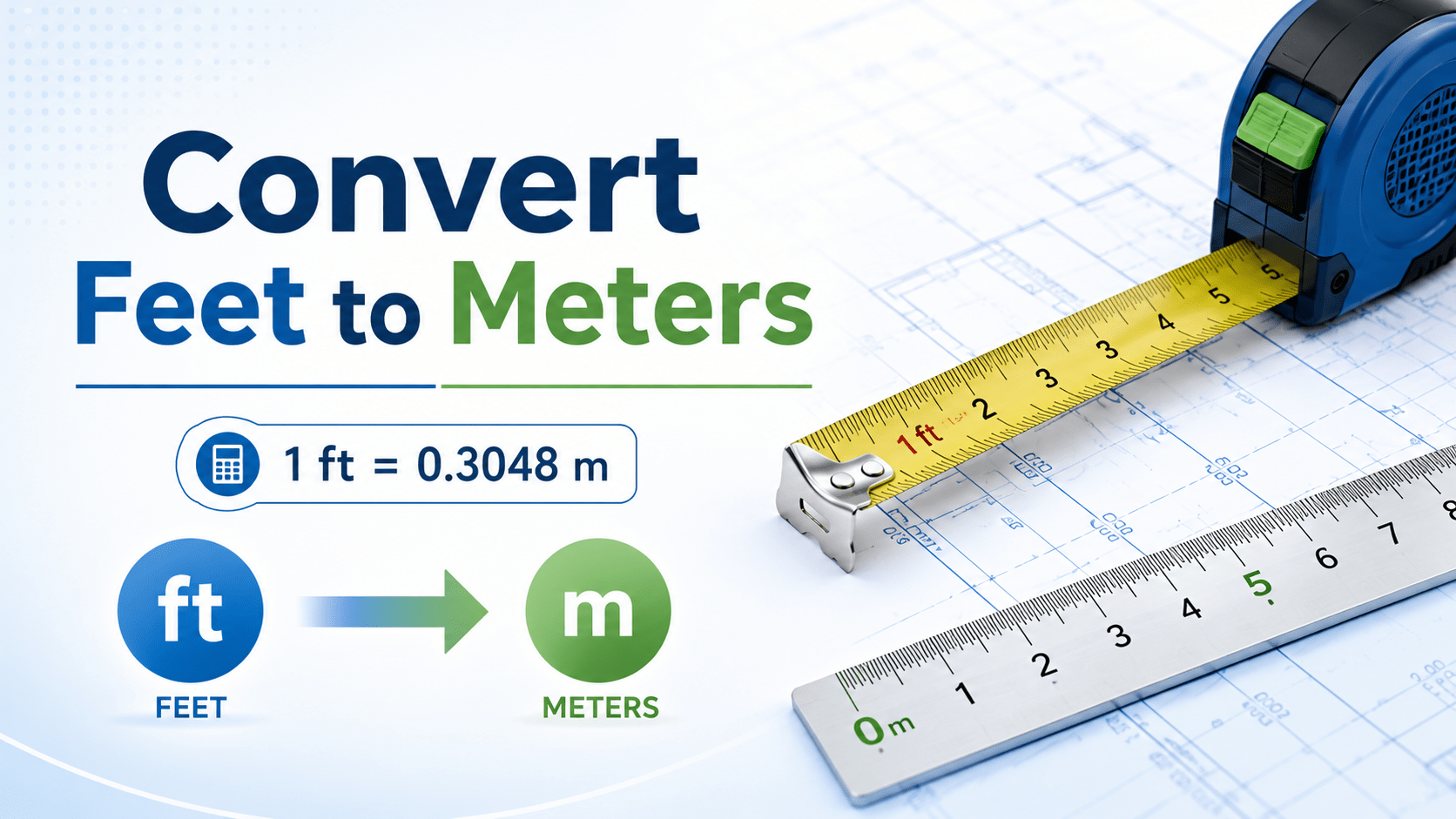
If you need to convert feet to meters, the exact rule is simple: multiply the number of feet by 0.3048. One international foot is defined as exactly 0.3048 meter, so the conversion itself is exact. Use the calculator below for an instant result, or continue for the formula, worked examples, common real-world uses, accuracy guidance and a quick conversion table.
Instant Conversion Calculator
Enter any length in feet into the calculator below and it will return the equivalent value in meters. The calculator uses the exact international relationship of 1 foot = 0.3048 meter and rounds only the displayed result.
Quick formula: meters = feet × 0.3048
Conversion Formula
For a manual calculation, multiply the number of feet by 0.3048
meters = feet × 0.3048
For example, with an input of 12 ft:
12 × 0.3048 = 3.6576 meters
So:
12 ft = 3.6576 m
Because 0.3048 is an exact conversion factor, you do not need an additional correction factor. Any rounding should normally be done only after the calculation.
Why Is 0.3048 Used?
The modern international foot is defined as exactly:
1 foot = 0.3048 meter
This relationship was internationally standardized in 1959 and is now the normal foot used for modern measurement.
In the United States, an older unit called the U.S. survey foot was historically used for some surveying and mapping work. NIST states that it was retired after December 31, 2022 and that the international foot should be used in modern applications, except where historic or legacy data specifically requires the old survey-foot definition.
Worked Examples
Example 1: 5 ft
5 × 0.3048 = 1.524
Therefore:
5 ft = 1.524 m
Example 2: 10 ft
10 × 0.3048 = 3.048
Therefore:
10 ft = 3.048 m
Example 3: 25 ft
25 × 0.3048 = 7.62
Therefore:
25 ft = 7.62 m
Example 4: 100 ft
100 × 0.3048 = 30.48
Therefore:
100 ft = 30.48 m
What Is a Foot?
A foot, symbol ft, is a unit of length used mainly in the U.S. customary system and in some contexts associated with Imperial measurement. One foot contains 12 inches.
Feet remain common in everyday measurements such as a person’s height, room dimensions, construction, property descriptions and some sports. Aviation also commonly expresses aircraft altitude in feet.
What Is a Meter?
A meter, symbol m, is the SI base unit of length. It is used worldwide in science, engineering, construction, education, transport and everyday metric measurements.
One meter equals:
100 centimeters
and:
1,000 millimeters
Because SI is the internationally standardized measurement system, converting measurements into meters is often useful when comparing specifications, plans or data from different countries.
When Is This Conversion Useful?
Feet and meters are both widely encountered, but they belong to different measurement conventions. A conversion is often needed when measurements created in the United States or other foot-using contexts need to be understood in countries and industries that use SI units.
Construction and Architecture
Building plans, room dimensions and product specifications may use feet in one source and meters in another.
Accurate conversion helps when comparing plans, estimating available space or checking whether an item fits a specified area.
Real Estate and Property Measurements
Room lengths, ceiling heights and property dimensions may be described in feet, while international buyers, renters or contractors may be more familiar with meters.
For example, a room described as 15 feet long is:
15 × 0.3048 = 4.572 meters
Aviation
Aircraft altitude is commonly expressed in feet, while many other technical measurements and geographic datasets use metric units.
This is one of the most familiar professional contexts in which both measurement systems may appear.
Sports and Recreation
Field dimensions, jumping distances, diving depths and other sports measurements can be reported in different systems depending on the country or organization.
Converting them allows easier comparison.
Travel and International Communication
A hotel room, building height, hiking measurement or local specification may be given in feet even when the reader normally thinks in meters.
A quick conversion makes the measurement much easier to visualize.
Engineering, Education and Technical Work
Students, engineers, technicians and designers may work with reference materials from several countries.
Converting the units consistently helps prevent errors when values from different measurement systems are combined.
Why Accuracy Matters
A rough mental estimate is often enough when you only need a general sense of scale.
For example:
1 foot ≈ 0.3 meter
However, this approximation should not replace the exact factor when precision matters.
For 100 feet, using 0.3 gives:
100 × 0.3 = 30 meters
The exact conversion is:
100 × 0.3048 = 30.48 meters
That is a difference of:
0.48 meter
For casual estimation, that may be acceptable.
For construction, equipment dimensions, technical drawings or other precision-sensitive work, use the exact factor of 0.3048 and round only the final result.
Conversion Accuracy and Rounding
The relationship between the international foot and the meter is exact:
1 ft = 0.3048 m exactly
This does not mean every original measurement is equally precise.
For example, if a room is described as 12 feet long only to the nearest foot, reporting the converted result as:
3.657600000 meters
would imply a level of measurement precision that the original value did not contain.
For everyday use, three or four decimal places are usually more than enough. In technical work, follow the tolerance, significant-figure and rounding requirements of the specific project.
The calculator on this page keeps the exact conversion factor during the calculation and rounds only the displayed result.
Common Conversion Mistakes
Multiplying in the wrong direction.
For this direction, multiply the value in feet by 0.3048. For the reverse calculation, divide by 0.3048 or multiply by approximately 3.28084.
Using 0.3 as if it were exact.
It is useful for rough mental estimates but introduces an error of about 1.6% compared with the exact conversion factor.
Confusing feet with inches.
One foot equals 12 inches, so make sure the input measurement is actually in feet.
Rounding too early.
Keep the full calculated value until the final step, especially if the converted measurement will be used in another calculation.
Ignoring legacy survey data.
Modern conversions should use the international foot. Historical U.S. surveying records may occasionally use the former U.S. survey foot, so the source data should be checked when working with legacy mapping or cadastral information.
Reverse Conversion
The formulas are direct reverses of each other.
From feet:
meters = feet × 0.3048
Reverse direction:
feet = meters ÷ 0.3048
If your starting measurement is in meters, use our reverse conversion calculator.
Conversion Standard and How We Check Accuracy
Easy Unit Convert uses standardized unit definitions rather than approximate conversion factors.
For this conversion, we use the international foot definition:
1 foot = 0.3048 meter exactly
NIST also states that the former U.S. survey foot is obsolete for modern applications and that the international foot has superseded it.
For more information about how conversion factors, examples and page content are checked, see our Accuracy & Editorial Policy.
Related Length Converters
- Convert Meters to Feet
- Convert feet to inches
- Convert Inches to Feet
- Convert cm to Inches
- Convert Inches to cm
- Length Converters
Quick Conversion Table
Use this table to check common values without entering each number into the calculator. The values below use the exact factor of 0.3048 meter per foot.
| Feet (ft) | Meters (m) |
|---|---|
| 1 | 0.3048 |
| 10 | 3.048 |
| 20 | 6.096 |
| 30 | 9.144 |
| 40 | 12.192 |
| 50 | 15.240 |
| 60 | 18.288 |
| 70 | 21.336 |
| 80 | 24.384 |
| 90 | 27.432 |
| 100 | 30.480 |
For any value not shown in the table, use the calculator at the top of the page.
Frequently Asked Questions
1 foot is exactly 0.3048 meter.
Multiply the number of feet by 0.3048:
meters = feet × 0.3048
10 feet equals exactly:
3.048 meters
100 feet equals exactly:
30.48 meters
Yes. The international foot is defined as exactly 0.3048 meter.
You can use 0.3 for a quick estimate, but it is not the exact conversion factor.
For accurate calculations, use 0.3048.
The U.S. survey foot was historically used for some surveying and mapping applications.
NIST states that it was retired after December 31, 2022 and should generally be avoided except for historic and legacy applications.
For everyday use, rounding is fine.
For technical, engineering, construction or scientific work, keep enough digits to match the required precision and the accuracy of the original measurement.