
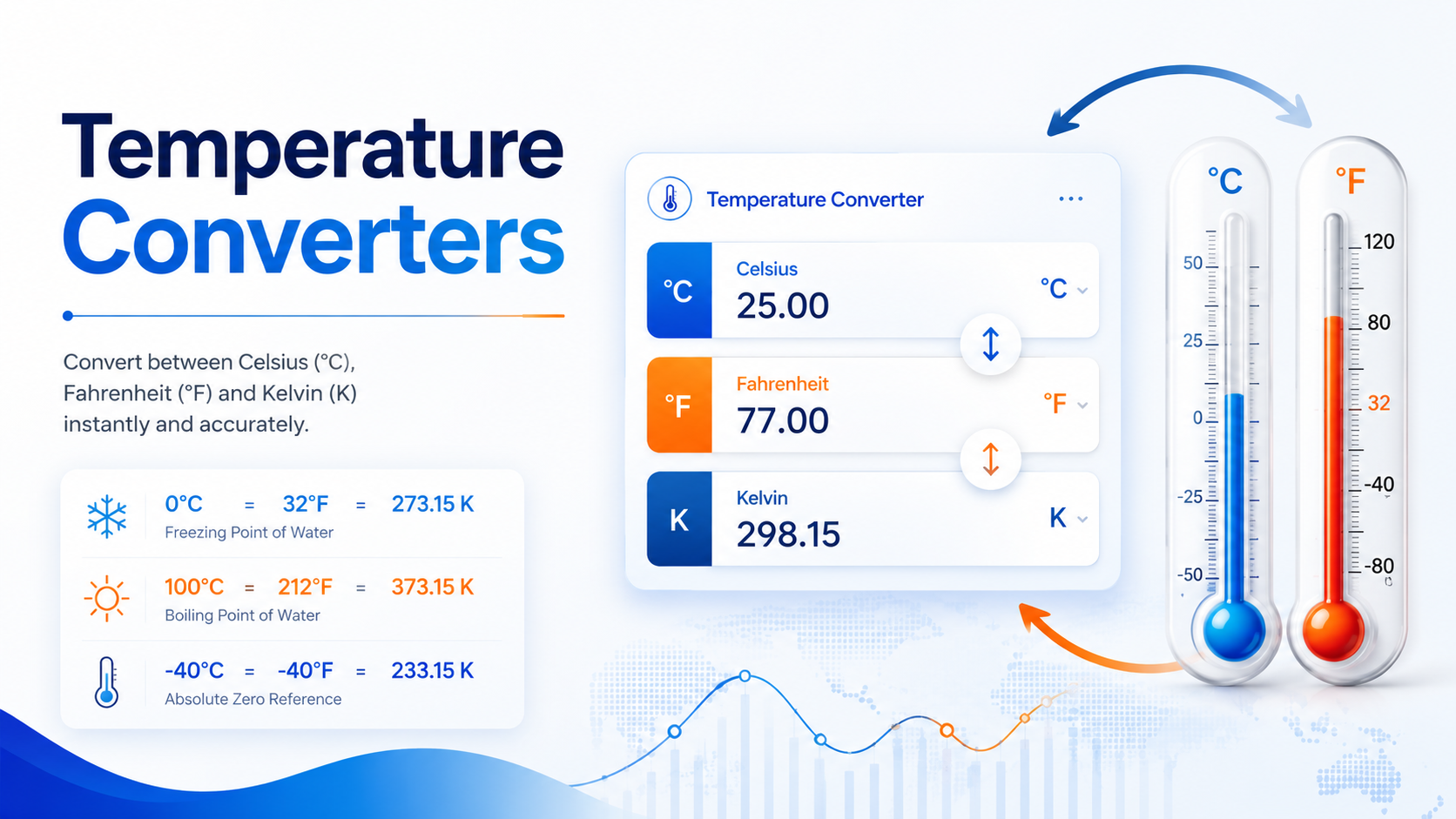
These tools convert values between Celsius, Fahrenheit and Kelvin without changing the physical quantity being measured. Use the tools in this category to convert between Celsius, Fahrenheit and Kelvin, compare common reference values, calculate oven settings or interpret weather forecasts and thermometer readings.
Choose the conversion you need, enter a value and get an accurate result instantly. Each tool also explains the formula used, helping you understand how the calculation works instead of showing only the final number.
Available Tools and Reference Guides
The following tools and reference pages cover common everyday, scientific, cooking and weather-related calculations.
| Converter or resource | What it helps you calculate |
|---|---|
| Celsius to Fahrenheit | Convert values from degrees Celsius to degrees Fahrenheit |
| Fahrenheit to Celsius | Convert values from degrees Fahrenheit to degrees Celsius |
| Celsius to Kelvin | Convert Celsius values to the Kelvin scale |
| Kelvin to Celsius | Convert Kelvin values to degrees Celsius |
| Fahrenheit to Kelvin | Convert Fahrenheit values directly to Kelvin |
| Kelvin to Fahrenheit | Convert Kelvin values directly to Fahrenheit |
| Celsius, Fahrenheit and Kelvin Chart | Compare common reference values across the three scales |
| Oven Settings Chart | Compare oven settings in Celsius, Fahrenheit and Gas Mark |
| Formula Guide | Find and understand the main Celsius, Fahrenheit and Kelvin formulas |
| Thermometer Reading Tool | Compare thermometer readings in Celsius and Fahrenheit |
| Weather Tool | Compare Celsius and Fahrenheit forecast values |
| Gas Mark to Celsius Converter | Convert British Gas Mark oven settings to Celsius |
Celsius, Fahrenheit and Kelvin Explained
The Celsius scale (°C) is widely used for weather forecasts, cooking and everyday measurements. Water freezes at approximately 0°C and boils at approximately 100°C under standard atmospheric pressure.
The Fahrenheit scale, written as °F, places the freezing point of water at 32°F and its boiling point at approximately 212°F under the same conditions.
The Kelvin scale, written as K without a degree symbol, is the SI base unit used for thermodynamic measurements.. It begins at absolute zero, where 0 K equals −273.15°C. A temperature interval of 1 kelvin has the same size as an interval of 1 degree Celsius.
Quick Reference Chart
Use this chart to compare several important temperature reference points.
| Reference point | Celsius | Fahrenheit | Kelvin |
|---|---|---|---|
| Absolute zero | −273.15°C | −459.67°F | 0 K |
| Freezing point of water | 0°C | 32°F | 273.15 K |
| Typical indoor value | 20°C | 68°F | 293.15 K |
| Typical thermometer reference | 37°C | 98.6°F | 310.15 K |
| Boiling point of water | 100°C | 212°F | 373.15 K |
The freezing and boiling values in the table refer to water under standard atmospheric conditions. The boiling point can change with atmospheric pressure and altitude. The indoor and thermometer values are approximate reference points rather than universal fixed values.
Celsius, Fahrenheit and Kelvin Formulas
The most common scale changes use the following formulas:
| Conversion | Formula |
|---|---|
| Celsius to Fahrenheit | °F = (°C × 9/5) + 32 |
| Fahrenheit to Celsius | °C = (°F − 32) × 5/9 |
| Celsius to Kelvin | K = °C + 273.15 |
| Kelvin to Celsius | °C = K − 273.15 |
| Fahrenheit to Kelvin | K = (°F − 32) × 5/9 + 273.15 |
| Kelvin to Fahrenheit | °F = (K − 273.15) × 9/5 + 32 |
These formulas are exact for conversions between the Celsius, Fahrenheit and Kelvin scales.
How to Use The Temperature converters?
Select the tool that matches your starting scale and the scale you need. Enter your value into the calculator, and the converted result will appear automatically.
For example:
- 20°C equals 68°F.
- 32°F equals 0°C.
- 25°C equals 298.15 K.
- 300 K equals 26.85°C.
For quick everyday calculations, you can use the approximate rule that doubling a Celsius value and adding 30 gives a rough Fahrenheit estimate. However, use the exact formula or calculator whenever accuracy matters.
Which Tool Should You Choose?
Use a direct Celsius, Fahrenheit or Kelvin calculator when you already know the two scales involved. Choose the reference chart when you want to compare several values at onc.
For recipes and baking, use the Oven Settings Chart or the Gas Mark to Celsius tool. Weather forecasts are easier to interpret with the weather tool, while the thermometer tool is designed for comparing thermometer readings.
Thermometer results are provided for unit conversion and general information only. They should not be used to diagnose fever, illness or another medical condition.
Frequently Asked Questions
What are the three main scales?
The three main scales are Celsius, Fahrenheit and Kelvin. Celsius and Fahrenheit are common in everyday use, while Kelvin is the SI unit used for thermodynamic temperature.
Is one degree Celsius equal to one kelvin?
A change of 1°C is equal in size to a change of 1 K. However, their zero points are different: 0°C equals 273.15 K.
Why does Kelvin not use a degree symbol?
The correct unit symbol is K, not °K. Kelvin is an absolute thermodynamic unit rather than a conventional degree scale.
What is the fastest way to change between scales?
For an accurate result, select the appropriate calculator, enter your value and choose the required scale. This avoids calculation errors and provides a result using the correct formula.