Kelvin to Celsius Converter

kelvin to celsius
kelvin to celsius

Convert Kelvin to Celsius Instantly

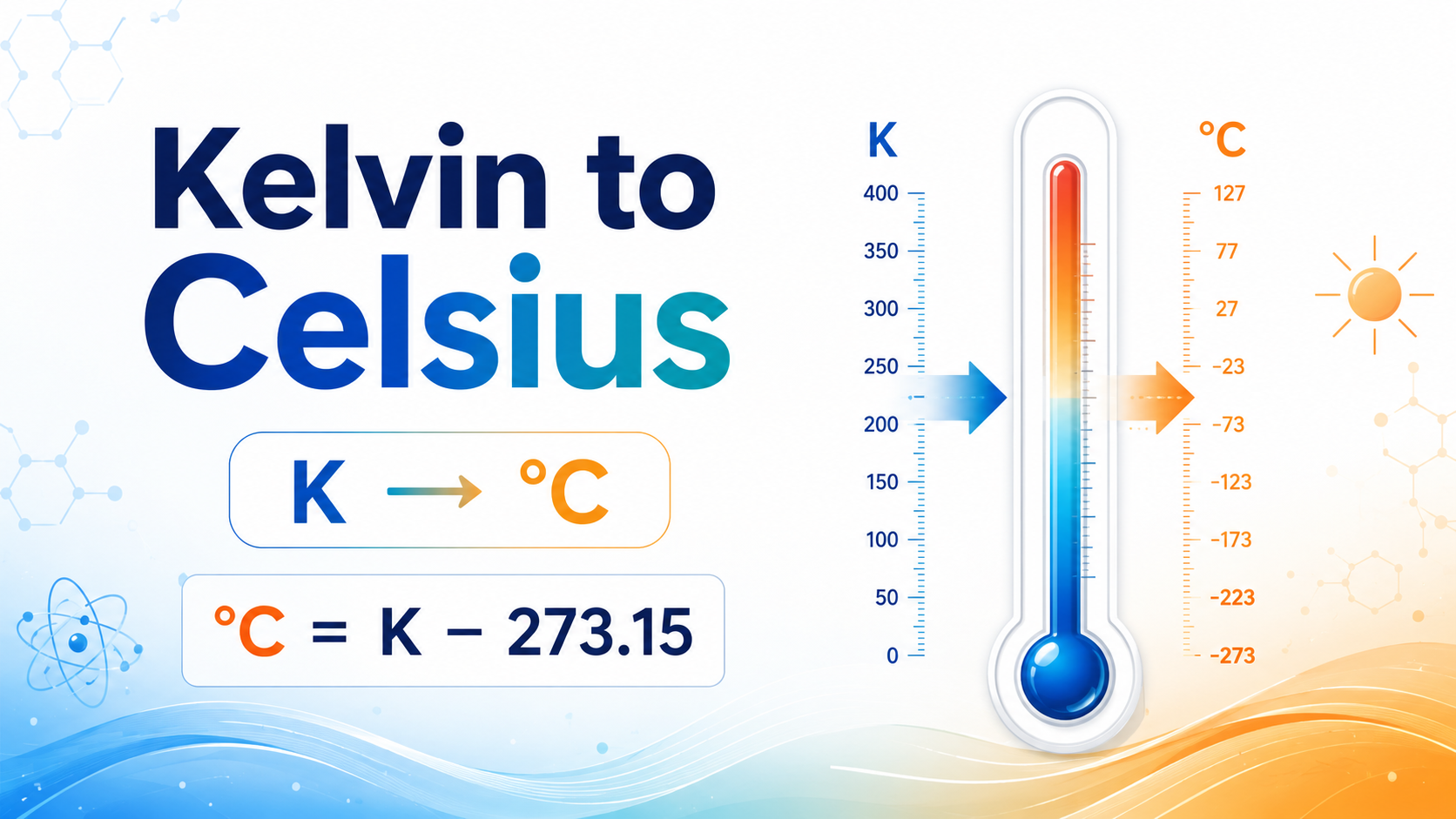
Need a quick and accurate temperature conversion? Enter a Kelvin value in the calculator below and select Convert K to °C. The result is calculated using the exact formula °C = K − 273.15.

The calculator accepts whole numbers and decimals, including 0 K. Temperatures below 0 K are not accepted because absolute zero is the lowest physically meaningful temperature on the Kelvin scale.

Kelvin to Celsius Calculator

Enter the value in K without a degree symbol.

Kelvin to Celsius Converter

A Kelvin to Celsius conversion is used to express an absolute temperature in the more familiar Celsius scale. To convert Kelvin to Celsius, subtract 273.15 from the Kelvin value:

Degrees Celsius = Kelvin − 273.15

For example, 300 K equals 26.85°C. Use the calculator above for an instant result, or follow the formula and examples below to complete the calculation manually.

Kelvin to Celsius formula

The exact conversion formula is:

°C = K − 273.15

In this formula:

  • K represents the temperature in kelvins.
  • °C represents the temperature in degrees Celsius.
  • 273.15 is the exact difference between the zero points of the two scales.

The Kelvin and Celsius scales use intervals of the same size. A temperature change of 1 K is equal in magnitude to a temperature change of 1°C. The only difference is where each scale begins.

Zero kelvin is absolute zero, while zero degrees Celsius is the freezing point of water under commonly defined standard conditions. Therefore:

0 K = −273.15°C

273.15 K = 0°C

How to convert Kelvin to Celsius

Follow these three steps:

  1. Write down the temperature in Kelvin.
  2. Subtract 273.15 from that value.
  3. Add the Celsius symbol, °C, to the result.

Example: convert 300 K to Celsius

Start with the formula:

°C = K − 273.15

Insert 300 K:

°C = 300 − 273.15

Calculate the result:

300 K = 26.85°C

Example: convert 310.15 K to Celsius

310.15 − 273.15 = 37

Therefore:

310.15 K = 37°C

This example is useful because 37°C is commonly associated with normal human body temperature, although actual body temperature varies by person, measurement method and time of day.

Example: convert 250 K to Celsius

250 − 273.15 = −23.15

Therefore:

250 K = −23.15°C

A Kelvin value can produce a negative Celsius result without being physically invalid. Only a Kelvin temperature below 0 K would fall below absolute zero.

Why is the conversion important?

The Kelvin to Celsius calculation connects an absolute scientific temperature scale with a scale that is more familiar in everyday life.

Kelvin is especially useful in science because it begins at absolute zero. This makes it suitable for equations involving thermal energy, thermodynamics, radiation and the behaviour of gases. Celsius is easier for most people to interpret because it is widely used for weather, room temperature, cooking, refrigeration and everyday temperature measurements.

Converting between the two allows scientific measurements to be communicated in a practical and understandable form without changing the underlying temperature.

Where is Kelvin most commonly used?

Kelvin is the SI base unit of thermodynamic temperature and is commonly used in:

  • Physics and thermodynamics
  • Chemistry and laboratory research
  • Astronomy and space science
  • Engineering and materials science
  • Cryogenics and low-temperature research
  • Climate and atmospheric modelling
  • Electronics and sensor calibration
  • Heating, ventilation and refrigeration calculations

Scientific instruments, datasets and equations may provide temperatures in Kelvin even when the final result needs to be presented in degrees Celsius.

For example, a laboratory sensor might record 295.15 K. Converting the value gives 22°C, which is easier to recognise as a typical indoor temperature.

When do you need a Kelvin to Celsius conversion?

You may need this conversion when:

  • Reading a scientific paper or laboratory report
  • Comparing technical data with everyday temperatures
  • Completing physics or chemistry calculations
  • Interpreting temperature sensor output
  • Working with engineering specifications
  • Converting astronomy or climate data
  • Preparing educational materials
  • Checking values in international scientific datasets

Students often encounter the conversion in equations involving pressure, volume, heat and energy. Engineers and researchers may use Kelvin during calculations and then convert the final value into Celsius for reports, displays or operating instructions.

Kelvin compared with Celsius

Kelvin is an absolute temperature scale. Its lowest possible value is 0 K, known as absolute zero. At this theoretical limit, a system has the minimum possible thermal energy under the principles of thermodynamics.

Celsius is a relative scale historically connected with the freezing and boiling behaviour of water. It is widely used for practical temperature communication.

An important notation difference is that Kelvin does not use a degree symbol:

  • Correct: 300 K
  • Incorrect: 300°K
  • Correct Celsius notation: 26.85°C

The unit name is written as “kelvin” in lowercase, while its symbol is an uppercase K.

Accuracy and rounding

The constant 273.15 is exact for this conversion. Do not shorten it to 273 when accuracy matters.

For everyday use, rounding the result to one or two decimal places is usually sufficient:

298 K = 24.85°C

Rounded to one decimal place:

298 K ≈ 24.9°C

Scientific and engineering work may require more decimal places. The converted result should normally retain a level of precision appropriate to the original measurement.

Common conversion mistakes

One common mistake is adding 273.15 instead of subtracting it. Adding is used for the reverse conversion from Celsius to Kelvin.

Another mistake is using 273 rather than 273.15. This creates an error of 0.15°C, which may be significant in precise measurements.

Do not add a degree sign to the Kelvin symbol. Write 100 K, not 100°K.

It is also important not to confuse thermodynamic temperature with lighting color temperature. Lamps may be described as 2700 K or 6500 K, but converting those values into Celsius is normally not useful. In lighting, Kelvin describes the visual appearance of the light, not necessarily the physical temperature of the lamp.

Kelvin to Celsius conversion table

The following chart provides common values from 1 K to 100 K. Because these temperatures are below 273.15 K, all corresponding Celsius values are negative.

Kelvin Celsius
1 K −272.15°C
10 K −263.15°C
20 K −253.15°C
30 K −243.15°C
40 K −233.15°C
50 K −223.15°C
60 K −213.15°C
70 K −203.15°C
80 K −193.15°C
90 K −183.15°C
100 K −173.15°C
What is the easiest way to convert Kelvin to Celsius?

Subtract 273.15 from the Kelvin value:
°C = K − 273.15
For example, 290 K equals 16.85°C.

What is 0 K in Celsius?

Zero kelvin is equal to −273.15°C. This temperature is known as absolute zero.

What is 273.15 K in Celsius?

273.15 K is exactly 0°C.

Is a change of 1 K equal to a change of 1°C?

Yes. The size of one kelvin is equal to the size of one degree Celsius. The scales have different zero points, but their temperature intervals are equal.

Can Kelvin have a negative value?

A thermodynamic temperature cannot be below 0 K. Negative Kelvin values should therefore not be entered into a standard temperature converter.

Why does Kelvin not use a degree symbol?

Kelvin is an absolute SI unit and is written without the degree symbol. The correct notation is 300 K, while Celsius is written as 26.85°C.

Is 300 K hot or cold?

300 K equals 26.85°C, which most people would describe as warm room temperature.

How do I convert Celsius back to Kelvin?

Add 273.15 to the Celsius value:
K = °C + 273.15
For example, 20°C equals 293.15 K.
Celsius to Kelvin Converter

celsius to kelvin
celsius to kelvin

Use this Celsius to Kelvin converter to change any valid temperature from degrees Celsius (°C) into kelvins (K). Enter the Celsius value below and select Convert °C to K to receive an instant result.

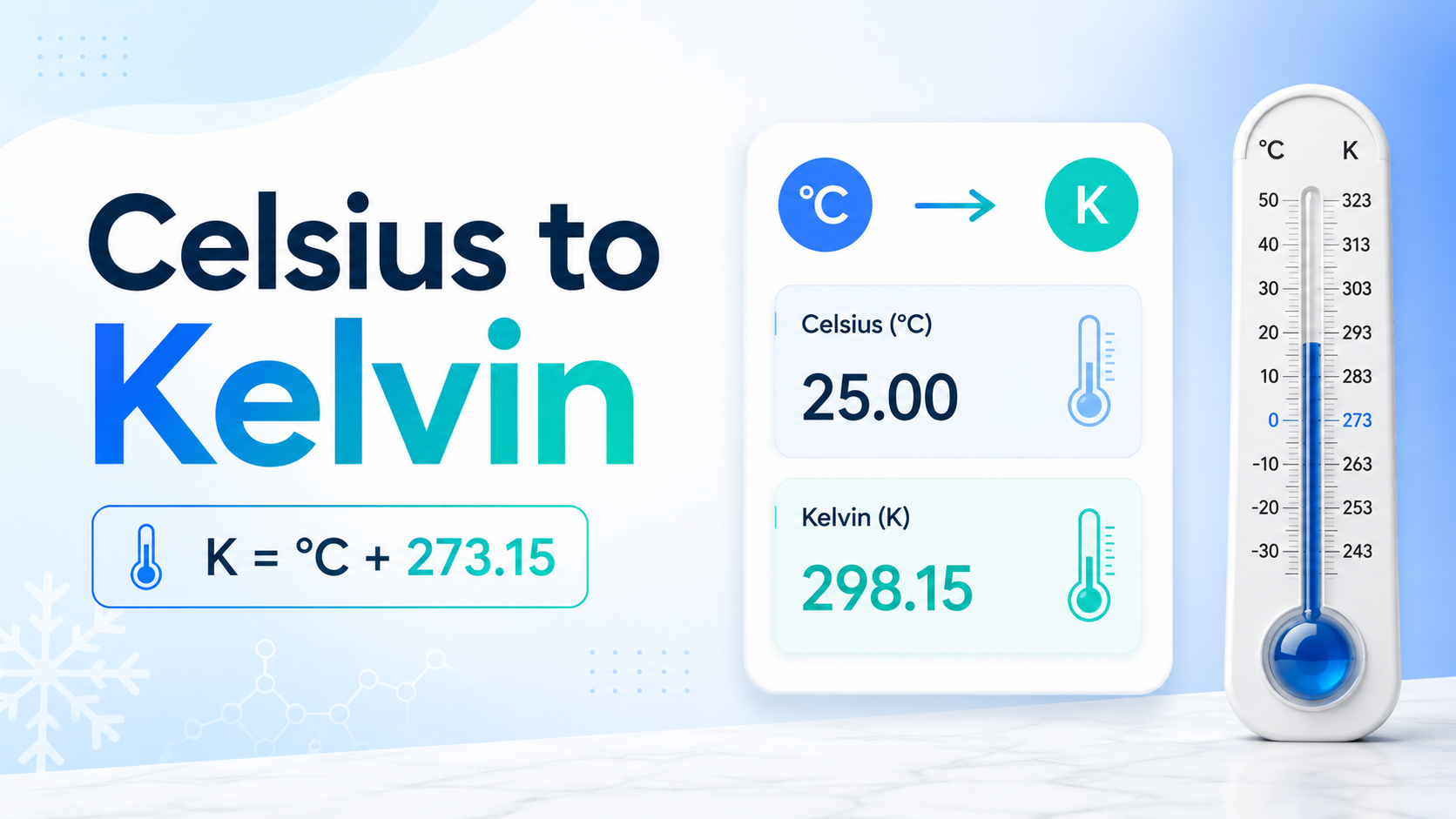
The calculator uses the exact formula K = °C + 273.15. It accepts positive, zero, decimal, and negative Celsius values down to absolute zero at −273.15 °C. Remember that kelvin values are written without a degree symbol. For example, 25 °C equals 298.15 K.

Convert Celsius to Kelvin

Minimum valid temperature: −273.15 °C.

How to Convert Celsius to Kelvin

The Celsius to Kelvin conversion is simple because the two temperature scales use intervals of the same size. The only difference is their starting point.

Use this exact formula:

Kelvin = Celsius + 273.15

Or in symbols:

K = °C + 273.15

To complete the calculation manually, take the temperature in degrees Celsius and add 273.15. You do not need to multiply or divide the value.

For example:

25 °C + 273.15 = 298.15 K

Therefore, 25 degrees Celsius is equal to 298.15 kelvins.

Worked conversion examples

Here are several common examples:

  • 0 °C = 273.15 K
  • 20 °C = 293.15 K
  • 25 °C = 298.15 K
  • −40 °C = 233.15 K
  • 100 °C = 373.15 K

The conversion works in exactly the same way for decimal temperatures. For example, 36.6 °C is equal to 309.75 K.

Why Is the Celsius to Kelvin Conversion Important?

Celsius is practical for everyday temperatures, weather reports, cooking, and household measurements. Kelvin, however, is the SI unit of thermodynamic temperature and is widely used in scientific and technical work.

The Kelvin scale begins at absolute zero. Absolute zero is the lowest point of the thermodynamic temperature scale:

−273.15 °C = 0 K

Because the Kelvin scale starts at absolute zero, it is useful in calculations involving heat, energy, gases, radiation, and other physical processes. Many scientific equations require an absolute temperature rather than a relative Celsius value.

Using Celsius directly in these equations can produce an incorrect result. Therefore, converting Celsius to Kelvin is often a necessary step rather than an optional formatting change.

Where Is Kelvin Used Most Often?

Physics and thermodynamics

Kelvin is commonly used when studying heat transfer, thermal energy, entropy, and the behavior of matter. Many thermodynamic equations require temperatures to be entered in kelvins.

Chemistry

Chemists use Kelvin in calculations involving gases, reaction rates, equilibrium, and molecular motion. For example, temperature values in the ideal gas law are normally expressed in kelvins.

Engineering

Engineers may need Kelvin when working with engines, industrial processes, materials, electronics, refrigeration, and thermal systems. Converting the original Celsius measurement helps keep technical calculations consistent.

Astronomy and space science

Scientists describe the temperatures of stars, planets, gases, and objects in space using kelvins. The scale is especially useful because many of these temperatures are far outside normal weather ranges.

Atmospheric and environmental science

Public weather forecasts usually display degrees Celsius or Fahrenheit. However, researchers, satellite systems, and atmospheric models often process temperatures in kelvins.

Lighting

Kelvin is also used to describe the color appearance of light. A lower color temperature appears warmer, while a higher value appears cooler or more blue. However, lighting color temperature is a separate application and should not be confused with converting the physical temperature of a room or object.

When Do You Need to Convert Celsius to Kelvin?

You may need this conversion when:

  • completing physics or chemistry homework;
  • preparing a laboratory report;
  • entering data into a scientific equation;
  • comparing international datasets;
  • working with sensors or technical specifications;
  • analysing atmospheric or astronomical data;
  • checking an engineering calculation;
  • converting a temperature before using the ideal gas law.

The online calculator is useful when accuracy matters or when you need to process a negative or decimal Celsius value quickly.

What Is the Difference Between Celsius and Kelvin?

Celsius and Kelvin have the same interval size. A temperature increase of 1 °C is the same size as an increase of 1 K.

However, their zero points are different:

  • 0 °C equals 273.15 K.
  • −273.15 °C equals 0 K.
  • 100 °C equals 373.15 K.

This means that you only need to add 273.15 when converting from Celsius. There is no scaling factor.

Another important difference is notation. Celsius values include the degree symbol, such as 20 °C. Kelvin values do not use a degree symbol. The correct form is 293.15 K, not “293.15 °K.”

Accuracy, Rounding and Common Mistakes

For an accurate Celsius to Kelvin result, always add 273.15. Adding only 273 may be acceptable for a rough classroom estimate, but it is not the exact conversion.

Avoid these common errors:

  • Do not multiply the Celsius value by 273.15.
  • Do not use the Fahrenheit conversion formula.
  • Do not write a degree symbol before K.
  • Do not enter a Celsius temperature below −273.15 °C.
  • Do not round the starting value too early in a multi-step calculation.

The calculator displays results to two decimal places. When working with scientific measurements, the final number of significant figures may depend on the precision of the original Celsius measurement.

Calculation Methodology

This calculator adds exactly 273.15 to the entered Celsius value:

Result in K = entered value in °C + 273.15

It accepts whole numbers, decimals, zero, and negative Celsius temperatures. Values below −273.15 °C are rejected because they would fall below absolute zero on the standard thermodynamic scale.

Celsius to Kelvin Conversion Chart

The following chart begins at 1 °C and then continues in ten-degree steps up to 100 °C.

Celsius (°C) Kelvin (K)
1 °C 274.15 K
10 °C 283.15 K
20 °C 293.15 K
30 °C 303.15 K
40 °C 313.15 K
50 °C 323.15 K
60 °C 333.15 K
70 °C 343.15 K
80 °C 353.15 K
90 °C 363.15 K
100 °C 373.15 K

Accuracy and review: This calculator uses the exact Celsius–Kelvin relationship K = °C + 273.15. The formula, examples, and conversion chart were manually checked for mathematical accuracy. Last reviewed: July 2026.

What is the formula for Celsius to Kelvin?

The formula is K = °C + 273.15. Add 273.15 to the Celsius temperature to obtain the temperature in kelvins.

What is 0 degrees Celsius in Kelvin?

0 °C is exactly 273.15 K.

What is 100 degrees Celsius in Kelvin?

100 °C is equal to 373.15 K.

Can a Kelvin temperature be negative?

On the standard thermodynamic temperature scale, Kelvin begins at 0 K. A Celsius value below −273.15 °C would correspond to a value below absolute zero and is not accepted by this calculator.

Is a change of 1 °C equal to a change of 1 K?

Yes. The size of one Celsius degree is equal to the size of one kelvin. However, the two scales have different zero points.

Does Kelvin use the degree symbol?

No. Write 300 K, not “300 °K.” Celsius does use the degree symbol, as in 26.85 °C.

How do you convert Kelvin back to Celsius?

Subtract 273.15 from the Kelvin value:
°C = K − 273.15
For example, 300 K minus 273.15 equals 26.85 °C.

Is “celcius to kelvin” the correct spelling?

No. The correct spelling is Celsius to Kelvin. “Celcius to Kelvin” is a common search misspelling, but both phrases refer to the same temperature conversion.

Convert Fahrenheit to Celsius

fahrenheit to celsius

Convert Fahrenheit to Celsius Instantly

Need a quick and accurate temperature conversion? Enter any Fahrenheit value in the calculator below to see the equivalent temperature in Celsius immediately. The calculator accepts positive numbers, negative temperatures, and decimals.

It uses the exact formula °C = (°F − 32) × 5/9 and displays the result to a maximum of two decimal places. This makes it suitable for weather, travel, cooking, study, and everyday temperature conversions.

Fahrenheit to Celsius Calculator

Enter a temperature in degrees Fahrenheit to convert it to Celsius.

°F
°C

Fahrenheit to Celsius Converter

Converting Fahrenheit to Celsius is simple when you use the correct formula or the calculator on this page. Enter any temperature in degrees Fahrenheit to receive the equivalent value in degrees Celsius instantly. For a manual calculation, subtract 32 from the Fahrenheit value and multiply the result by 5/9.

Quick answer:
°C = (°F − 32) × 5/9

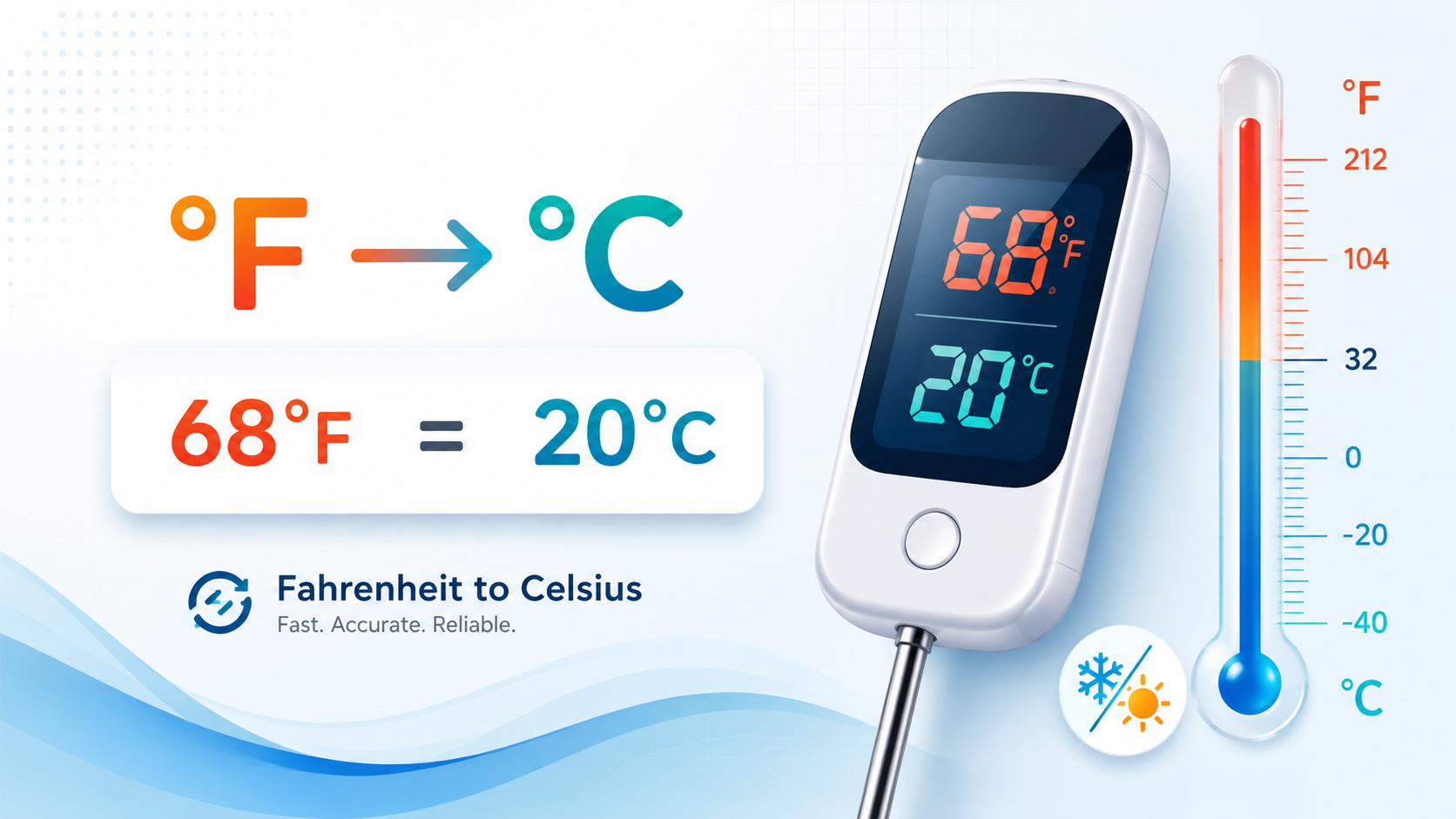
For example, 68°F equals 20°C. The National Institute of Standards and Technology lists the equivalent exact formula as (°F − 32) ÷ 1.8.

How to Convert Fahrenheit to Celsius

The exact Fahrenheit to Celsius formula is:

°C = (°F − 32) × 5/9

Follow these two steps:

  1. Subtract 32 from the Fahrenheit temperature.
  2. Multiply the result by 5/9, or divide it by 1.8.

Both methods produce the same answer.

Fahrenheit to Celsius Example

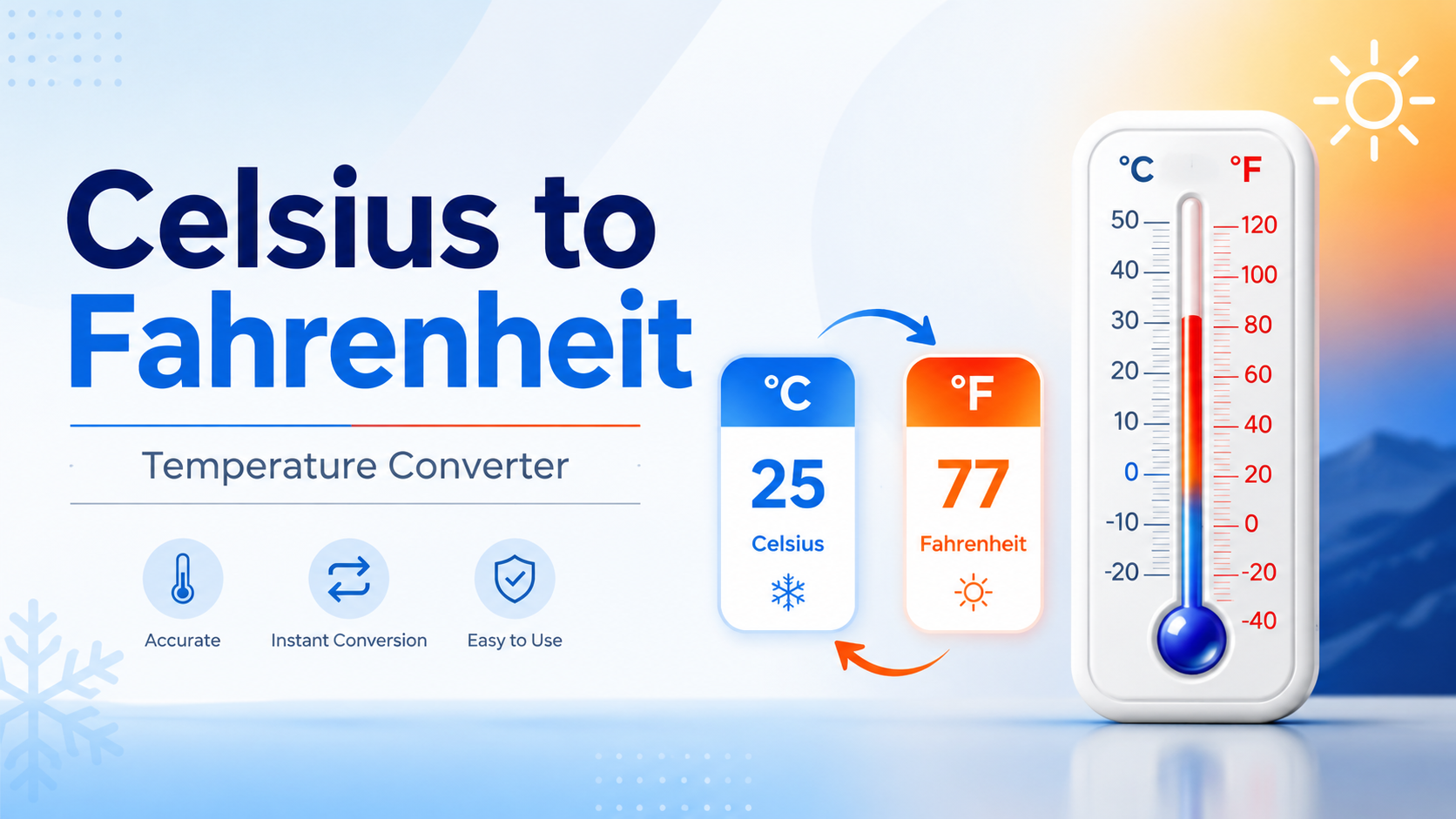
To convert 77°F:

(77 − 32) × 5/9 = 25°C

Therefore, 77°F is equal to 25°C.

Another useful example is 32°F:

(32 − 32) × 5/9 = 0°C

This is the freezing point of water under standard reference conditions.

Why Fahrenheit to Celsius Conversion Matters

Temperature scales are not used uniformly around the world. Fahrenheit is the standard scale commonly used for everyday temperatures in the United States, while Celsius is standard in most areas outside the United States.

This difference makes temperature conversion important whenever information moves between countries, measurement systems, publications, devices, or audiences.

A reliable Fahrenheit to Celsius converter removes uncertainty and reduces the risk of calculation mistakes. It is especially useful when an exact answer matters more than a quick mental estimate.

Where Is This Conversion Used Most Often?

Weather and International Travel

A U.S. weather forecast may describe 86°F as a hot day, while a forecast using Celsius reports the same temperature as 30°C.

Travelers, international students, remote workers, and people reading foreign weather reports often need to change Fahrenheit to Celsius to understand local conditions. Weather services outside the United States commonly display temperatures in Celsius, although some allow users to change the preferred unit.

Cooking and Oven Temperatures

Recipes and ovens may use different temperature scales. A recipe written for an American audience may list an oven setting in Fahrenheit, while an oven elsewhere may be marked in Celsius.

Because cooking conversions are sometimes rounded to practical oven settings, use an oven temperature conversion chart when selecting an actual appliance setting. For example, 350°F converts mathematically to approximately 176.67°C, but an oven may commonly be set to 175°C or 180°C.

Science, Education, and Technical Work

Celsius is widely used in scientific education and metric-based measurement. Students and professionals may need to convert readings from older documents, U.S. equipment, technical manuals, or imported instruments.

In technical work, retain enough decimal places for the precision required by the task. Avoid rounding the result before completing any additional calculations.

Body Temperature and Health Information

Thermometers, health articles, and medical documents may display different scales. For reference, 98.6°F converts to 37°C.

The conversion itself is mathematical, but the interpretation of a body-temperature reading may also depend on the measurement method, age, symptoms, and professional medical guidance.

Appliances, Heating, and Air Conditioning

Thermostats, refrigerators, freezers, laboratory equipment, and industrial controls can use Fahrenheit or Celsius.

Conversion may be necessary when:

  • changing thermostat settings;
  • following an appliance manual;
  • comparing product specifications;
  • using imported equipment;
  • communicating with someone who uses another scale.

Important Reference Temperatures

A few familiar values make the two scales easier to understand:

  • 32°F = 0°C: freezing point of water under standard reference conditions
  • 50°F = 10°C: a cool outdoor temperature
  • 68°F = 20°C: a common room-temperature reference
  • 86°F = 30°C: a hot day
  • 212°F = 100°C: boiling point of water at standard atmospheric pressure
  • −40°F = −40°C: the point at which both scales display the same number

NIST also uses 32°F, 50°F, 68°F and 86°F as practical reference values for freezing conditions, a cold day, room temperature and a hot day.

These reference points are useful for checking whether a calculated result appears reasonable.

How Accurate Is the Calculator?

The calculator uses the exact relationship between the two temperature scales:

°C = (°F − 32) ÷ 1.8

Results are displayed to a maximum of two decimal places for readability. This is usually sufficient for weather, travel, cooking, home temperature settings, and other everyday uses.

For laboratory, engineering, or scientific applications, retain the number of decimal places required by the original measurement and the accuracy standard of your work. Rounding too early can introduce avoidable errors into later calculations.

Can You Estimate Celsius Without a Calculator?

For a quick mental estimate, subtract 30 from the Fahrenheit value and divide by 2:

Estimated °C ≈ (°F − 30) ÷ 2

For example:

80°F → (80 − 30) ÷ 2 = approximately 25°C

The exact result is 26.67°C. The shortcut is therefore useful for a rough weather estimate, but it should not replace the exact Fahrenheit to Celsius formula for cooking, science, body-temperature readings, or technical work.

Common Conversion Mistakes

The most common mistake is applying the operations in the wrong order. Always subtract 32 before multiplying by 5/9. Multiplying first produces an incorrect result.

Another mistake is using the reverse formula. The formula:

°F = (°C × 9/5) + 32

converts Celsius to Fahrenheit, not Fahrenheit to Celsius.

Also remember that converting an actual temperature is different from converting a temperature interval. A temperature change of 1°F equals a change of 5/9°C, but an actual reading such as 1°F must also account for the 32-degree offset between the scales.

Finally, do not reject negative inputs. Cold-weather temperatures can fall below 0°F, and the correct formula works normally with negative values. For example:

−4°F = −20°C

Fahrenheit to Celsius Conversion Chart

The table below starts at 1°F and then lists temperatures in 10-degree Fahrenheit intervals up to 100°F. Results are rounded to two decimal places.

Fahrenheit (°F) Celsius (°C)
1°F −17.22°C
10°F −12.22°C
20°F −6.67°C
30°F −1.11°C
40°F 4.44°C
50°F 10°C
60°F 15.56°C
70°F 21.11°C
80°F 26.67°C
90°F 32.22°C
100°F 37.78°C
What is the easiest way to convert Fahrenheit to Celsius?

Subtract 32 from the Fahrenheit value, then multiply the result by 5/9. You can also divide the result by 1.8.

What is 100°F in Celsius?

100°F is approximately 37.78°C.

What is 70°F in Celsius?

70°F is approximately 21.11°C.

What temperature is the same in Fahrenheit and Celsius?

The two scales are equal at −40 degrees:
−40°F = −40°C

Is 32°F equal to 0°C?

Yes. Under standard reference conditions, 32°F equals 0°C, which is the freezing point of water.

Is Celsius more accurate than Fahrenheit?

Neither temperature scale is inherently more accurate. Accuracy depends on the thermometer, sensor, calibration, measurement method, and rounding. Fahrenheit and Celsius simply express temperature using different reference points and degree sizes.

Why do I subtract 32 when converting Fahrenheit to Celsius?

The Fahrenheit and Celsius scales use different zero points. Subtracting 32 removes the offset between the two scales before the Fahrenheit-sized degree interval is converted into the Celsius-sized interval.

Can the calculator convert negative Fahrenheit values?

Yes. The calculator accepts negative numbers and decimal values. For example, −4°F converts to −20°C.

Calculation and accuracy note: This converter uses the exact temperature conversion formula °C = (°F − 32) ÷ 1.8. Results are calculated automatically and rounded only for display. The calculation method has been checked against conversion guidance published by the National Institute of Standards and Technology.

Convert Celsius to Fahrenheit

celsius to fahrenheit

Convert Celsius to Fahrenheit Instantly

Use this Celsius to Fahrenheit calculator to change any temperature from degrees Celsius (°C) into degrees Fahrenheit (°F). Enter a whole number, decimal value, zero or a negative temperature, then select Convert to see the result. For a manual calculation, multiply the Celsius value by 9/5 and add 32.

Celsius to Fahrenheit Converter

Enter a temperature in degrees Celsius to calculate the equivalent value in Fahrenheit.

Formula: °F = (°C × 9/5) + 32

How to Convert Celsius to Fahrenheit

The exact Celsius to Fahrenheit formula is:

°F = (°C × 9/5) + 32

You can also write 9/5 as 1.8:

°F = (°C × 1.8) + 32

For example, to convert 25°C:

  1. Multiply 25 by 1.8: 25 × 1.8 = 45.
  2. Add 32: 45 + 32 = 77.

Therefore, 25°C equals 77°F.

The multiplication is necessary because one Celsius degree and one Fahrenheit degree are not the same size. A change of 1°C is equal to a change of 1.8°F. The addition of 32 aligns the two scales at the freezing point of water.

Why Celsius and Fahrenheit Conversion Is Important

Celsius is used as the everyday temperature scale in most countries and is also widely used in science. Fahrenheit remains the standard scale for everyday weather reporting in the United States and is used in some other locations and applications.

Because both systems remain in active use, temperature values often need to be translated before they can be understood or applied correctly. A visitor reading a U.S. weather forecast, a cook following an American recipe or a student comparing scientific data may all need a reliable Celsius to Fahrenheit conversion.

Accurate conversion is especially useful when a small temperature difference matters. An approximate result may be enough for casual weather comparisons, but cooking instructions, laboratory work and technical specifications usually require the exact formula.

Where Is Celsius to Fahrenheit Used Most Often?

Weather and international travel

Weather forecasts are one of the most common reasons to convert temperatures. A forecast of 30°C describes a hot day and equals 86°F. A winter temperature of -10°C equals 14°F.

Converting the value helps travelers choose suitable clothing, understand heat or frost warnings and compare conditions with temperatures they already know.

Cooking and oven temperatures

Many recipes published in the United States give oven settings in Fahrenheit, while ovens and recipes in Europe and many other regions use Celsius. For example, 180°C equals 356°F. In practical cooking, this may be rounded to 350°F or 355°F depending on the recipe and the oven controls.

Always follow the temperature stated by the recipe when possible. Oven calibration, fan-assisted settings and recipe rounding can affect the required setting, so a mathematical conversion does not automatically account for differences between oven types.

Body temperature and healthcare information

Body temperatures may be displayed in either scale depending on the thermometer, country or source. A commonly used reference value of 37°C equals 98.6°F, while 38°C equals 100.4°F.

Temperature alone does not provide a diagnosis, but correct conversion helps people understand measurements and instructions written in the other scale.

Education, science and technical work

Students frequently convert between the two scales in mathematics and science exercises. Temperature conversion can also appear in engineering documentation, manufacturing instructions, equipment manuals and international datasets.

In these settings, decimals and correct rounding are often important.

Key Celsius and Fahrenheit Reference Points

Several reference values make the relationship between the scales easier to remember:

  • Water freezes at 0°C or 32°F under standard reference conditions.
  • Water boils at 100°C or 212°F under standard atmospheric pressure.
  • The two scales show the same number at -40°, so -40°C equals -40°F.
  • A temperature difference of 1°C equals 1.8°F.

These reference points are useful for checking whether a result is reasonable. For example, any Celsius temperature between 0°C and 100°C should convert to a Fahrenheit value between 32°F and 212°F.

A Quick Mental Conversion

For a fast estimate, you can double the Celsius temperature and add 30:

Estimated °F ≈ (°C × 2) + 30

For 20°C, this shortcut gives 70°F, while the exact result is 68°F. For 30°C, it gives 90°F instead of the exact 86°F.

This method is convenient for casual travel or weather conversations, but it is only an approximation. Use the exact Celsius to Fahrenheit formula or the calculator when accuracy matters.

Accuracy, Decimals and Rounding

The mathematical conversion can produce a whole number or a decimal. For instance:

  • 21°C = 69.8°F
  • 36.5°C = 97.7°F
  • -17.8°C ≈ 0°F

The calculator displays results to a practical level of precision and removes unnecessary trailing zeros.

When using a converted value in a recipe, report, experiment or technical document, round it only to the precision that the original measurement supports. A Celsius measurement given to the nearest whole degree should not normally be presented as an excessively precise Fahrenheit measurement.

Celsius to Fahrenheit Conversion Table

The following chart provides frequently needed values from 1°C to 100°C.

Celsius (°C) Fahrenheit (°F)
1°C 33.8°F
10°C 50°F
20°C 68°F
30°C 86°F
40°C 104°F
50°C 122°F
60°C 140°F
70°C 158°F
80°C 176°F
90°C 194°F
100°C 212°F
What is the formula for Celsius to Fahrenheit?

Multiply the temperature in Celsius by 9/5, then add 32. The formula is:
°F = (°C × 9/5) + 32

What is 0 degrees Celsius in Fahrenheit?

0°C equals 32°F. This is the freezing point of water under standard reference conditions.

What is 100 degrees Celsius in Fahrenheit?

100°C equals 212°F. This is the boiling point of water at standard atmospheric pressure.

At what temperature are Celsius and Fahrenheit equal?

The two scales are equal at -40 degrees. Therefore:
-40°C = -40°F

How can I convert Celsius to Fahrenheit without a calculator?

Use the exact formula by multiplying the Celsius value by 1.8 and adding 32. For a rough mental estimate, double the Celsius value and add 30.

Can Celsius temperatures be negative?

Yes. The Celsius scale includes negative temperatures. The calculator accepts values below zero, such as -10°C, which equals 14°F.

Is the Fahrenheit number always higher than the Celsius number?

No. Fahrenheit has a higher numerical value than Celsius for temperatures above -40 degrees. Below -40 degrees, the Fahrenheit number is lower. At -40 degrees, the values are identical.